




English Fire Screen
An English fire screen shields the face from roaring flames while anchoring the hearth with period timber and textile work.
English Fire Screen
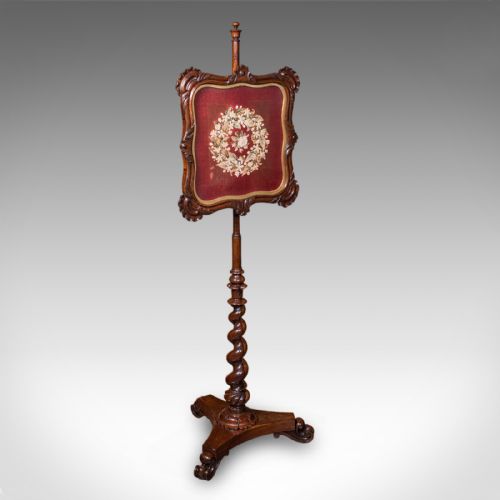
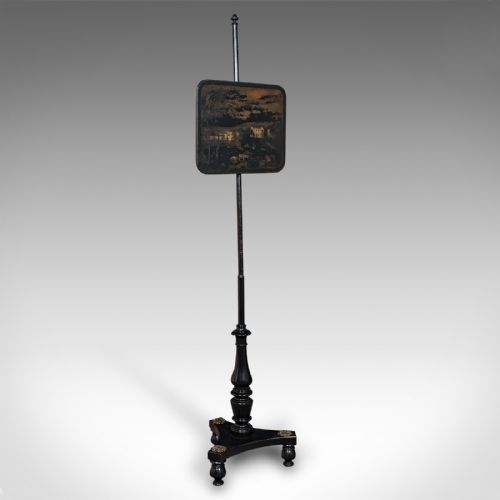
An English fire screen serves as a movable barrier designed to protect a person from the direct heat of an open fire. These pieces appear frequently as pole screens, cheval frames, and folding brass nursery guards.
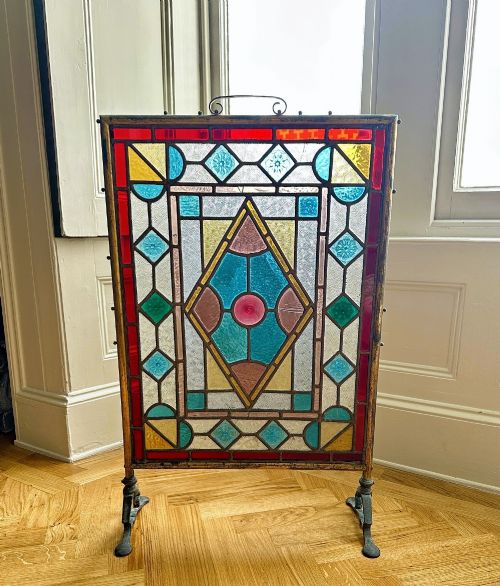
The materials span the Georgian, Regency, William IV, and Victorian eras, alongside Arts and Crafts and 1930 examples. Timber frames carry embroidered panels, needlepoint, crewelwork, and stained glass.
Pole screens dominate the selection, supporting adjustable shields on tripod or pedestal bases. Other variants combine utility by functioning as occasional tables or decorative wall art.
Materials and Technique
Cabinetmakers used dense hardwoods such as mahogany, rosewood, walnut, and giltwood to build stable frames and turned columns. Brass and iron provide the structural metalwork for guards and stands.
Textile panels display needlepoint, wool embroidery, silkwork, and tapestry stretched across internal frames or suspended from adjustable brass collars on vertical poles.
Listings span multiple periods including Georgian, Regency, William IV, Victorian, Arts and Crafts, and 1930.
Judging Quality
Quality rests in the crispness of the timber carving, the stability of the support base, and the intricacy of the hand-stitched needlework panel. Heavy brass elements and tight joinery separate superior pieces from simpler utilitarian items.
The sophistication of the period style, from Regency giltwood to Arts and Crafts stained glass, dictates the visual presence of the screen within a room.
The English Fire Screen Glossary
- Pole screen
- A freestanding wooden shaft with an adjustable sliding panel used to block radiant heat from the face. The panel typically moves vertically along the pole and fixes with a screw mechanism.
- Needlepoint
- Hand-stitched yarn worked over a stiff canvas mesh to create pictorial and floral panels. This technique forms the primary decorative insert for nineteenth-century frames.
- Cheval screen
- A rectangular frame mounted on two side pillars with pivot joints allowing the panel to tilt. This form provides a broader protective surface than a standard pole screen.
- Giltwood
- Timber coated with a thin layer of gold leaf over a prepared gesso base. This finish appears on high-status Regency and Georgian frames.
- Crewelwork
- Embroidery executed with wool yarn on a linen or cotton twill foundation. It produces textured floral and botanical designs on period fire panels.
English Fire Screen: Frequently Asked Questions
How did people use pole screens?
A person sat between the fireplace and the heat source, sliding the vertical panel upward to shield the face from scorching.
This protected heavy makeup and delicate skin from excessive warmth before central heating existed.
What is a cheval fire screen?
A cheval screen uses a wide rectangular frame supported by two upright legs with pivot hinges.
The design allows the user to tilt the viewing angle of the tapestry or glass panel.
How do I date a fire screen?
Dating relies on timber choices, such as Regency rosewood versus Victorian walnut, and decorative motifs.
Needlepoint styles and hardware construction methods also indicate the manufacturing period.
Can I place these near a working fire?
Historic timber and antique textiles suffer damage from extreme heat and dryness.
Owners typically position them beside dormant hearths or use them as decorative room dividers.