



English Castle Watercolour
An english castle watercolour captures historic fortresses across British landscapes through delicate pigment and paper.
English Castle Watercolour
An english castle watercolour depicts historic strongholds, royal palaces and ancient ruins set within riversides, coastal views and rural landscapes. These works span the Victorian era, Edwardian period and the twentieth century, reflecting shifting artistic approaches to topography and landscape.
The most frequent examples on this page are twentieth-century and late nineteenth-century paintings, often rendered by regional artists capturing Yorkshire strongholds like Bolton Castle alongside major royal sites such as Windsor. These pieces range from detailed architectural studies to atmospheric landscape drawings framed under glass with wood surrounds.
How They Were Made
Artists applied watercolour pigment and ink onto paper supports, often building up washes to define stone masonry, water and sky. Pen lines frequently outline structural details before or after painting, adding precision to the composition.
Framed works utilise wood mouldings and glass to protect the paper from environmental degradation while retaining the delicate surface texture of the paint.
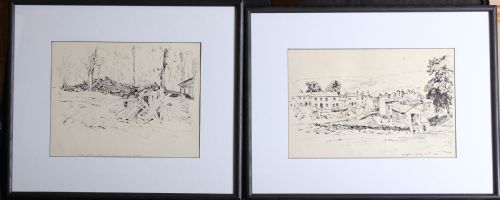
One artist filled a winter day sketching behind a farm at Castle Bolton.
What Varies in Quality
The strength of the composition and the confidence of the brushwork distinguish finer examples from standard topographical illustration. Skilled artists capture light and atmosphere on stone and water rather than merely recording architectural outlines.
Condition and provenance also separate pieces, with works retaining strong, un faded pigments and clear attribution to documented painters commanding greater recognition among collectors.
Alfred Young Nutt·Fred Lawson·F A Roylance·Thomas Cooper Moore·George Graham·James Orrock·David Cox Jnr·William Wyld·Alfred Robert Quinton·Frederick Tully Lott·Carleton Grant·J D Walker·Owen Bowen·Tom Anderton·David Cox Senior·J W Wilson·John Bates Noel·J Scott·F J Lees·Leathley·R Thomas·James Lawson Stewart·Albert Milton Drinkwater
The English Castle Watercolour Glossary
- Topography
- The detailed mapping or description of specific places and landscapes. In these paintings, it refers to accurate depictions of real castles and rivers.
- Wash
- A thin, semi-transparent layer of diluted watercolour paint applied to paper. Painters use washes to create expansive skies or smooth water surfaces.
- Sepia
- A reddish-brown pigment derived from the ink sac of the cuttlefish. Many period drawings utilise this single tone for monochromatic tonal work.
- Gilt
- A thin layer of gold leaf or gold-coloured paint applied to frames. This finish adds a reflective border around the paper artwork.
English Castle Watercolour: Frequently Asked Questions
What periods do these watercolours date from?
The works span from the eighteenth century through the Victorian and Edwardian eras into the mid twentieth century. Most pieces currently listed reflect late nineteenth and early twentieth century British landscape traditions.
Artists during these periods frequently recorded historic architecture and changing rural environments across England and Wales.
Which castles appear most often?
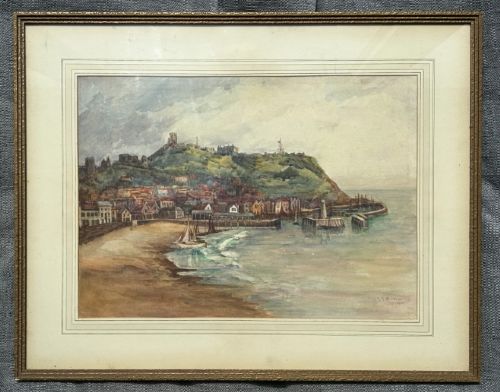
Bolton Castle in Wensleydale appears frequently among twentieth century works, alongside royal residences such as Windsor Castle. Other regular subjects include Richmond, Barnard, and Scarborough castles.
These locations offered artists a combination of rugged stone architecture and picturesque river or coastal settings.
How should I display them at home?
These works require protection from direct sunlight to prevent the watercolour pigments from fading over time. Standard framing with glass and acid free mounts helps safeguard the paper.
Keeping them in rooms with stable humidity levels preserves both the wooden frame and the paper support.
Are these works signed by the artists?
Many pieces bear signatures, monograms or contemporary inscriptions identifying the creator and the specific castle depicted. Some include dates or form part of documented sketchbooks.
Unsigned works are often attributed to specific regional schools based on style, technique and subject matter.