
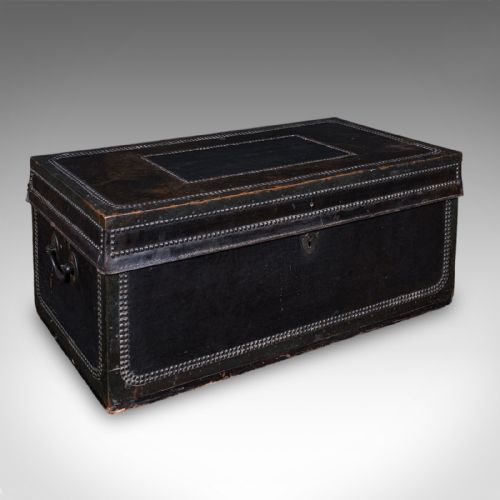


English Campaign Chest
An english campaign chest is built for transport, pairing timber with metal hardware for travellers on the move.
English Campaign Chest
An english campaign chest takes several forms across the Georgian, Regency, and Victorian periods, including drawer chests built in sections, trunks, and silver chests. You will frequently meet pieces configured as military chests of drawers in two stacked sections, designed to separate easily for travel.
Materials span teak, mahogany, camphorwood, oak, and walnut, often accompanied by brass or iron mounts, inset handles, and corner brackets. The construction prioritises mobility and durability, leading to practical storage solutions ranging from blanket boxes to specialised apothecary and specimen cases.
Materials and construction
Makers utilised dense timbers such as teak, mahogany, camphorwood, oak, and walnut to withstand travel and changing climates. These woods were chosen for their stability and resilience, providing a sturdy carcase for transport.
Brass and iron hardware, including flush-inset handles, corner straps, and binding, reinforced the corners and joints while keeping the exterior free of protruding elements. Chests designed for officers often split into separate modular sections secured by brass binding and pins.
Listings feature camphorwood, teak, mahogany, oak, walnut, and pitch pine paired with brass and iron hardware across Georgian, Regency, and Victorian eras.
Gradations in quality
Quality rests in the precision of the brass fittings, the snugness of the drawer joints, and the retention of original transportation cases or inset handles. Finer examples display meticulous dovetailing and unblemished hardware fitted flush into the timber.
The choice of primary wood also dictates the tier, with figured mahogany and teak commanding higher regard than secondary pines. Originality of finish and the presence of maker stamps elevate a piece above standard utility trunks.
Graves and Sons of Devonport
The English Campaign Chest Glossary
- Campaign chest
- A modular chest of drawers or trunk constructed in two or more stackable sections for military transport. These pieces utilise recessed brass handles and corner brackets to prevent damage during transit.
- Flush handle
- A metal pull inset level with the wood surface. This prevents snagging and allows multiple chests to sit flush against one another.
- Binding
- Metal strapping, typically in brass or iron, fastened around the edges and corners of a chest. It reinforces the structure against the rigours of shipping and travel.
- Camphorwood
- An aromatic timber frequently utilised for campaign trunks and blanket boxes. Its natural scent helped deter insects from stored uniforms and textiles.
English Campaign Chest: Frequently Asked Questions
What is an english campaign chest?
An english campaign chest is a portable piece of furniture designed for military officers and travellers on active service. They are built in modular sections to ease loading onto ships and wagons.
These chests combine robust timbers like teak or mahogany with protective metal hardware. The design allows officers to transport personal belongings and uniforms without sacrificing utility.
Why do campaign chests split in two?
Modular construction allows heavy storage units to divide into manageable sections for transport. Each section fits securely atop the other using alignment pins and brackets.
This division made packing simpler for military campaigns and long sea voyages. Once at the destination, the sections were reassembled into a single tall chest.
How do I identify the period?
Georgian and Regency pieces often showcase figured mahogany or walnut with restrained brass mounts. Victorian examples frequently employ teak, camphorwood, or oak with heavier iron or brass strapping.
Examining the internal drawer construction and the style of the flush handles helps narrow the decade of manufacture. Earlier pieces lean towards understated elegance, while High Victorian trunks prioritise rugged utility.
Where were they used?
These chests travelled across the British Empire with military officers, colonial administrators, and diplomats. They served inside campaign tents, colonial quarters, and aboard merchant ships.
The durable timbers and metal reinforcements protected contents from moisture and rough handling during transit.