


Enamel Table Lamps Pair
These enamel table lamps pair sets bring vibrant colour and intricate metalwork into a room.
Enamel Table Lamps Pair
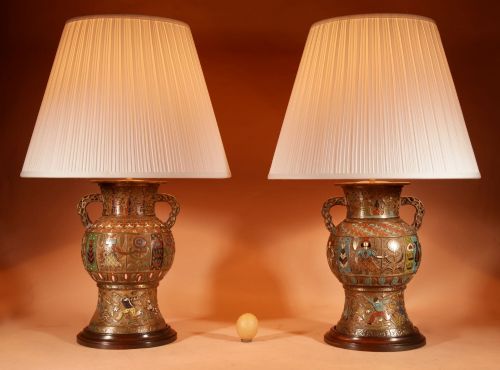
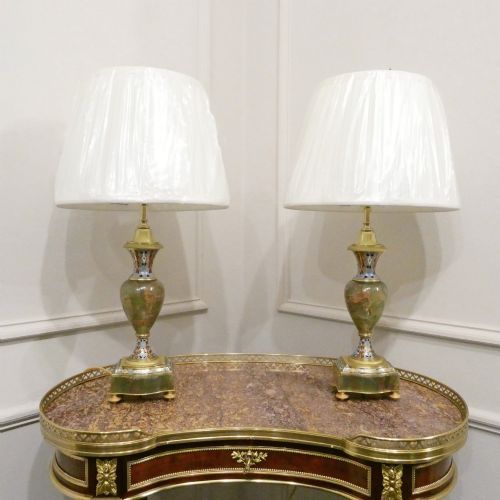
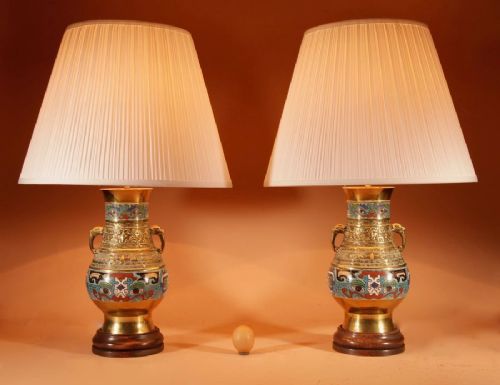
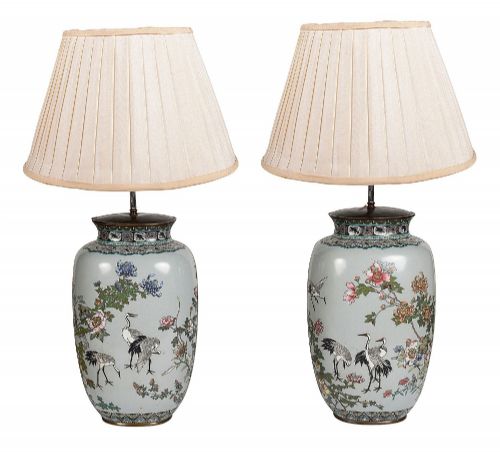
When searching for an enamel table lamps pair, you encounter decorative vases and urns converted into lighting from the nineteenth and early twentieth centuries. These matching sets predominantly originate from Chinese, Japanese and French workshops, utilising historical porcelain and metal vessels fitted for illumination.
The pieces on this page span several distinct cultural styles, including Chinese Export, Japanese Meiji period and 19th Century French design. Many examples began life as decorative vases before receiving brass, gilt bronze or ormolu mounts to serve as functional table lamps.
How they were made
Maker workshops built these bodies using brass, bronze, copper and porcelain as a foundation for intricate surface decoration. Cloisonné and champlevé techniques involved soldering delicate wire partitions onto a metal base or carving troughs into the surface to hold coloured glass pastes before firing.
Artisans applied enamel powders into the designated cells and fired the pieces multiple times to achieve a durable, glossy finish. Workshops then mounted these vessels onto metal bases and fitted them with electrical wiring or burner components.
Current listings feature materials including brass, cloisonne enamel, porcelain, gilt bronze and copper across nineteenth-century and early twentieth-century periods.
What varies in quality
Quality rests upon the crispness of the wirework, the complexity of the enamel colour palette and the weight of the supporting metal mounts. Finer examples display meticulous cell alignment and rich, unblemished vitreous enamels that maintain their brilliance across both vessels in the pair.
The integration of the mountings also dictates the distinction between standard production and exceptional craftsmanship. Superior pairs show seamless adaptation where original vases transition into functional lighting without compromising the integrity of the historic body.
The Enamel Table Lamps Pair Glossary
- Cloisonné
- A decorative metalwork technique where thin wire is soldered to a metal base to create compartments for enamel paste. This method produces intricate, patterned surfaces filled with vibrant colours.
- Champlevé
- An enamelling technique where troughs or cells are carved directly into a thick metal plate and filled with enamel. The surrounding metal walls remain visible as part of the final design.
- Ormolu
- Gilded bronze applied to furniture and decorative objects, providing a bright golden finish. It frequently appears as decorative mounts on nineteenth-century lamp bases.
- Meiji Period
- A Japanese historical era lasting from 1868 to 1912 noted for exceptional decorative arts and metalwork exported globally. Pieces from this time often feature highly detailed cloisonné enamel.
- Famille Rose
- A prominent palette of Chinese porcelain enamels dominated by opaque pink or rose colours introduced in the eighteenth century. Later nineteenth-century lamp conversions frequently utilise these floral and figural designs.
Enamel Table Lamps Pair: Frequently Asked Questions
How do I clean enamel lamps?
Dust the surfaces gently with a soft, dry cloth to prevent accumulation within the wire cells. Avoid harsh chemical cleaners that can damage vintage metal finishes and delicate vitreous enamels.
Keep the lamps away from direct moisture and check electrical cords periodically for safety. Professional rewiring ensures historic vessels remain functional for daily home use.
Are these lamps converted vases?
Many examples begin as decorative vessels or antique vases fitted with electrical components during later periods. Workshops adapt these bodies to create balanced pairs suitable for domestic illumination.
The original vessel integrity often remains visible beneath the metal mounts and wiring hardware added during conversion.
How do I date an enamel lamp?
Examine the style of the metal mounts, the wiring type and the characteristics of the enamel work. Nineteenth-century pieces typically display heavier bronze or brass components and hand-mixed vitreous colours.
Comparing the decorative motifs with documented export styles helps narrow the production era. Subtle variations in manufacturing techniques reveal whether a piece dates to the early or late nineteenth century.
How do I match lamps in a pair?
Inspect the height, base construction and enamel colour consistency across both objects. Handcrafted pairs often exhibit minor individual variations from the manufacturing process rather than factory uniformity.
Matching sets maintain similar decorative motifs and proportion to create visual balance on a table. Checking the mounting style confirms whether the two pieces originated together as a matched pair.