
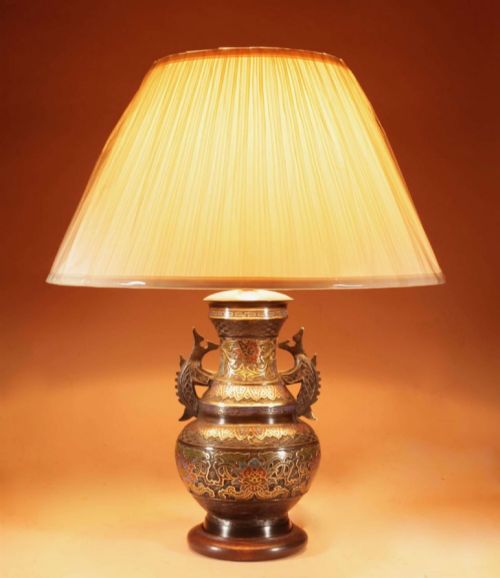
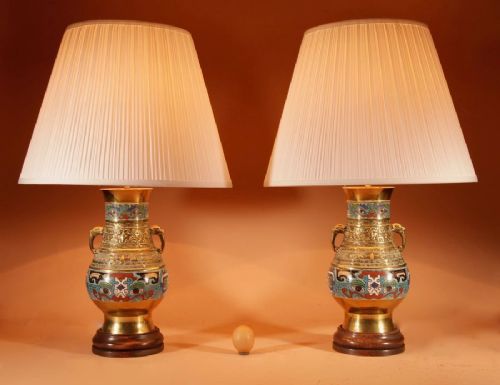


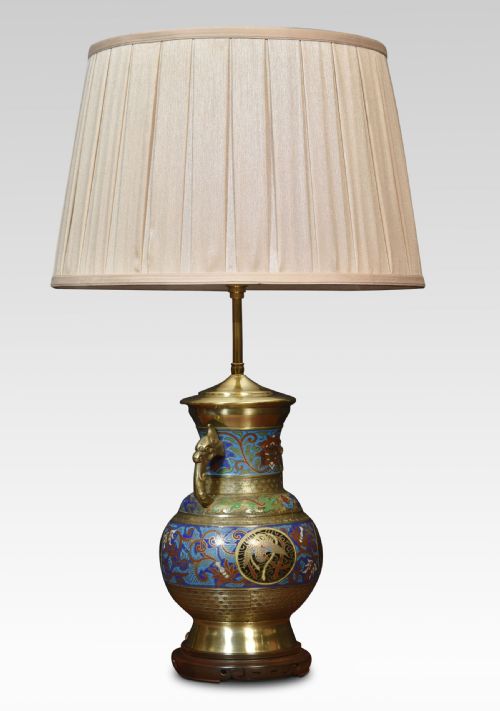

Brass Cloisonne Lamp
A brass cloisonne lamp brings heavy metalwork and colourful enamel into a room, offering warm illumination through centuries-old craftsmanship.
Brass Cloisonne Lamp
A brass cloisonne lamp combines heavy metal framing with vibrant coloured enamelwork, forming substantial table lighting for a room. When you search for a brass cloisonne lamp, you encounter items originating from Chinese and Japanese workshops during the nineteenth and early twentieth centuries.
Many examples begin life as vases before conversion into table lamps, often retaining twin handles or bulbous bodies. The selection spans Chinese Qing Dynasty, Chinese Republic, and Japanese Meiji periods alongside Victorian British imports.
Most entries appear as pairs rather than single items, giving symmetry to a mantelpiece or sideboard. The forms rely on bronze, copper, and brass frameworks soldered with fine wires to separate distinct fields of enamel.
How they were made
The construction starts with a metal body of brass, bronze, or copper onto which thin metal ribbons are soldered to form raised outlines of a pattern. Artisans then fill the resulting cells with coloured enamel paste before firing the piece in a kiln.
Workers grind and polish the cooled surface until the metal wires and the hardened enamel sit flush in a smooth skin. Later conversions involve drilling the base or threading wiring through existing vessels to adapt them for electrical lighting.
Several heavy vessels originally designed to hold flowers or wine now quietly support modern electrical bulbs.
What varies in quality
The refinement of the wirework determines much of the visual standard, where thinner, crisper soldering lines demand higher skill than thick, irregular partitions. Finer pieces maintain uniform enamel depth across complex floral or geometric motifs without pitting or cloudiness.
The weight and finish of the underlying bronze, brass, or copper chassis also separate utilitarian vessels from ambitious studio output. Heavier metal gauge and meticulous hand-polishing of the finished surface distinguish the superior examples.
The Brass Cloisonne Lamp Glossary
- Cloisonne enamel
- A technique where thin metal wires are soldered to a metal base to create compartments for coloured glass paste, which is then fired and polished. This method produces intricate, patterned surfaces on vases and lamp bases.
- Champleve
- A metalworking process where troughs or cells are carved directly into the surface of bronze or brass and filled with enamel before firing. It creates bold patterns without using soldered wire outlines.
- Meiji Period
- A Japanese historical era lasting from 1868 to 1912 marked by rapid artistic output exported to Western markets. Pieces from this era often feature detailed flora and fauna designs.
- Qing Dynasty
- The final imperial dynasty of China, ruling from 1644 until 1912. Enamelwork from this period frequently displays rich turquoise grounds and traditional symbolic motifs.
- Chinese Export
- Items manufactured in China specifically for trade with European and American buyers during the nineteenth century. These objects often blend Eastern manufacturing techniques with Western functional requirements.
Brass Cloisonne Lamp: Frequently Asked Questions
Are these lamps originally electrified?
Most of these pieces started life as decorative vases or vessel bases before receiving electrical fittings at a later date. This conversion process usually adapts the original hollow interior or base to house modern wiring.
Because original domestic wiring from the nineteenth or early twentieth century rarely survives safely, contemporary fixtures are fitted during conversion. The underlying metal body remains antique while the electrical components are updated for modern use.
How do I identify a Japanese piece from a Chinese one?
Japanese items from the Meiji period frequently rely on bronze or copper bases with meticulous wirework depicting natural subjects like birds and flowers. The enamel backgrounds often show tight, precise geometry.
Chinese pieces from the Qing Dynasty or Republic era tend to feature heavy brass or bronze foundations with distinct turquoise enamel grounds. The overall scale can feel more robust and ceremonial compared to Japanese export wares.
Can I use standard lampshades with them?
Standard lampshades fit these bases provided the harp and fitter match the threaded rod emerging from the top of the lamp. Consideration must be given to the visual weight of the heavy enamel body when choosing a shade.
A balanced proportion ensures the decorative brass and enamel patterns remain visible rather than being overwhelmed by an oversized shade. The height of the fitting also affects how the light distributes across the coloured panels.
How should I clean the brass and enamel?
Cleaning requires a soft, dry cloth to remove dust from the intricate wire partitions and enamel surfaces. Moisture and chemical polishes can damage vulnerable antique enamel fillings or age the metal unevenly.
Gentle dusting preserves the polished finish of the brass frame without abrading the delicate soldered borders. Regular care keeps the colours bright without risking chemical degradation of the glass paste.