



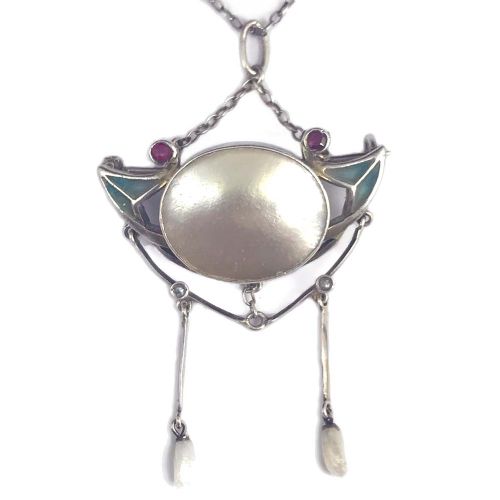


Enamel Pearl Drop Necklace
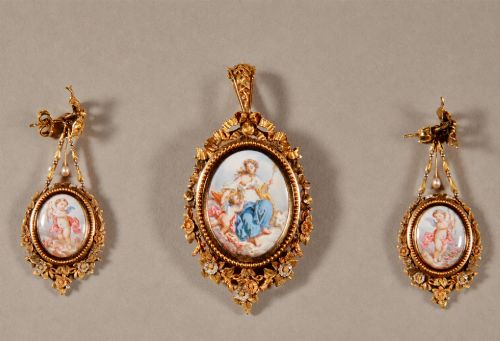
An enamel pearl drop necklace brings together glowing vitreous work and lustrous pearls in a pendant form that defines late nineteenth and early twentieth century design.
Enamel Pearl Drop Necklace
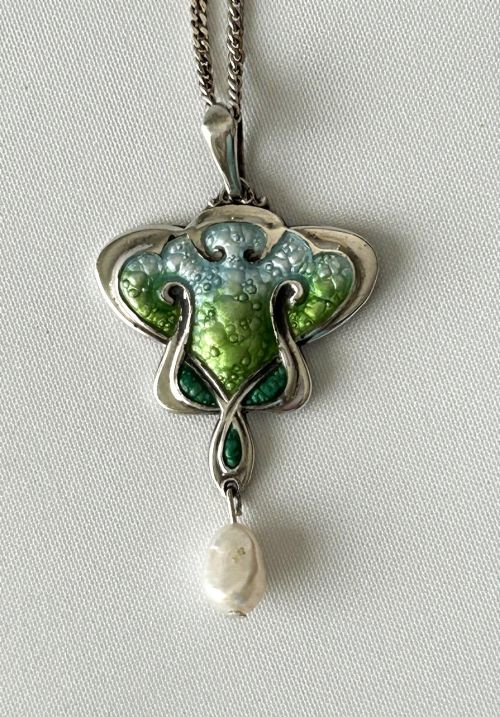
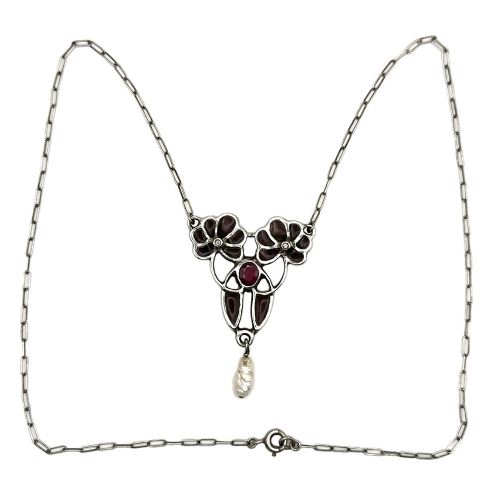
An enamel pearl drop necklace is a pendant jewel uniting coloured vitreous decoration with dangling pearls, spanning the Victorian, Arts and Crafts, and Art Nouveau periods. These pieces range from restrained Victorian gold lockets to flowing silver pendants executed in the manner of the early twentieth century.
The form typically suspends a central jewelled element or pearl drop from a matching chain or ribbon. Makers from Austro-Hungarian workshops as well as British and continental designers produced these items in silver, silver gilt, and yellow gold.
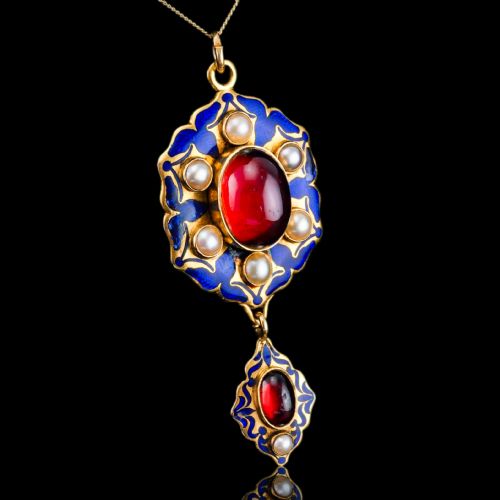
Victorian examples often lean towards Renaissance Revival motifs with garnets and deep blue enamel, whilst later pieces embrace botanical lines, plique-à-jour translucency, and organic blister pearls.
Materials and Construction
Makers formed the structural mounts of an enamel pearl drop necklace from silver, silver gilt, 15ct gold, or 18ct gold. Metalwork techniques involved delicate wirework, bezel settings for gems, and cast frames designed to hold vitreous pastes.
Enamelling methods varied from opaque blue fields to translucent plique-à-jour techniques that allowed light to pass through the coloured glass without a backing metal. Pearls, ranging from spherical specimens to irregular blister pearls, were then hung as swinging drops or set directly into the composition.
Enamel Pearl Drop Necklace Retail Price Guide 2026
Typical asking prices for enamel pearl drop necklace among the pieces listed under this phrase on Sellingantiques today, from the lower quarter to the upper quarter. They describe what is for sale here now, not the wider market.
Listings feature pieces spanning the nineteenth century up to nineteen hundred, encompassing Victorian, Arts and Crafts, and Art Nouveau movements.
Assessing Quality and Execution
The standard of an enamel pearl drop necklace rests primarily on the skill of the enameller and the refinement of the metalwork. Superior pieces display flawless vitreous surfaces without cracking, alongside meticulous cell work in cloisonné or plique-à-jour designs.
The integration of the stones also dictates worth, as master workshops selected pearls with strong orient and matched them harmoniously with supporting gems such as amethysts and garnets. Signed works or authenticated studio pieces by notable makers command higher regard for their documented provenance.
Archibald Knox·Liberty & Co·Murrle Bennett·Wilhelm Fuhner·Levinger & Bissinger·Otto Prutscher·Eduard Loss·Meyle & Meyer
The Enamel Pearl Drop Necklace Glossary
- Plique-à-jour
- An enamelling technique where the enamel is fired in open cellular frames, creating a stained-glass effect that lets light shine straight through the transparent colour.
- Blister pearl
- A pearl that has grown attached to the inside shell of an oyster, resulting in a domed shape with a hollow or flat back commonly utilised in organic pendant designs.
- Silver gilt
- Silver that has been coated with a thin layer of gold, providing the warm tone of precious gold combined with a silver base.
- Holbeinesque
- A Victorian revival style inspired by sixteenth-century designs associated with Hans Holbein, characterised by elaborate geometric goldwork, enamel, and dangling gemstone drops.
- Renaissance Revival
- A nineteenth-century artistic movement that revived the ornate decorative vocabulary, heavy gold settings, and polychrome enamel of the sixteenth century.
Enamel Pearl Drop Necklace: Frequently Asked Questions
How do I date an enamel pearl drop necklace?
Dating relies on stylistic clues, hallmarks, and the characteristic materials of the period. Victorian pieces tend to feature heavier gold settings and revival motifs, whereas items from nineteen hundred often showcase flowing botanical lines and plique-à-jour enamel.
Examining the construction of the clasp, the cut of any supporting gemstones, and the presence of maker marks helps narrow down the decade of creation.
What is plique-à-jour enamel?
Plique-à-jour is a specialised enamelling method where transparent glass powder is fired within wire partitions without a solid backing metal. This allows light to pass directly through the coloured sections like miniature stained glass.
It is frequently found on Art Nouveau silver pendants where delicate natural forms require a luminous, glowing background.
How should I care for my antique necklace?
Antique jewellery requires gentle handling due to the delicate nature of enamel and organic pearls. Avoid harsh chemical cleaners, ultrasonic baths, and prolonged exposure to moisture, which can damage the vitreous surfaces and weaken pearl adhesives.
Store the piece flat in a lined box away from other items to prevent scratching the soft gold or silver mounts.
Are these necklaces fragile to wear?
While wearable, these historical pieces require mindfulness because enamel can chip if struck hard against a hard surface. Pearls are also sensitive to cosmetics, perfumes, and body oils that can dull their lustre over time.
Putting the necklace on after applying makeup and removing it before physical activity preserves both the metalwork and the stones.