


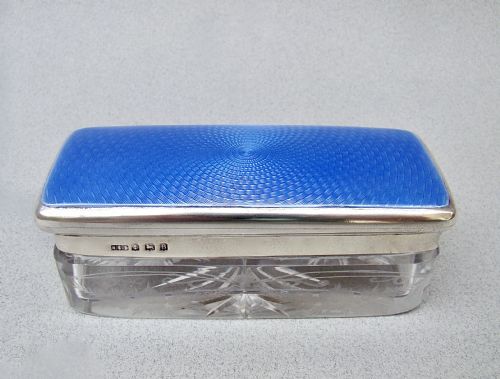



Enamel Dressing Table Jar
An enamel dressing table jar brings bright colour and polished metal to a vanity top, combining functional storage with decorative flair.
Enamel Dressing Table Jar
An enamel dressing table jar serves as a container for cosmetics, pins, or perfumes on a vanity surface, often formed with a glass or crystal body beneath a decorated lid. These pieces frequently appear from the Victorian and Edwardian eras through the Art Deco period, showcasing varied geometric or floral ornamentation.
Buyers will most commonly encounter sterling silver mounts paired with cut glass or coloured glass bodies, alongside engine-turned guilloche enamel work in shades of blue or other bright tones. The selection spans straightforward lidded pots to more complex scent bottles and trinket boxes bearing British hallmarks.
Origins stretch from English workshops in Birmingham and London to nineteenth-century French makers, reflecting the changing tastes of dressing room accessories over several decades. Each example balances utility with decorative metalwork and glazed ceramic or glass components.
How they were made
Silversmiths formed the protective collars and lids from sterling silver, frequently applying Birmingham or London assay office marks to certify the metal standard. Glass bodies were blown, moulded, or cut with geometric patterns to catch the light on a dressing table.
Enamel work involved fusing powdered glass to a metal base under high heat, often over an engine-turned guilloche pattern scratched into the silver beneath. This technique produced translucent layers that revealed intricate engraved details underneath the coloured surface.
Enamel Dressing Table Jar Retail Price Guide 2026
Typical asking prices for enamel dressing table jar among the pieces listed under this phrase on Sellingantiques today, from the lower quarter to the upper quarter. They describe what is for sale here now, not the wider market.
Listings feature items spanning the Victorian era through the mid-twentieth century, highlighting periods like Art Deco and Edwardian design.
What varies in quality
The clarity and depth of the guilloche enamel set finer examples apart from simpler pieces, particularly where complex engine-turning catches the light through translucent coloured layers. Intact enamel free from chipping or heavy scratching indicates careful handling over the decades.
The weight and thickness of the sterling silver mount and cut glass body also determine the substance of the piece, with heavier gauge metal providing greater durability. Well-defined hallmarks and crisp maker marks add to the documented provenance of the item.
Henry Clifford Davis·Henry Perkins
The Enamel Dressing Table Jar Glossary
- Guilloche enamel
- A decorative technique where a metal surface is mechanically engraved with intricate geometric patterns before translucent enamel is applied over the top. This allows the underlying pattern to show through the coloured glass layer.
- Sterling silver
- An alloy of silver containing 92.5 percent pure silver and 7.5 percent other metals, usually copper, to add strength. Most British dressing table jars utilise this standard for their lids and collars.
- Cut glass
- Glass decorated by cutting facets or patterns into its surface using a wheel, creating sharp edges that refract light. It forms the heavy body of many vanity jars and scent bottles.
- Hallmark
- A series of official marks stamped on precious metal items in the United Kingdom to indicate the standard of purity, the assay office, and the year of manufacture. These stamps help date pieces precisely.
- Cranberry glass
- A type of red-pink glass created by adding gold chloride to the molten glass mixture during production. It is frequently seen in Victorian and Edwardian vanity items.
Enamel Dressing Table Jar: Frequently Asked Questions
What is an enamel dressing table jar?
An enamel dressing table jar is a small lidded container used historically for holding cosmetics, pins, or trinkets on a bedroom vanity. These items combine a glass or ceramic vessel with a decorated metal lid.
The coloured enamel top adds a vibrant decorative element to the functional piece, making it a popular collectible today.
How do I date an antique silver and enamel jar?
You can date these pieces by examining the hallmarks stamped into the silver mounts, which indicate the specific assay office and year letter. Stylistic clues such as geometric Art Deco shapes or flowing Edwardian lines also point to the era of manufacture.
Comparing the manufacturing technique and glass type helps narrow down the period when precise marks are absent.
Were these jars used for perfume?
Many jars with fitted stoppers or inner glass linings were indeed used to hold liquid scents and perfumes. Shallower pots served instead for creams, face powders, or small hair pins.
Manufacturers tailored the interior design of each vessel to suit the specific cosmetic product of the time.
How should I clean my enamel dressing table jar?
Clean the glass body with warm soapy water while taking care to keep moisture away from any exposed edges of the enamel. Polish the silver mount gently with a soft cloth designed for precious metals.
Harsh chemical dips should be avoided to prevent damage to the delicate glazed enamel surface.