




Empire Period Candle Holders
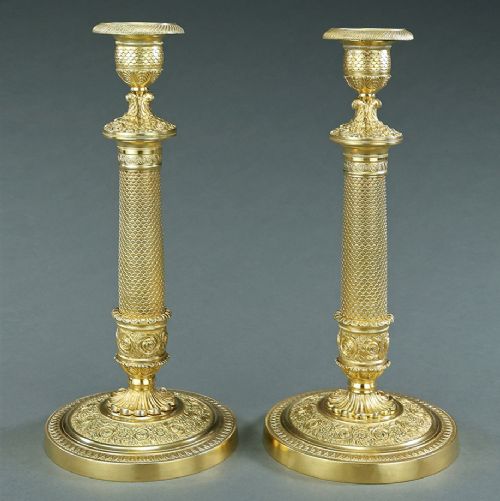
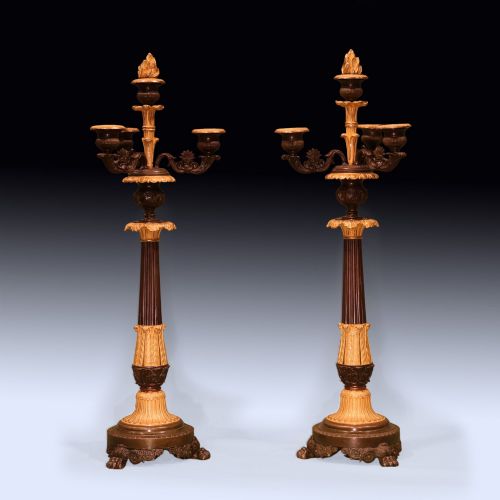
These empire period candle holders bring classical weight and dual-tone metalwork to a mantelpiece, combining deep patinated bronze with bright ormolu.
Empire Period Candle Holders
Empire period candle holders encompass candlesticks and candelabra produced during the 19th century, drawing on French Empire, Regency, Charles X, and Restoration styles. A buyer searching for empire period candle holders meets matched pairs and sets configured for two, three, or four lights.
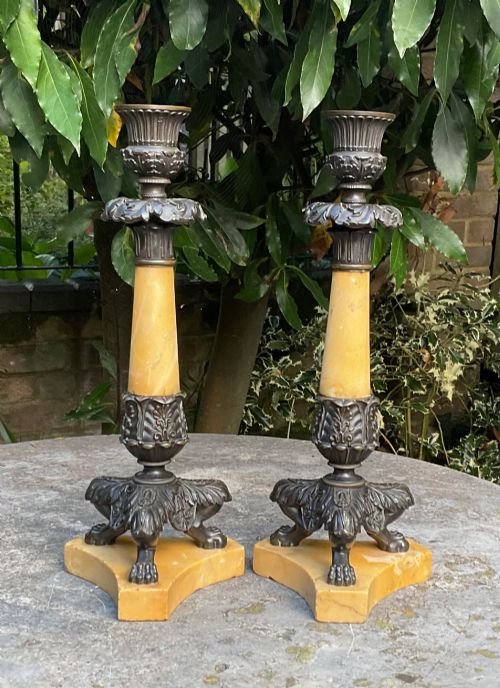
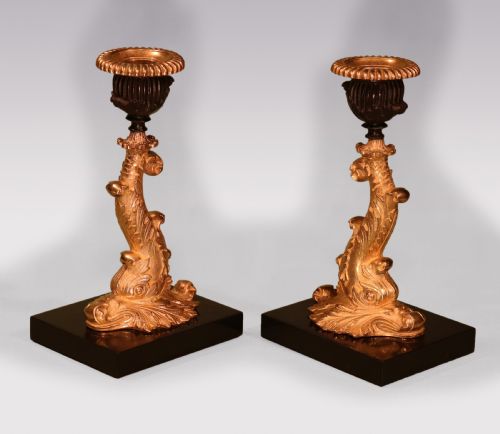
The forms span column designs, classical Athenienne shapes, and sculptural figures including dolphins and griffins. Many examples rest on plinths of marble, sienna marble, or slate, raising the metalwork above the surface.
Originating predominantly from French and Regency workshops, these pieces bridge the continental Empire aesthetic and British Regency taste. The surviving examples rely heavily on heavy cast bronze combined with mercury-gilded components.
How they were made
The construction of these pieces relies on cast bronze, separated into patinated dark sections and bright ormolu or gilt-bronze highlights. Foundries used lost-wax or sand casting methods to produce the heavy components before hand-chiselling the surface details.
Mounts and bases frequently incorporate natural stone elements such as white marble, slate, or Sienna marble, turned and polished to anchor the metal work. Cut glass lustres appear on specific lustre candlesticks, suspended to refract the candlelight.
Assembly involved mechanical threading and pinning to secure the multi-light arms, nozzles, and drip pans to the central shafts.
Listings feature pieces spanning the 19th century, combining patinated bronze, ormolu, cut glass, and marble plinths across French Empire and Regency styles.
What varies in quality
Quality rests significantly on the crispness of the chasing and the depth of the original gilding on the ormolu. Superior examples display sharp relief in the acanthus leaves, classical drapery, and figural mounts, whereas inferior casting appears soft and blurred.
Rabiat
The Empire Period Candle Holders Glossary
- Ormolu
- Gilt-bronze produced by applying a mercury and gold amalgam to a bronze base and heating it to drive off the mercury. This technique creates a durable, golden surface finish characteristic of the period.
- Patinated bronze
- Bronze treated with chemicals to darken the surface to a deep brown or black tone. It provides a strong visual contrast against bright ormolu highlights.
- Candelabra
- A branched candle holder holding two or more lights on separate arms. They differ from single candlesticks through their multi-light configuration.
- Lustre
- A candle holder fitted with glass pendants or prisms hung below the candle nozzle. These pendants catch and scatter the light from the flame.
- Athenienne
- A classical tripod stand form adapted during the neoclassical period to serve as a decorative vessel or candle holder. It draws inspiration from ancient Greek furniture designs.
Empire Period Candle Holders: Frequently Asked Questions
How do I identify a Charles X piece from a Regency one?
Charles X and French Restoration pieces often exhibit softer floral motifs and lighter scaled ormolu, reflecting French tastes of the 1820s and 1830s. Regency pieces produced in Britain frequently incorporate robust classical details like griffins, dolphins, and strict architectural columns.
Both styles share the foundational use of patinated bronze and marble plinths seen across this period.
Were these candle holders intended for dining tables?
Many pairs and sets served as garniture on mantelpieces, chests of drawers, or console tables rather than everyday dining lighting. Their heavy marble bases and sculptural bronze figures made them decorative objects of status as much as functional light sources.
Desk candlesticks also existed in smaller scales specifically for writing surfaces.
Why do some empire candle holders have marble bases?
Marble and slate plinths provided essential physical weight to anchor heavy bronze shafts and prevent tipping. They also introduced contrasting geological colours and textures that complemented the yellow shine of the ormolu.
Sienna marble added warm yellow tones, while black slate offered a stark, dark foundation for the metalwork.