


Emerald Pearl Jewellery
Emerald pearl jewellery unites green beryl and nacre across Georgian, Victorian, Edwardian, and mid-century designs.
Emerald Pearl Jewellery
Emerald pearl jewellery comprises rings, pendants, necklaces, bracelets, brooches, tiara rings, and lockets spanning Georgian, Victorian, Edwardian, Belle Époque, Art Deco, and 1950s periods. These pieces combine lustrous pearls with vibrant emeralds, frequently accompanied by diamonds, rubies, sapphires, and amethysts.
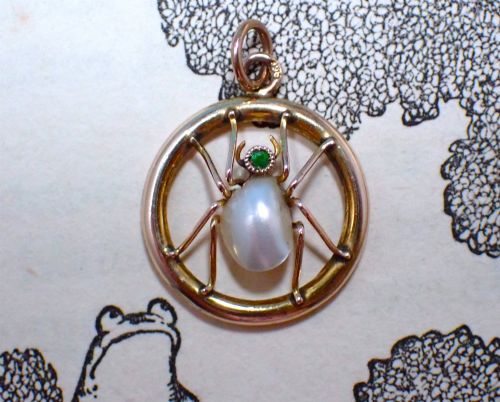
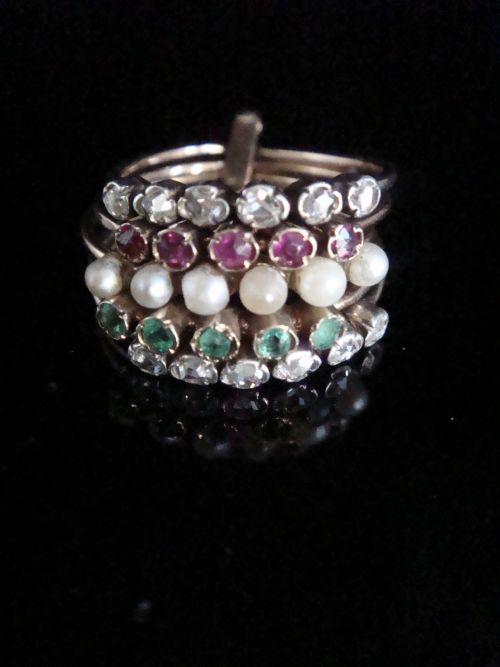
Buyers encountering emerald pearl jewellery on this page will find varied forms ranging from delicate spider pendants and flower vase pendants to multi-strand necklaces and harem stacking rings. Materials span platinum, silver, 9ct, 15ct, and 18ct yellow and rose gold, demonstrating origins from France, Portugal, and Austro-Hungary alongside British styles.
How emerald pearl jewellery was made
Maker construction relies on precious metals including platinum, silver, and high-carat yellow and rose gold such as 9ct, 15ct, and 18K to mount gemstones securely. Jewellers combined natural saltwater pearls and cultured pearls with emeralds, diamond accents, rubies, and sapphires.
Among the spiders, hearts, and tiara rings, a double-sided flower vase pendant spins entirely unexpected charm into the emerald pearl collection.
What varies in quality in emerald pearl jewellery
The sophistication of the period workmanship dictates value, distinguishing standard production from refined French, Portuguese, or Austro-Hungarian artisanal creations. Preservation of original clasps, fine gemstone cuts, and balanced integration of supplementary diamonds or rubies further define superior examples.
The Emerald Pearl Jewellery Glossary
- Emerald
- A variety of beryl coloured green by trace amounts of chromium or vanadium. It is traditionally cut in a rectangular emerald shape or step cut.
- Pearl
- A hard, lustrous object produced within the soft tissue of a mollusc. Natural saltwater pearls are particularly prized in antique pieces.
- Belle Époque
- A period of French design spanning the late nineteenth century and early twentieth century. It is characterised by light, garland-style platinum and diamond work.
- Paste
- Faceted lead glass used in historic jewellery to imitate gemstones. Austro-Hungarian pieces frequently utilised coloured paste alongside pearls.
- Tiara ring
- A ring shaped to resemble a small tiara or crown. These designs often incorporate symmetrical arrangements of pearls, emeralds, and diamonds.
Emerald Pearl Jewellery: Frequently Asked Questions
How do I care for antique pearl and emerald items?
Pearls and emeralds require gentle handling because both materials are sensitive to harsh chemicals, ultrasonic cleaners, and extreme temperature changes. Wipe them with a soft, dry cloth after wearing and store them separately to avoid scratching.
Keep emerald pearl jewellery away from perfumes, cosmetics, and household detergents. Professional cleaning should only be undertaken by specialists familiar with antique gemstone settings and strung pearls.
What periods do these pieces date from?
The inventory spans the Georgian era through Victorian, Edwardian, Belle Époque, and Art Deco periods into the 1950s mid-century. Each era brings distinct metal choices and mounting techniques.
Earlier items from the Georgian and Victorian eras often feature high-carat gold and closed-back settings, while Edwardian and Belle Époque designs frequently showcase platinum and delicate lace-like frameworks.
Are the pearls natural or cultured?
Antique pieces from the Georgian and Victorian eras generally feature natural pearls, whereas twentieth-century items may include cultured varieties or specific natural saltwater specimens. Each listing notes the specific pearl and gemstone characteristics recorded for that item.
Gemmological testing can confirm the origin of the pearls by examining the internal structure under magnification or X-ray radiography.
What metals were used in these mounts?
Makers utilised silver, platinum, 9ct gold, 15ct yellow gold, and 18K yellow or rose gold depending on the period and origin. High-carat yellow gold is common in Victorian work, while platinum gained prominence in Edwardian and Belle Époque creations.
Clasps and settings often combine different metals, such as platinum-topped gold, to provide both structural strength and a bright white surface for diamond and pearl highlights.