
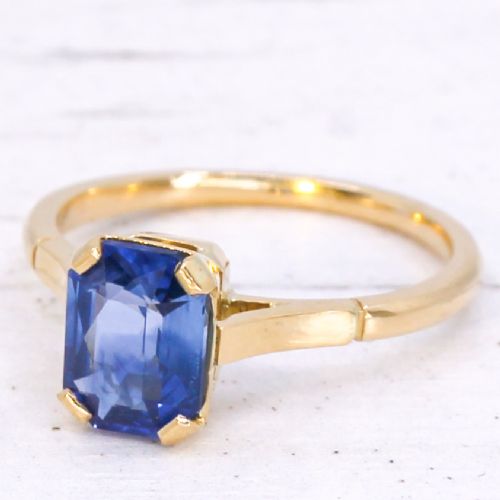
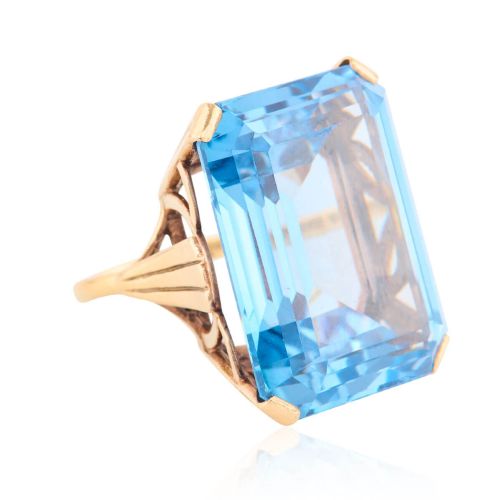
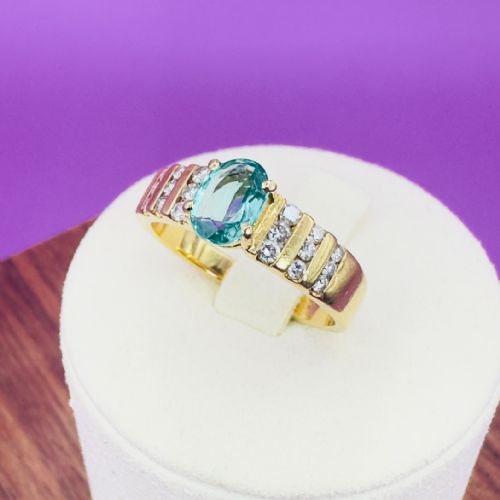


Emerald Cut Solitaire Ring
An emerald cut solitaire ring offers a clean, architectural silhouette that showcases a single central stone with quiet authority.
Emerald Cut Solitaire Ring
An emerald cut solitaire ring centres on a single rectangular stone with cropped corners and step-cut facets, creating a hall-of-mirrors effect rather than brilliant sparkle. When you search for an emerald cut solitaire ring, you encounter pieces spanning the Art Deco period through to the mid-twentieth century.
The selections on this page draw heavily from the nineteen-twenties and nineteen-thirties, alongside post-war nineteen-fifties designs. These rings often feature substantial central gems, including emeralds, amethysts, and aquamarines, mounted simply to let the geometric form dominate the finger.
Materials and construction methods
Metals span yellow gold, white gold, and platinum, providing contrasting secure settings for the prominent step-cut stones. Jewellers utilised yellow and white gold in nine-carat and eighteen-carat purities, alongside durable platinum, to construct sturdy claws and bezels that frame the rectangular outlines.
The stones themselves - whether diamonds, beryls, or coloured quartz - rely on precision cutting to emphasise clarity and depth over scattered light. Master lapidaries aligned the parallel facets carefully, demanding high raw material quality because step cuts conceal few internal inclusions.
Listings span periods from nineteen-twenty to nineteen-sixty, featuring yellow gold, white gold, and platinum set with diamonds, emeralds, aquamarines, and amethysts.
Assessing quality and craftsmanship
Quality rests primarily on the optical clarity and saturation of the central stone, particularly when dealing with large emeralds or aquamarines. Superior examples exhibit clean crystal structures and even colour distribution without heavy masking inclusions.
Metalwork integrity defines the upper tier of these rings, visible in crisp geometric prongs and well-preserved gallery work. Finer pieces maintain sharp facet junctions and secure settings that protect the vulnerable corners of the rectangular cut.
The Emerald Cut Solitaire Ring Glossary
- Solitaire
- A ring setting designed to showcase a single gemstone without accompanying smaller side stones. This minimalist approach focuses attention entirely on the proportions and quality of the main gem.
- Step cut
- A stone faceting style featuring long, parallel rectangular facets that resemble stairs. This cut produces broad flashes of light rather than the fiery dispersion of a brilliant cut.
- Art Deco
- A design style prevalent during the nineteen-twenties and nineteen-thirties characterised by geometric symmetry, clean lines, and architectural influence. Pieces from this era favour bold shapes and strong contrasts.
- Platinum
- A dense, silvery-white precious metal prized in jewellery for its strength and hypoallergenic properties. It holds intricate settings securely without adding yellow tones to colourless diamonds.
- Beryl
- The mineral family that includes emerald, aquamarine, and various coloured gemstones found across these historic pieces. Its good hardness makes it suitable for daily ring wear.
Emerald Cut Solitaire Ring: Frequently Asked Questions
What defines an emerald cut?
An emerald cut is a rectangular stone shape featuring truncated corners and parallel step-cut facets. This geometry prioritises stone clarity and deep flashes of light over traditional sparkle.
Originally developed for cutting emeralds to reduce pressure during shaping, the style was later adopted for diamonds and coloured stones for its sophisticated look.
How do I care for antique rings?
Antique and vintage rings require gentle handling, particularly specimens featuring softer beryls or large amethysts. Clean them with warm soapy water and a soft brush rather than ultrasonic machines.
Regularly check the setting claws with a jeweler to ensure the central stone remains secure in its historical mount.
Are these stones natural?
Many listings feature certified natural gemstones, including Colombian emeralds and untreated coloured varieties. Historical pieces from the Art Deco and mid-century eras predominantly utilised natural earth-mined materials.
Documentation and certification details accompany specific pieces to verify the geological origin and treatment status of the stone.
How do I date these rings?
Dating relies on stylistic markers, metal types, and cut characteristics typical of periods like the nineteen-twenties or nineteen-fifties. Art Deco pieces show strict geometric symmetry, while post-war examples often display bolder proportions.
Hallmarks stamped inside the band also provide official assay office stamps and date letters where present.