
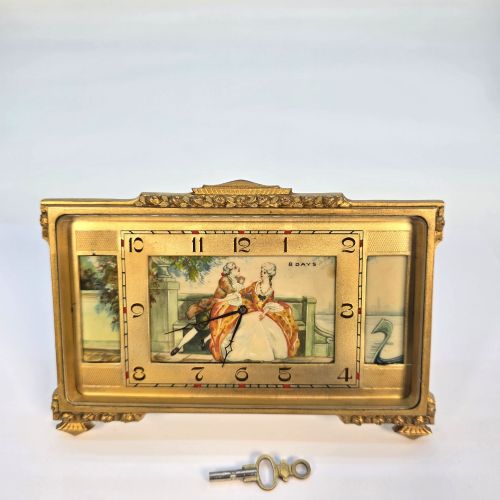
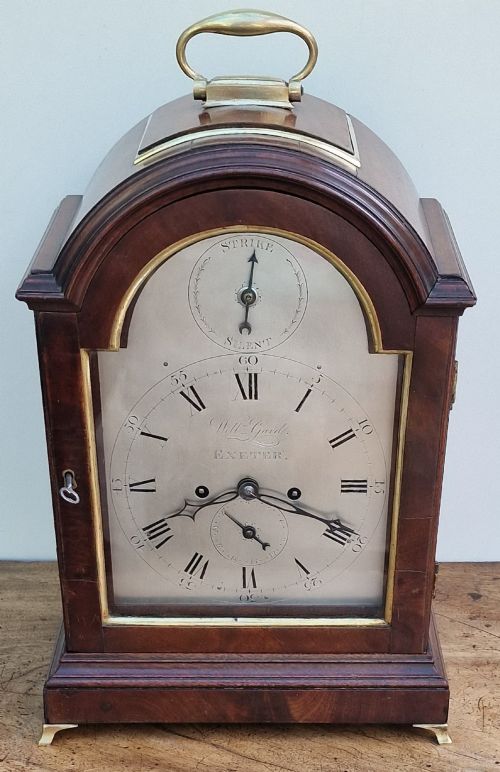
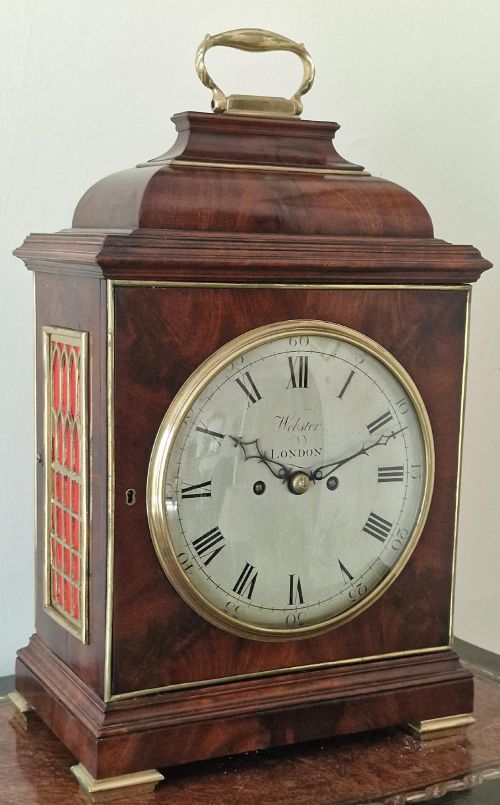


Eight Day Table Clock
An eight day table clock brings mechanical precision and period presence to a room, measuring time through driven movements housed in architectural cases.
Eight Day Table Clock
An eight day table clock is an autonomous timekeeper designed to stand on a bracket, mantel, or table surface without requiring daily winding. When exploring an eight day table clock on this page, a buyer encounters forms ranging from compact brass carriage models to substantial mahogany and rosewood bracket pieces.
The historical span represented in these objects covers periods from the seventeenth and eighteenth centuries through the Victorian and Edwardian eras. Pieces originate from English workshops and French makers, displaying styles that shift from Georgian restraint to ornate Louis XVI Revival and Chinoiserie.
Enamelled dials, silvered chapter rings, and glass panels often protect the internal workings while exposing the motion of the escapement. The most frequent configurations combine striking mechanisms with wooden cases or marble housings built to endure.
Materials and Construction
Makers constructed these cases using dense hardwoods such as mahogany, oak, ebony, and rosewood, frequently incorporating brass fittings, gilt bronze, or ormolu mounts. Glass inspection panels and convex or flat enamelled dials completed the exterior architecture.
Internal movements relied on brass wheel trains, steel arbors, and escapements driven by weights or spring barrels governed by fusee or platform setups. Cabinets often featured inlaid veneers, marquetry work, or carved mouldings applied by specialist joiners.
Listings feature movements housed in oak, mahogany, rosewood, and marble, spanning Georgian, Victorian, and Edwardian periods.
Distinctions in Quality
The standard of an eight day table clock depends upon the crispness of the movement's execution and the integrity of its housing. Superior examples display refined engraving on backplates, precise wheel cutting, and original components that operate in harmony.
Case construction separates ordinary items from exceptional ones through the selection of timber grain, the retention of original patination, and the complexity of musical or striking trains. The distinction lies in whether the mechanism and cabinet remain unaltered over centuries of use.
Thwaites of London·Winterhalder And Hofmeier·Richard Rooker·Hampson And Son
The Eight Day Table Clock Glossary
- Bracket clock
- A portable spring-driven clock originally designed to sit upon a matching wall bracket or table surface. These pieces often feature bell-top cases and sophisticated striking mechanisms.
- Fusee
- A conical pulley used in spring-driven clocks to equalize the diminishing power of the mainspring as it unwinds. This device ensures consistent torque reaches the gear train for accurate timekeeping.
- Verge escapement
- An early mechanical escapement that controls the release of power in a clock movement through a crown wheel and pallet geometry. It is typically found in seventeenth and eighteenth-century pieces.
- Ormolu
- Gilt bronze ornamentation applied to clock cases, created by coating cast bronze with a mercury-gold amalgam and heating it. This technique produced a durable, rich golden surface finish popular in French designs.
- Chapter ring
- The separate metal ring on a clock face that bears the hour numerals. These are frequently silvered or enamelled and mounted onto the dial plate.
Eight Day Table Clock: Frequently Asked Questions
How do I wind an eight day table clock?
Winding requires inserting the appropriate key into the winding holes on the dial face and turning it gently until resistance indicates the mainspring is fully tensioned. Care must be taken not to overwind the mechanism, which can damage the internal spring.
Most eight day table clocks require winding once a week to maintain continuous operation. Keeping a consistent schedule helps preserve the tension regulation within the movement.
Where should I place a table clock?
These clocks perform best on a sturdy, level surface away from direct sunlight, moisture, and extreme temperature fluctuations. Placing them on a stable mantelpiece or dedicated bracket prevents vibrations from disrupting the pendulum or balance wheel.
Level placement is particularly essential for older mechanical movements to ensure the escapement beats evenly. A stable foundation also protects delicate wood veneers and gilt bronze mounts from accidental knocks.
How do I identify the period of a clock?
Period identification relies on examining the case style, wood selection, dial materials, and the signature of the maker inscribed on the movement plate. Georgian pieces often display restrained mahogany architectural forms, while Victorian examples introduce marble or ornate gilt details.
Internal construction methods also indicate age, as movement designs evolved from verge escapements to later platform and anchor setups. Consulting maker records helps narrow down the decade of production.
What maintenance do mechanical clocks need?
Mechanical clocks benefit from professional cleaning and lubrication every few years to prevent dried oils from wearing down the brass pivots and gears. Dust accumulation inside the case should be cleared carefully by a specialist.
Routine care involves keeping the exterior wood conditioned and ensuring the glass panels remain secure. Avoiding amateur adjustments to the internal spring and escapement preserves the long-term health of the movement.