




Edwards and Roberts Bureau
These pieces of edwards and roberts bureau show the finest cabinet-making traditions, offering refined workspaces built for Victorian and Edwardian homes.
Edwards and Roberts Bureau
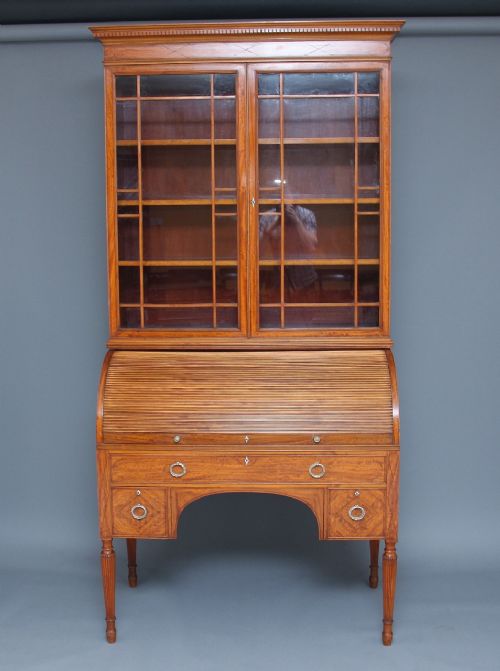
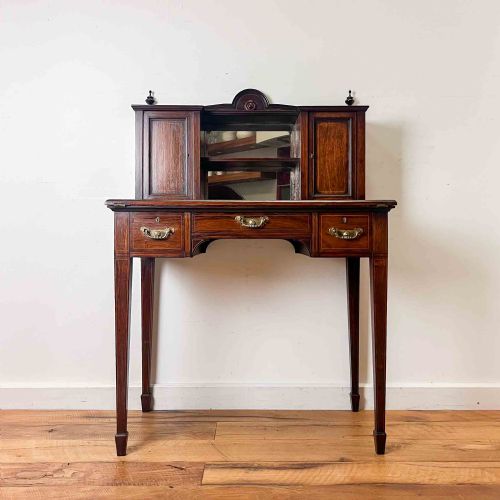
You are most likely to meet cylinder desks, ladies desks, and bureau plat forms on this page. The designs draw heavily upon Edwardian Sheraton Revival, Victorian, and Louis XV Revival styles, reflecting the eclectic tastes of their original owners.
How they were made
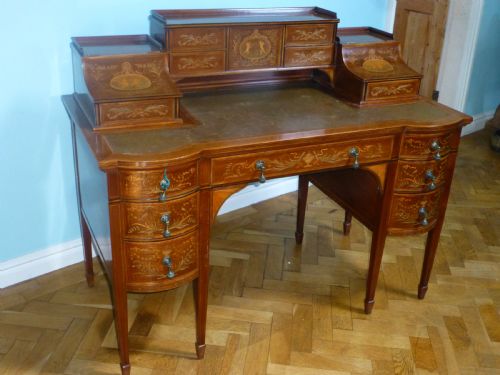
Makers utilised rich primary timbers such as mahogany, satinwood, rosewood, walnut, and oak to construct these pieces. Cabinet-makers applied intricate marquetry inlay to embellish surfaces, particularly on Edwardian Sheraton Revival pieces.
Metalwork details such as brass handles and fixtures complemented the timber frames, while fitted writing surfaces often incorporated leather. Specialised forms included glass and mirror glass components in bureau bookcases and display desks.
Secret compartments inside these desks remind us that Victorians loved hiding their diary keys.
What varies in quality
The degree of refinement in the marquetry inlay and the choice of primary timber separate standard production from superior pieces. Fine satinwood and rosewood examples demonstrate greater artistry than plain oak or standard mahogany versions.
Stylistic ambition also dictates distinction, where complex forms like cylinder bookcases and Carlton House desks require advanced joinery compared to straightforward writing desks.
Edwards and Roberts
The Edwards and Roberts Bureau Glossary
- Marquetry
- Decorative veneer work arranged in pictorial or geometric patterns. This technique utilised contrasting woods to create elaborate ornamentation on desk surfaces.
- Cylinder desk
- A writing desk featuring a curved, rolling cylinder shutter that conceals the writing surface and interior pigeonholes. It provides a secure enclosure for correspondence.
- Carlton House desk
- A refined writing desk shaped in a horseshoe curve with a raised superstructure of small drawers and compartments. It represents a sophisticated form of nineteenth-century workspace.
- Bureau plat
- A freestanding writing table, typically with drawers along the frieze, inspired by French eighteenth-century designs. This Louis XV revival form stands away from the wall.
- Secretaire bookcase
- A tall combination piece incorporating a writing drawer with a drop-front desk above shelving enclosed by glass doors. It serves both study and library functions.
Edwards and Roberts Bureau: Frequently Asked Questions
What is an edwards and roberts bureau?
An edwards and roberts bureau is a piece of antique writing furniture produced by the notable London cabinet-making firm during the Victorian and Edwardian periods. These items include desks, writing tables, and secretaire bookcases.
They represent high-quality craftsmanship from the late nineteenth and early twentieth centuries, often featuring elaborate inlay and premium timber construction.
How do I date an edwards and roberts bureau?
Dating involves examining the stylistic influences, such as Victorian aesthetic revival or Edwardian Sheraton Revival, alongside the primary timbers utilised. Pieces range from eighteen ninety to around nineteen hundred.
Makers marks and labels, where present, assist in narrowing the production era within the nineteenth and early twentieth centuries.
Which woods were used for these desks?
Cabinet-makers constructed these desks using a variety of fine timbers including mahogany, satinwood, rosewood, walnut, and oak. These woods provided durable structures and appealing grain patterns.
Exotic veneers and marquetry details were frequently applied to enhance the visual appeal of Edwardian and Victorian pieces.
How do I care for my antique desk?
Preserving these pieces requires placing them away from direct sunlight and maintaining stable room humidity to protect the timber and leather surfaces. Regular dusting with a soft, dry cloth maintains the polished finish.
Avoid chemical polishes and excess moisture, which can damage delicate marquetry inlay and antique brass fittings.