
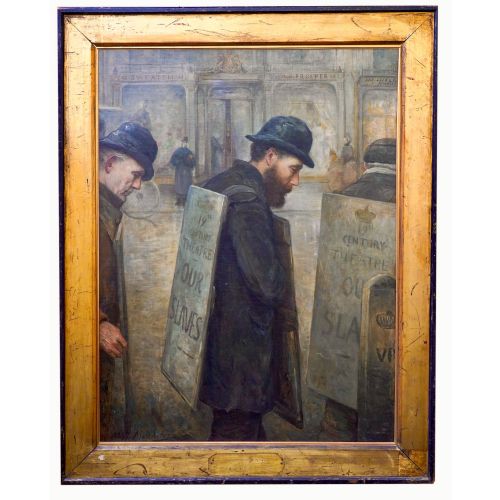


Edwardian Street Scene Painting
An edwardian street scene painting captures the hustle and charm of early twentieth-century thoroughfares, offering a charming window into historical daily life.
Edwardian Street Scene Painting
An edwardian street scene painting depicts urban and rural thoroughfares, markets, and town squares during the early twentieth century. These works capture the daily rhythm of public life, often focusing on figures navigating carriage-laden roads and historic shopfronts.
The selections available range from precise watercolours to robust oil paintings on canvas and board. Artists of the period recorded both bustling city squares in London and quiet provincial inns across English counties.
Pieces frequently reflect the broader artistic movements of the era, including British Impressionism and Victorian social realism. Buyers will encounter both atmospheric moonlit townscapes and brightly lit daytime genre scenes.
How they were made
Artists typically worked with watercolour paint on paper or applied oil paint directly to canvas and board. These mediums allowed painters to capture varying atmospheric conditions, from winter twilight to bright daytime markets.
Finished works were commonly housed in protective wooden frames, occasionally embellished with gold leaf. Glass was frequently placed over paper watercolours to shield the delicate pigments from environmental damage.
Historic street scenes occasionally feature stray dogs lingering near market stalls, faithfully recorded by artists who painted every passing detail.
What varies in quality
Quality rests in the artist's command of light, perspective, and atmospheric depth within the urban setting. Finer examples display confident brushwork and a convincing sense of movement among the figures populating the street.
The preservation of the medium itself marks a distinction between works, particularly with watercolours on paper. Well-preserved pieces retain their original pigment vibrancy without excessive fading from past exposure to light.
Felix Stone Moscheles·Thomas Ellison·Albert Ludovici Jnr·William Manners·Charles James Lauder·John Smith Atherton·George Whyatt·Andrew Young·Robert Hollands Walker·Joseph W Milliken·David Small·Annie L Lee·Matthew Hale·Alfred Leyman
The Edwardian Street Scene Painting Glossary
- Watercolour paint
- A water-based medium using finely ground pigments suspended in a water-soluble binder. It is traditionally applied to paper to achieve translucent washes of colour.
- Oil on canvas
- Pigments bound in a drying oil, such as linseed, and applied to a stretched woven fabric surface. This technique allows for rich texture and deep colour saturation.
- Genre painting
- Artwork depicting scenes from everyday life, typically involving ordinary people engaged in common activities. These works focus on narrative and social observation.
- Folk art
- Artistic work created by untrained or self-taught painters, often prioritising direct expression and decorative charm over formal academic perspective.
- Gold leaf
- Extremely thin sheets of beaten gold used to gild wooden frames. It provides a warm, reflective border that enhances the artwork.
Edwardian Street Scene Painting: Frequently Asked Questions
What subjects appear in these paintings?
The works depict town squares, market days, and quiet provincial streets populated by pedestrians and horse-drawn carriages. Locations range from London landmarks to rural village inns across England.
Artists also recorded specific weather conditions, capturing moonlit lanes, winter twilight, and snowy townscapes.
How should I display these works at home?
Watercolours on paper require framing behind glass to protect the delicate medium from moisture and dust. Oil paintings on canvas are more robust but still benefit from stable indoor humidity.
Keep framed pieces away from direct sunlight to prevent the fading of pigments and paper over time.
How do I identify the period of a painting?
Look to the clothing styles of the figures, the presence of horse-drawn transport, and the architectural details of the shopfronts. Signatures and dates inscribed by the artist also provide a direct guide to the creation era.
Framing materials and backing boards often offer additional clues regarding the age of the piece.
What is the difference between oil and watercolour versions?
Watercolour paintings use translucent washes on paper to create light, atmospheric effects suited for detailed town views. They are typically presented behind protective glass.
Oil paintings utilise heavier pigments on canvas or board, offering rich textures and deeper colour tones that do not require glass.