
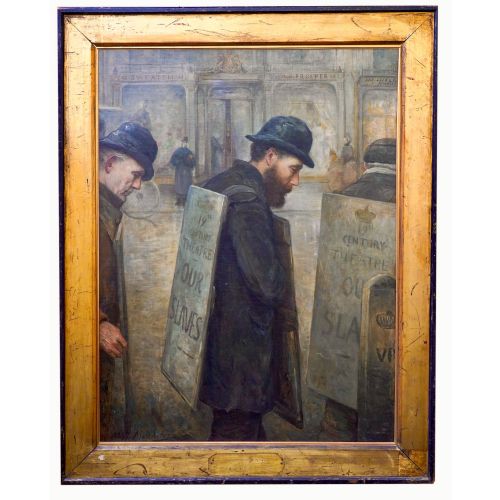


Edwardian Street Scene Art
Edwardian street scene art captures the bustle and quiet corners of town life through watercolours, oils, and ink.
Edwardian Street Scene Art
Edwardian street scene art brings together urban views and townscapes created in the late nineteenth and early twentieth centuries. These works record city thoroughfares, market squares, and village lanes from periods including the Victorian era, the Edwardian years, and the 1920s.
The watercolours and oil paintings on this page range from bustling London squares and Venetian markets to quiet rural inns and snowy lanes. Most examples are framed works on paper or board, capturing daily life through British Impressionism, social realism, and folk art traditions.
How they were made
Artists of these urban scenes relied principally on watercolour paint on paper and oil on canvas or board. Ink was frequently used for fine line work beneath watercolours, defining the architecture and figures before washes of colour were applied.
Finished works were typically housed in wood frames, occasionally embellished with gold leaf. The combination of durable paper, stable board, and traditional wood framing ensured these paintings survived over a century of domestic display.
Artists braved the elements to paint moonlight, snow, and winter twilight directly onto paper and board.
What varies in quality
The quality of a street scene rests on the artist's handling of light and atmosphere, whether capturing moonlit lanes or bright market squares. Works by documented painters show greater confidence in perspective and human movement than anonymous folk art pieces.
Materials also distinguish the range, from simple wood frames to substantial gold leaf mouldings. The depth of the composition and the preservation of the pigment on paper or board determine the visual impact of each piece.
Felix Stone Moscheles·Thomas Ellison·Albert Ludovici Jnr·William Manners·Charles James Lauder·John Smith Atherton·George Whyatt·Andrew Young·Robert Hollands Walker·Joseph W Milliken·David Small·Annie L Lee·Matthew Hale·Alfred Leyman
The Edwardian Street Scene Art Glossary
- Watercolour
- A paint consisting of pigment suspended in a water-based solution, traditionally applied to paper to create translucent washes of colour. It is the dominant medium for street scenes from this period.
- Genre painting
- A style depicting scenes from everyday life, including market days, street cabs, and town squares. These works offer a record of ordinary activities in past decades.
- Impressionism
- An art movement focusing on transient effects of light and atmosphere rather than minute details. British practitioners applied these principles to local streets and weather conditions.
- Folk art
- Art produced by self-taught or non-professional painters, often characterised by a flat perspective and direct charm. These rural and street views stand apart from academic fine art.
Edwardian Street Scene Art: Frequently Asked Questions
What subjects appear in Edwardian street scene art?
These works depict townscapes, city squares, market days, and village inns. Artists recorded specific locations ranging from London and Leicester Square to Venice and rural Devon.
Scenes vary from bustling cab ranks and markets to quiet moonlit streets and snowy weather. Both grand urban thoroughfares and humble rural lanes feature across the selection.
How do I date a street scene painting?
Dating relies on recorded artist working dates, stylistic markers, and framing materials. Signatures and inscriptions on the reverse often point to specific decades between the late nineteenth century and the 1920s.
Clothing styles of figures within the paintings also help place them in the Victorian, Edwardian, or later periods. Period frames provide further clues regarding the age of the piece.
Where were these watercolours and oils displayed?
Original owners hung these framed works in domestic parlours, drawing rooms, and hallways. They served as decorative records of familiar city streets or holiday destinations.
Today, they suit similar residential settings, bringing historic character to living spaces and studies. Their diverse sizes allow for hanging in both narrow alcoves and larger wall areas.
Are these paintings glazed for protection?
Works executed on paper, such as watercolours and ink drawings, are typically set behind glass within their wood frames. This glazing protects the delicate pigments from dust and moisture.
Oil paintings on canvas or board generally remain unglazed, allowing the textured paint surface to be viewed directly. Original frames should be handled carefully to preserve their historic character.