



Edwardian Oval Drop Leaf Table
An edwardian oval drop leaf table brings folding leaves and curved timber together in a space-saving form designed to adapt to smaller rooms.
Edwardian Oval Drop Leaf Table
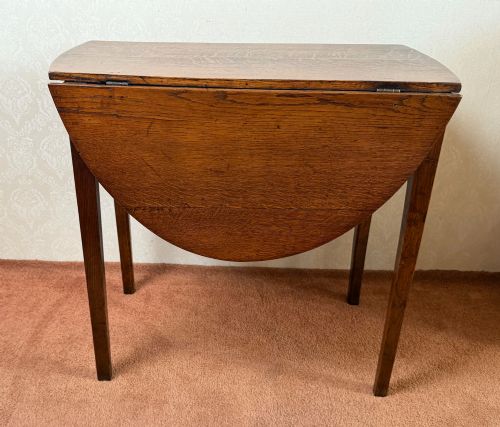
When you search for an edwardian oval drop leaf table, you encounter versatile wooden folding tables originating predominantly from the early twentieth century and the Edwardian period, alongside related gateleg and Pembroke forms. These items typically feature hinged side leaves supported by swinging legs or brackets, allowing the surface area to expand and contract according to immediate needs.
While the search specifies an Edwardian origin, the listings span several eras including the Victorian period, 18th Century, and 1920s, with oak and mahogany appearing most frequently. The forms range from compact coffee tables and occasional tables to larger gateleg dining tables and narrow Sutherland tables.
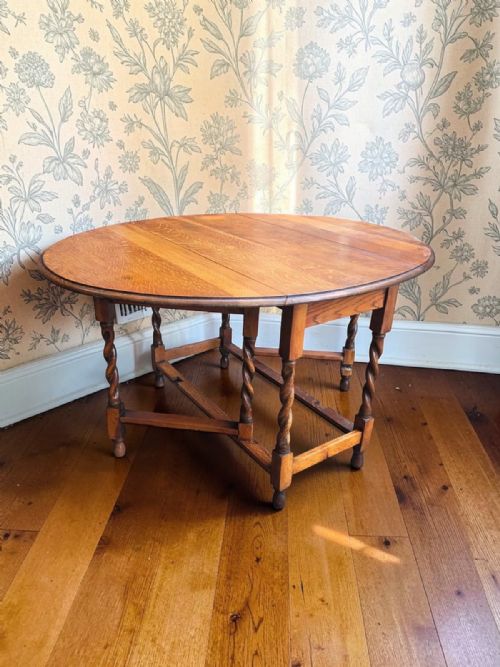
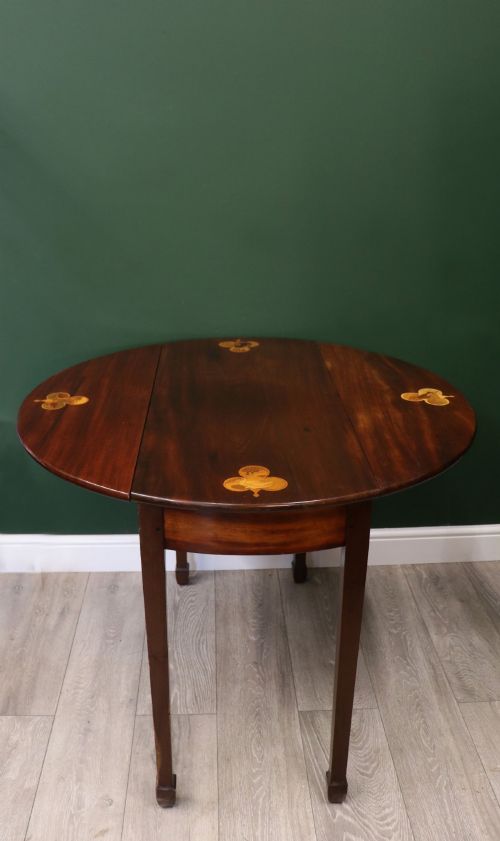
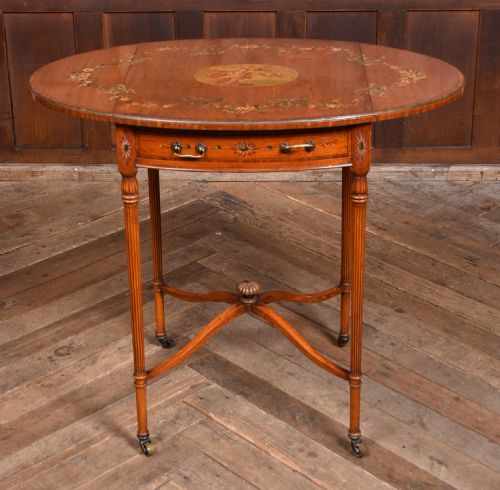
Mahogany examples often incorporate Sheraton Revival styling with inlaid stringing or hand-painted satinwood details, whereas oak variants tend to display sturdy barley twist legs. Buyers are most likely to meet mahogany Pembroke tables and oak gateleg tables with oval tops on this page.
How they were made
Cabinetmakers utilised solid timbers and veneers such as oak, mahogany, walnut, and burr walnut, sometimes enhancing the surfaces with satinwood inlay and brass fittings. The structural stability of these folding tables relies upon robust pivot hinges and swing-out legs or gatelegs that support the drop leaves when raised.
Turned woodwork, particularly barley twist legs, defines many of the oak examples, whilst finer mahogany and satinwood pieces often feature delicate stringing and painted motifs characteristic of Edwardian Sheraton Revival craftsmanship. Ceramic castors occasionally appear on the feet of larger tables to facilitate movement across floors.
Listings feature oak and mahogany predominantly, alongside walnut, burr walnut, satinwood, brass, and ceramic.
What varies in quality
The distinction between tiers of quality rests upon the selection of timber, the crispness of the turning on the legs, and the subtlety of any decorative inlay. Finer pieces demonstrate careful book-matching in burr walnut or precise marquetry and stringing in satinwood, whereas simpler utilitarian versions rely on plain cut oak.
Constructional integrity at the hinge joints and the smoothness of the drop leaf action also separate standard examples from finer works. The integration of solid brass hardware and well-fitted gate mechanisms indicates a higher grade of workshop production.
The Edwardian Oval Drop Leaf Table Glossary
- Drop leaf table
- A table with a fixed central section and hinged flaps that fold down at the sides. These flaps are supported when raised by hinged legs or wooden brackets.
- Gateleg table
- A drop leaf table where the legs swing out like a gate to support the leaves. This design provides sturdy support beneath the extended flaps.
- Pembroke table
- A small rectangular or oval table with two hinged leaves on opposite sides. It frequently includes one or more small drawers.
- Sutherland table
- A narrow table with exceptionally slender drop leaves that fold down almost vertically. It is designed to occupy minimal space when closed.
- Barley twist
- A type of decorative wood turning resembling a spiral rope. This technique is common on the legs of seventeenth-century revival and Edwardian oak furniture.
- Inlay
- A method of ornamenting a wooden surface by embedding pieces of contrasting timber, brass, or shell into carved recesses. Edwardian Sheraton Revival pieces often use this for linear stringing.
Edwardian Oval Drop Leaf Table: Frequently Asked Questions
What is an edwardian oval drop leaf table used for?
These tables function as adaptable pieces of furniture that serve as compact side or occasional surfaces when folded down. Raising the leaves transforms them for dining, writing, or display.
Their dual nature makes them practical for rooms where permanent large furniture would restrict movement. Many serve daily as coffee tables or occasional desks.
How do I distinguish an Edwardian table from a Victorian one?
Edwardian tables often display lighter framing, brighter mahogany veneers, and delicate Sheraton Revival satinwood inlay or hand-painted decoration. Victorian equivalents tend to utilise heavier timber dimensions and darker finishes.
Proportions also shift between the eras, with Edwardian pieces frequently favouring airier structures and simpler turnings compared to heavier Victorian gateleg designs.
Are these tables suitable for everyday dining?
Gateleg and Pembroke versions provide substantial surface area when fully extended, making them practical for regular meals in compact dining spaces. The folding leaves allow the furniture to shrink back against a wall when not in use.
Sturdy oak gateleg frames offer particular stability for seating several people comfortably around an oval top.
What woods were used for these tables?
Cabinetmakers constructed these tables using native and imported hardwoods, with oak and mahogany appearing most frequently across the listings. Burr walnut and satinwood also feature on finer decorative examples.
Secondary woods like pine or oak frequently form the interior framing and drawer linings of mahogany pieces.