

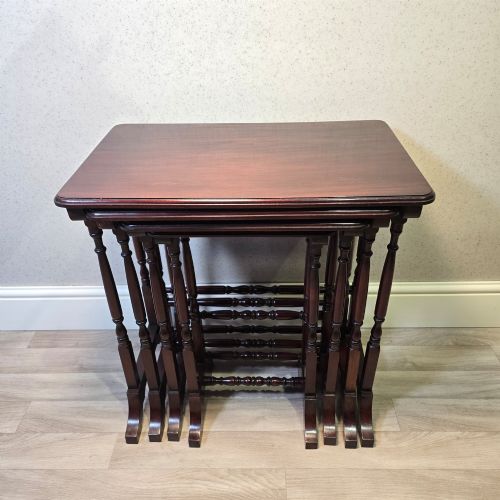
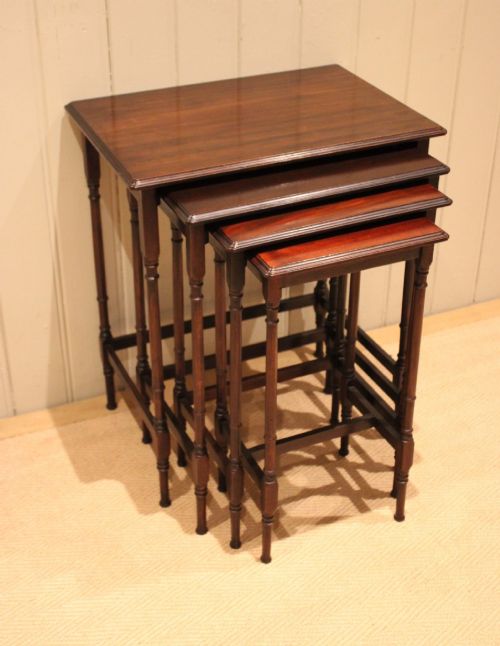
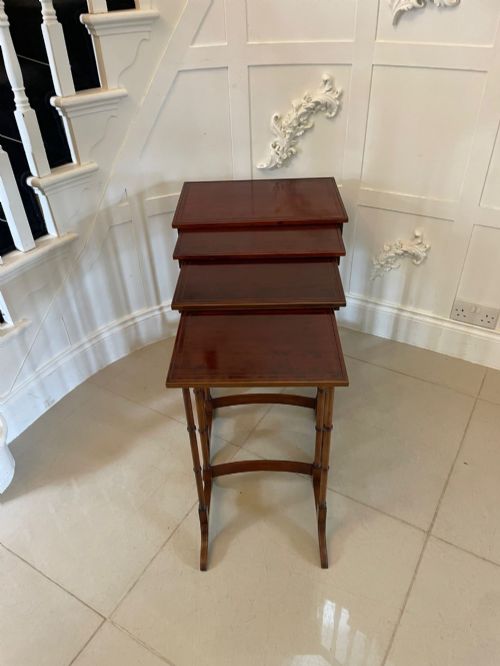




Edwardian Nest of Four Tables
An Edwardian nest of four tables offers ingenious modular design for compact spaces, stacking together neatly when not in use.
Edwardian Nest of Four Tables
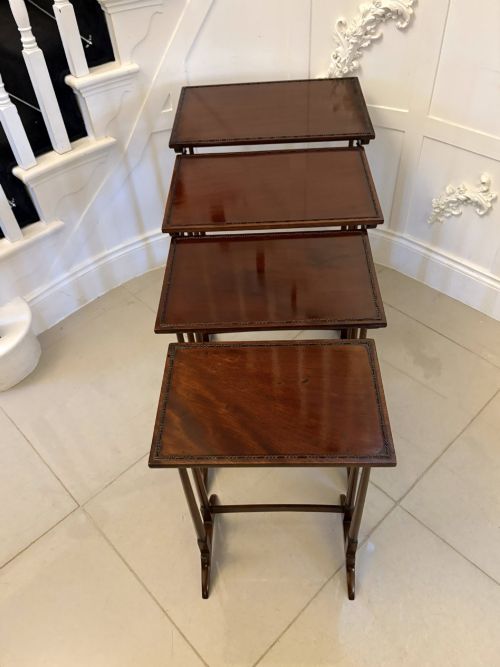
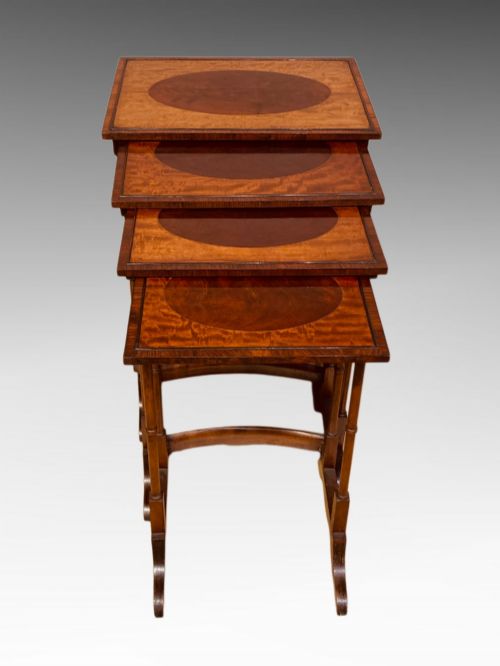
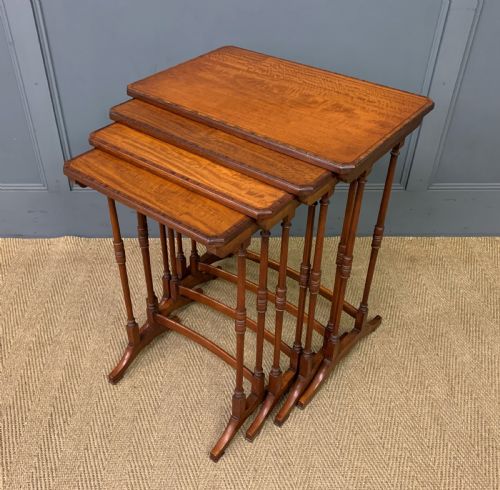
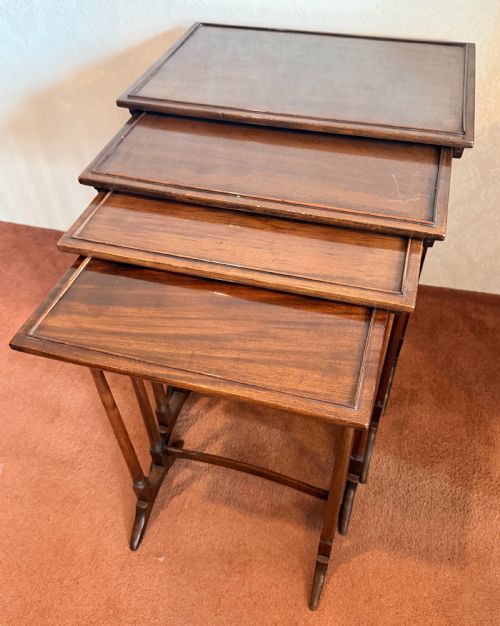
An Edwardian nest of four tables comprises a set of four graduated occasional tables designed to slide one beneath another. This clever format allows multiple surfaces to occupy the floor space of just one small table until required for tea, writing or display.
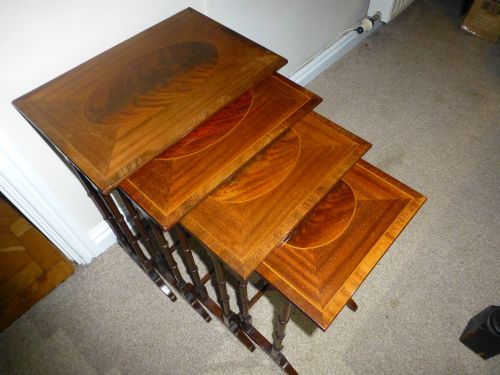
The version most commonly met on this page is the Edwardian mahogany model, often finished with delicate boxwood inlay. These pieces frequently appear under the traditional historical name of quartetto tables, reflecting their four-part construction.
While the core of the selection dates strictly from the Edwardian era and the early twentieth century, related examples span from the late nineteenth century into the interwar decades. Alongside standard mahogany iterations, variants emerge in walnut, satinwood, oak and lacquer.
Materials and construction
Makers relied heavily on mahogany as the primary timber, often enhanced by fine veneer work and contrasting boxwood inlay to frame the tops. Selected examples utilise walnut, satinwood, oak or specialised lacquer and Chinoiserie decoration.
Construction prioritized stability and precise scaling so each smaller table fits smoothly within the frame of the next. Joinery techniques ensured the legs and frames remained slender yet robust enough to withstand regular stacking and unstacking.
Edwardian Nest of Four Tables Retail Price Guide 2026
Typical asking prices for edwardian nest of four tables among the pieces listed under this phrase on Sellingantiques today, from the lower quarter to the upper quarter. They describe what is for sale here now, not the wider market.
One exceptional set bears the signature of E. Daligny, proving that even stacking tables could double as signed canvases.
Gradations in quality
Quality rests significantly on the choice of timber and the crispness of the inlay work. Finer examples display carefully matched mahogany grain and intricate satinwood or boxwood details rather than plain surfaces.
The structural precision of the nesting mechanism distinguishes standard production from superior workshops. Smooth sliding action and consistent proportions across all four graduated tables mark out the better pieces.
E. Daligny
The Edwardian Nest of Four Tables Glossary
- Quartetto
- A traditional term specifically designating a set of four nested tables. These sets were particularly popular during the late Victorian and Edwardian periods for entertaining.
- Inlay
- A decorative technique where contrasting woods such as boxwood or satinwood are inserted into recesses within the primary timber. This adds linear detail and geometric patterns to table tops.
- Veneer
- A thin layer of choice wood applied over a secondary timber base to create a figured surface. It allowed makers to showcase rich grain patterns while maintaining structural stability.
- Chinoiserie
- European decorative style reflecting Chinese artistic motifs, often rendered in lacquer with gold painting. Such decoration transforms functional occasional tables into striking focal points.
Edwardian Nest of Four Tables: Frequently Asked Questions
What is an Edwardian nest of four tables?
An Edwardian nest of four tables is a set of four graduated occasional tables designed to stack inside one another. They provide multiple surfaces while occupying minimal floor space.
Originally created for entertaining and tea service, these sets combine practical furniture design with the refined aesthetic of the early twentieth century.
How were these nesting tables used?
These tables served primarily as flexible surfaces for afternoon tea, reading materials or holding lamps. The stacked arrangement sat compactly against a wall or beside a chair until guests arrived.
Individual tables could then be distributed around a room as needed and returned to the stack once the gathering concluded.
How do I identify an Edwardian set?
Edwardian sets typically feature light mahogany construction, often augmented with boxwood inlay, satinwood banding or slender tapered legs. The timber finishes reflect the lighter, more refined tastes of the early 1900s.
They are frequently referenced in period terminology as quartetto tables, distinguishing them from later or earlier multi-tier designs.
How do I care for antique mahogany tables?
Keep wooden tables away from direct heat sources and strong sunlight to prevent the timber and veneer from drying out or fading. Regular dusting with a soft, dry cloth preserves the polished finish.
Applying a quality beeswax periodically nourishes the wood and maintains the natural lustre without building up heavy chemical residues.