

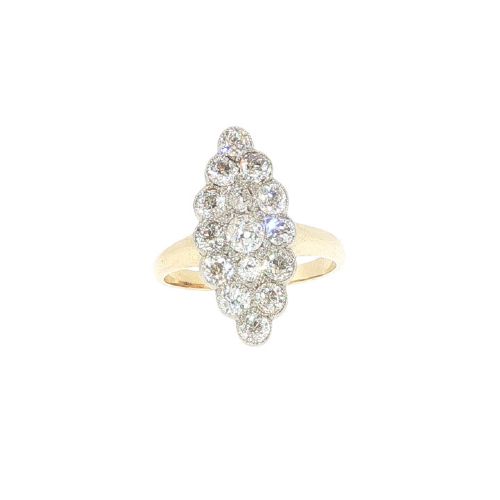


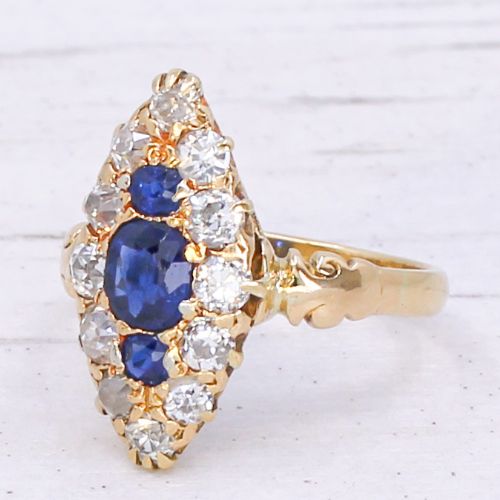


Edwardian Marquise Diamond Cluster
These edwardian marquise diamond cluster pieces are slender, elongated jewels that sit gracefully on the hand, offering brilliant presence and delicate period charm.
Edwardian Marquise Diamond Cluster
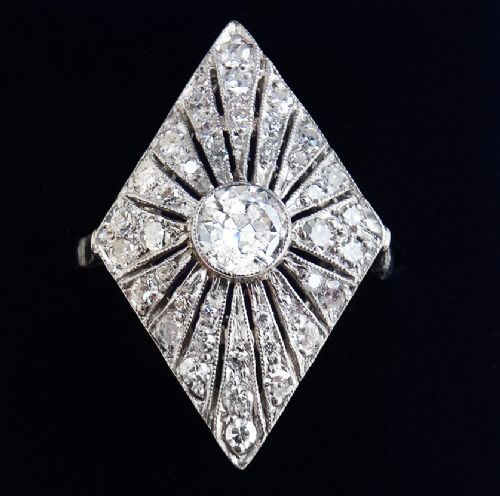
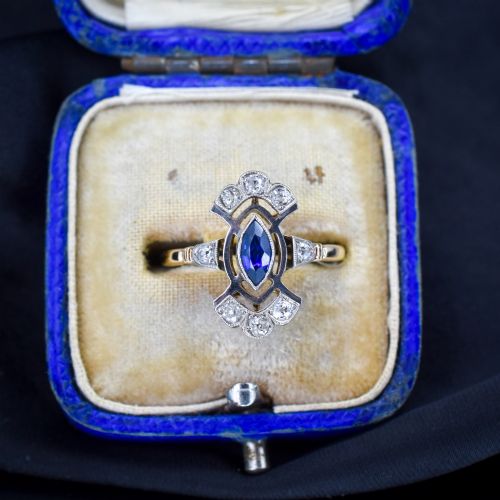
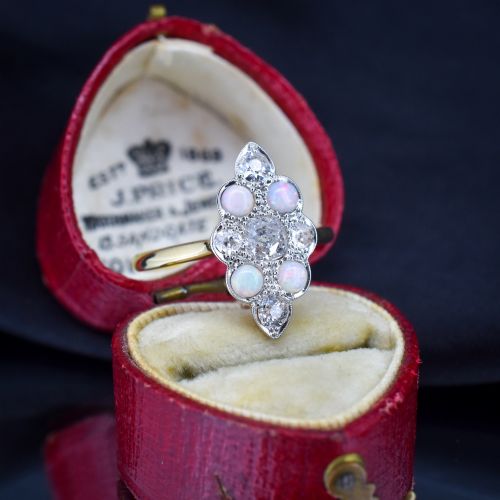
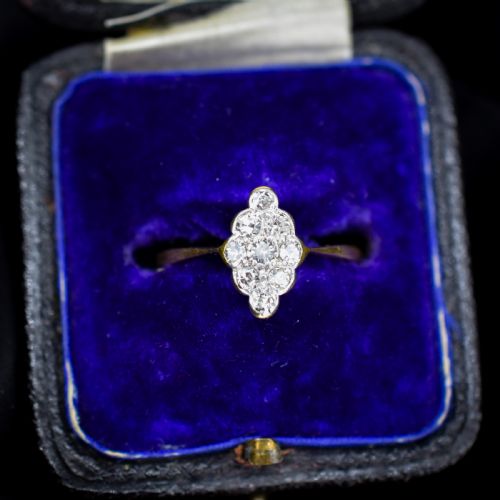
When you search for an edwardian marquise diamond cluster, you are looking at rings formed around a pointed, boat-shaped silhouette that stretches along the finger. These pieces draw the eye through length rather than height, creating a low-profile cluster that catches the light across multiple stones.
The versions most likely to meet you on this page span the Edwardian era into the Art Deco period, alongside Victorian and later twentieth-century iterations. They present old cut diamonds, old mine cuts, and rose cuts arranged alongside platinum settings and yellow gold shanks.
How they were made
Goldsmiths built these clusters by combining eighteen-carat gold with platinum, using the stronger white metal for the top surface to hold the stones securely while keeping the settings visually crisp. This dual-metal technique allowed workshops to mount diamonds closely together with minimal visible metal.
Stones were hand-set using early techniques such as bead-setting and rubover mounts, often incorporating millegrain decoration around the edges. Jewellers selected old cut, rose cut, and old mine cut diamonds, shaping them to fit the tapering contours of the navette outline.
Edwardian Marquise Diamond Cluster Retail Price Guide 2026
Typical asking prices for edwardian marquise diamond cluster among the pieces listed under this phrase on Sellingantiques today, from the lower quarter to the upper quarter. They describe what is for sale here now, not the wider market.
Some rings manage to look remarkably like tiny, diamond-encrusted canoes resting quietly upon your finger.
What varies in quality
The distinction between tiers rests upon the precision of the stone arrangement and the delicacy of the pierced platinum work supporting the cluster. Superior examples maintain a balanced proportion between the central stones and the surrounding border.
Quality also shows in the preservation of the millegrain beadwork and the integrity of the combined gold and platinum structure. Finer pieces display seamless integration between the slender shoulders and the elongated navette head.
The Edwardian Marquise Diamond Cluster Glossary
- Navette
- A French term meaning little ship, describing the pointed, boat-shaped silhouette characteristic of these rings. This outline creates an elongated appearance upon the finger.
- Millegrain
- A decorative technique featuring a row of tiny raised metal beads along the edge of a setting. It imparts a soft texture typical of Edwardian jewellery.
- Old Cut
- A diamond cut predating modern brilliant standards, featuring a smaller table, higher crown, and open culet. These stones produce a distinctive, blocky pattern of light.
- Platinum
- A dense, strong white metal utilised heavily in Edwardian and Art Deco jewellery for secure stone settings. It permits fine wirework and delicate prongs without bending.
Edwardian Marquise Diamond Cluster: Frequently Asked Questions
How do I wear an edwardian marquise diamond cluster?
Because of their elongated shape, these rings occupy considerable vertical space on the finger. They suit being worn alone on the hand to let the navette silhouette command attention.
When pairing them with wedding bands, consider a curved or custom band that sits flush against the tapered ends of the cluster.
Are these rings suitable for daily wear?
These antique pieces require mindful care due to their delicate platinum settings and fine gold shanks. Removing them during heavy manual tasks protects the small surrounding stones and millegrain edges.
Routine inspection by a jeweller ensures the old cut diamonds remain secure within their original mountings.
How can I tell an Edwardian piece from an Art Deco one?
Edwardian examples typically display softer, organic platinum wirework with flowing garlands and intricate millegrain details. Yellow gold shanks are frequently paired with platinum-topped heads.
Art Deco variations lean towards geometric rigour, sharper angles, and symmetrical arrangements that reflect machine-age influences.
What is the difference between a navette and a marquise?
In historical and modern jewellery terminology, navette and marquise refer to the same boat-shaped, pointed outline. Both terms describe stones or cluster settings that taper to points at either end.
Makers used these descriptions interchangeably across the Edwardian and Victorian periods.