

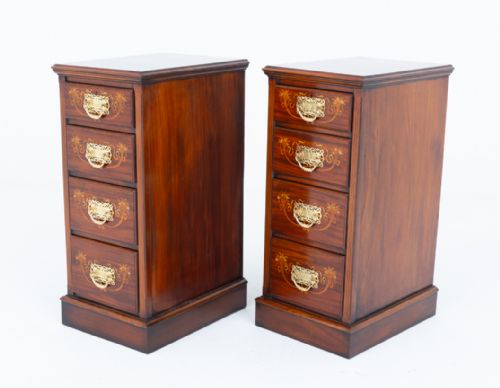


Edwardian Marquetry Bedside Cabinet
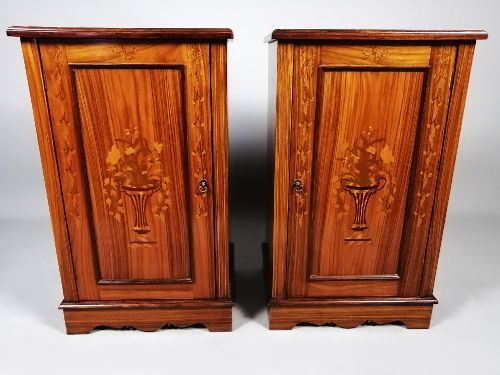
These edwardian marquetry bedside cabinet pieces combine timber with delicate inlay to hold bedside essentials in style.
Edwardian Marquetry Bedside Cabinet
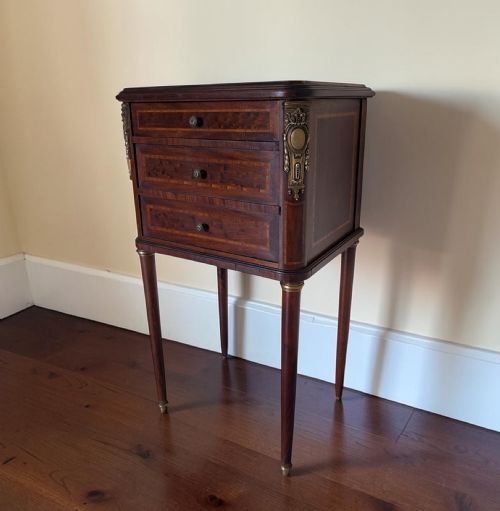
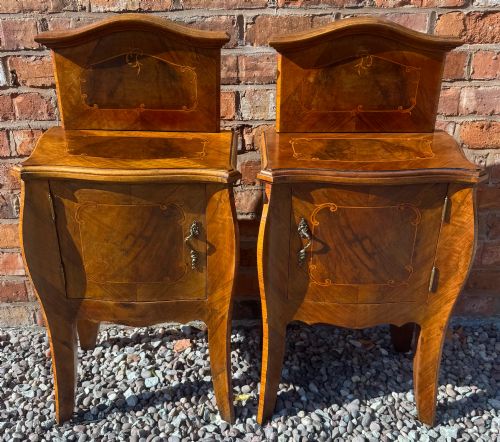
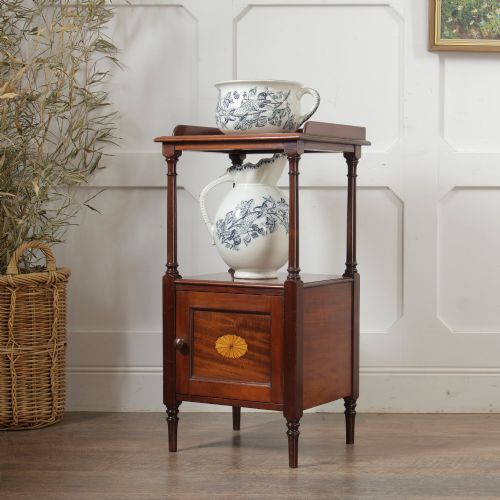
An edwardian marquetry bedside cabinet serves as a small bedside cupboard or table designed for storage next to a bed. The selection includes single cabinets, pairs, and related forms like bedside chests and side cabinets.
The objects span late Victorian, Edwardian, and early twentieth-century periods, alongside Sheraton Revival and Neo-Classical Revival styles. Mahogany, satinwood, and rosewood form the primary bodies of these small storage items.
How they were made
Cabinet makers utilised dense hardwoods such as mahogany, rosewood, and satinwood, often incorporating brass hardware and glass elements. Carcasses were constructed using traditional joinery methods suited to small-scale case furniture.
Marquetry decoration relied on contrasting timber veneers and stringing, including boxwood inlay, fitted into the primary wood surface. These decorative veneers created floral, classical, or geometric motifs across doors and drawer fronts.
Listings feature mahogany, satinwood, rosewood, and walnut woods across Edwardian, Victorian, and revival periods.
What varies in quality
The refinement of the marquetry and the choice of timbers define the upper tier of pieces. Finely figured satinwood or rosewood combined with intricate boxwood inlay marks out superior examples.
Construction details such as timber selection for secondary woods and the precision of the cabinet work distinguish standard production from exceptional workshop output.
Edwards and Roberts·Gillows
The Edwardian Marquetry Bedside Cabinet Glossary
- Marquetry
- Decorative patterns formed by the insertion of pieces of veneer into a wood base. This technique allows for complex pictorial or geometric designs.
- Satinwood
- A durable, lustrous timber native to India and Ceylon with a yellowish sheen. It frequently serves as a primary wood or a contrasting veneer.
- Pot cupboard
- A nineteenth century term for a small bedside cabinet containing a shelf or compartment for a chamber pot. They frequently double as general bedside storage today.
- Stringing
- Thin lines of contrasting wood inlay used to outline panels, drawers, or tabletops. It adds linear definition to case furniture.
Edwardian Marquetry Bedside Cabinet: Frequently Asked Questions
What is an edwardian marquetry bedside cabinet?
It is a small bedroom storage unit featuring decorative wood veneer patterns, produced during the Edwardian period or surrounding decades.
These cabinets usually include a single door or drawers to hold personal items beside a bed.
How do I care for inlaid wood?
Keep the timber away from direct sunlight and radiators to prevent the delicate veneer from drying out or lifting.
Apply a traditional wax polish occasionally to nourish the surface and maintain the sheen of the timber.
Are pairs common in these cabinets?
Matched pairs appear frequently among the listings, often matching twin beds or larger master bedrooms.
Finding a true pair requires checking that the timber grain and inlay patterns correspond closely across both pieces.
What timber was typically used?
Mahogany, satinwood, and rosewood form the main structural and decorative woods for these cabinets.
Craftsmen combined these dark and light timbers to make the marquetry designs stand out clearly.