


Edwardian Maritime Landscape
Edwardian maritime landscape works capture coastal scenes and harbour views through oils and watercolours produced around the turn of the twentieth century.
Edwardian Maritime Landscape
An edwardian maritime landscape encompasses coastal views, harbour scenes, and river vistas produced during the early twentieth century. These works record busy fishing ports, quiet estuaries, and coastal shipping around Britain and beyond.
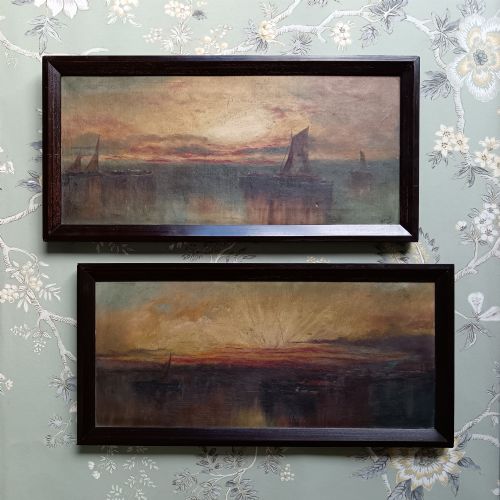
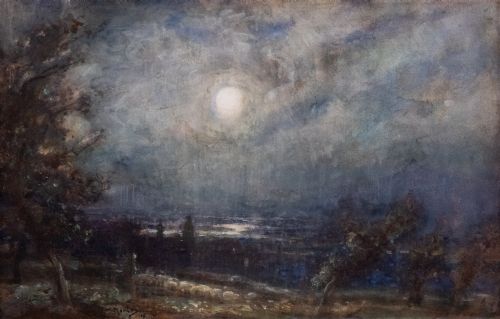
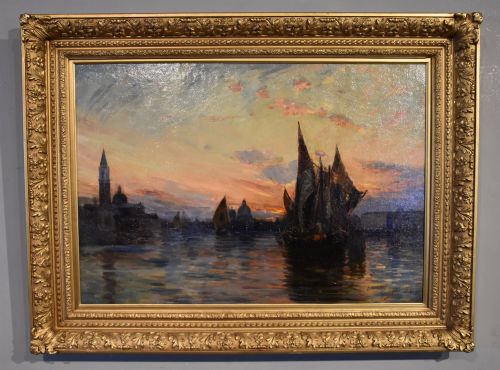
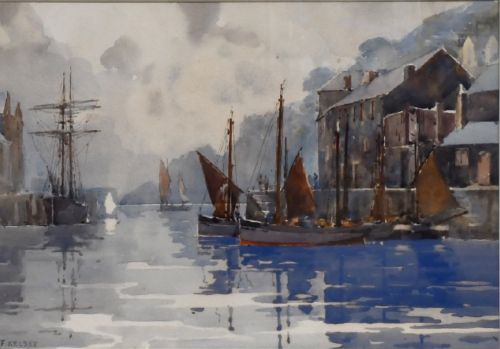
Watercolours on paper and oil paintings on canvas form the core of what appears in this selection. Buyers frequently encounter coastal watercolours from regional artists alongside framed oil paintings depicting sunrise, sunset, and moonlight over water.
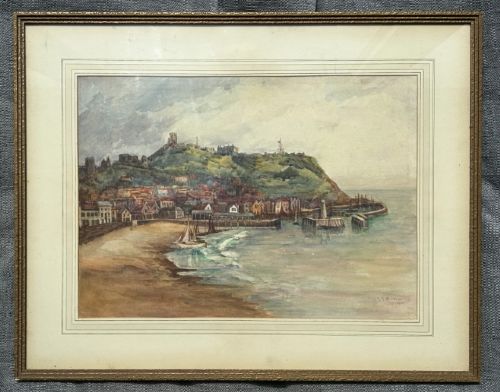
The objects span periods from the late nineteenth century into the 1930s, though the Edwardian era dominates the visual style. Scenes range from detailed topographical views of Yorkshire harbours to impressionistic beach settings.
How they were made
Artists utilised watercolour pigment on paper or oil paint on canvas, sometimes working on board. Watercolours often relied on washes to capture changing coastal light, while oils on canvas allowed for heavier impasto in choppy seas.
Framed works frequently employed glass to protect delicate watercolours, while oil paintings on canvas remained unglazed within decorative wood frames. Support materials included stretched canvas, paper sheets, and wooden panels.
Early twentieth-century makers occasionally bypassed paint entirely, assembling intricate coastal dioramas from ordinary seashells.
What varies in quality
Quality rests upon the artist's ability to handle atmospheric light and movement in water. Stronger examples display confident brushwork and accurate perspective in rendering ships, architecture, and tidal conditions.
Condition of the paper or canvas dictates the desirability of a piece. Works retaining their original colour without excessive fading or foxing represent the higher end of the range.
Thomas William Morley·Hector Caffieri·William Matthison·Thomas Hodgson Liddell·Frank Kelsey·Alfred George Morgan·Pieter Cornelis Dommersen·Edward Henry Eugene Fletcher·Fred Waugh·James Watson·George Hamilton Constantine·John Bell·James Webb·Leslie Rackham·H.E. Tidmarsh·E Tucker·Percy Brooke·Walter Duncan·William Lambert Bell·William Kay Blacklock·John McDougal·Frank Wood·Frank W. Scarborough·Harry Wanless·H. Hadfield Cubley
The Edwardian Maritime Landscape Glossary
- Watercolour
- A painting method where fine pigment is suspended in a water-based solution on paper. This technique yields translucent washes suited to coastal skies.
- Oil on canvas
- Pigment mixed with drying oil applied to stretched woven fabric. This medium provides rich textures and deep tones for marine scenes.
- Shadow box
- A deep, glass-fronted framed display containing three-dimensional objects. Examples in this field include shell dioramas.
- Impressionism
- An artistic approach focusing on light and everyday subjects rather than strict academic detail. British adaptations of this style appear across several coastal works.
Edwardian Maritime Landscape: Frequently Asked Questions
What periods do these landscapes cover?
The works primarily date from the Edwardian era, alongside pieces from the late Victorian period and the early decades of the twentieth century. Artists working during these decades recorded coastal and harbour scenes across Britain.
While the core output aligns with nineteen-hundred to nineteen-thirty, stylistic influences extend back into nineteenth-century British fine art traditions.
Are these paintings signed by the artists?
Many examples feature signatures or initials from the period artists who painted them. Signatures frequently appear in the lower corners of watercolours and oil paintings.
Attributions also rely on historical records linking specific topographical views, such as Whitby or St Ives, to known regional artists.
What subjects appear most often?
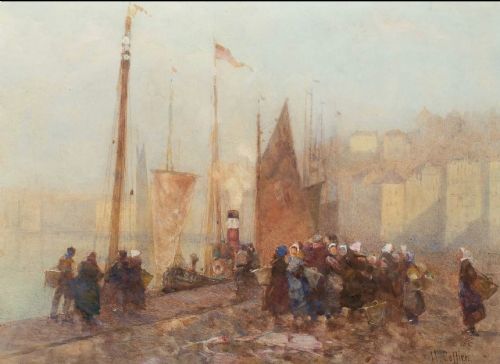
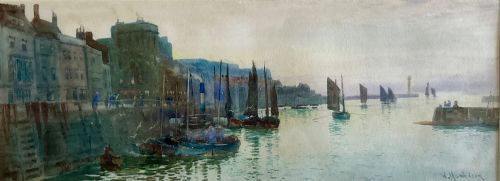
Harbour scenes, fishing boats bringing in the catch, and coastal cliffs dominate the selection. Locations range from Yorkshire ports like Whitby and Staithes to the River Thames in London.
Works also depict broader seascapes, Venetian evening light, and impressionistic beach settings.
How should framed watercolours be displayed?
Watercolours require protection from direct sunlight to prevent fading of the pigments on paper. Framing behind glass with conservation-grade mounts preserves the surface condition.
Keeping these pieces away from damp environments ensures the paper and wooden frames remain stable over time.