
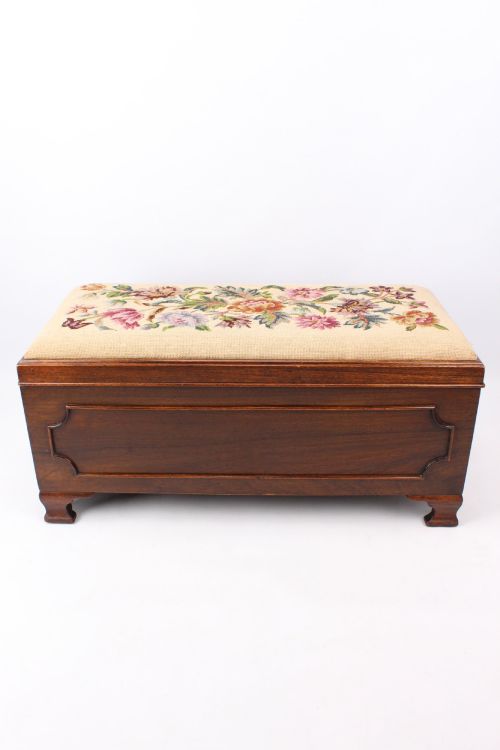
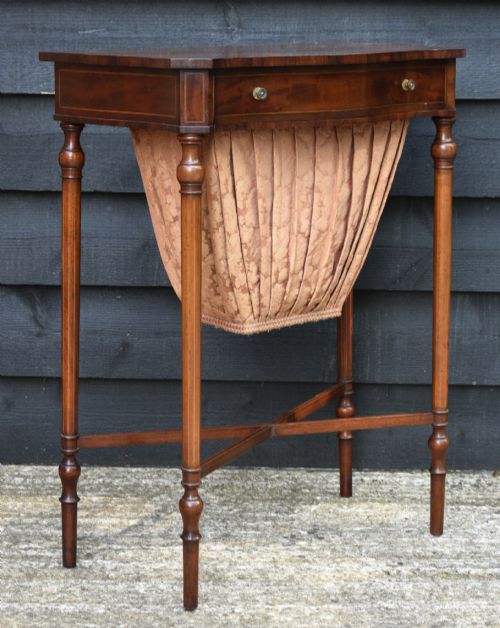
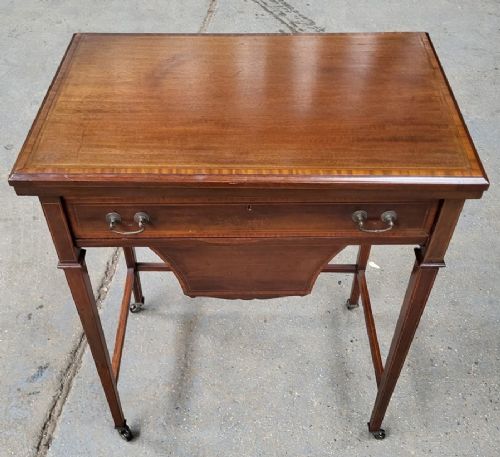
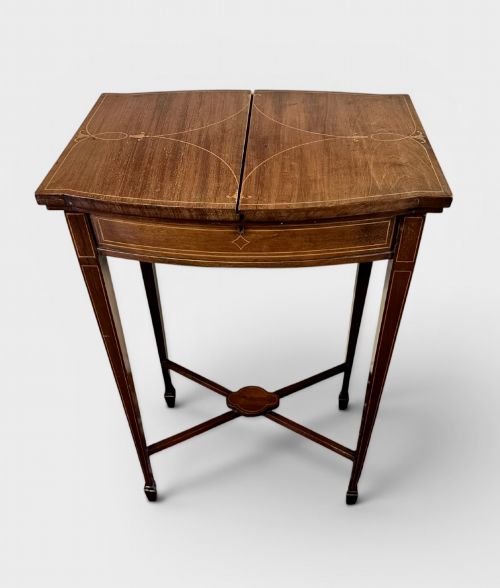
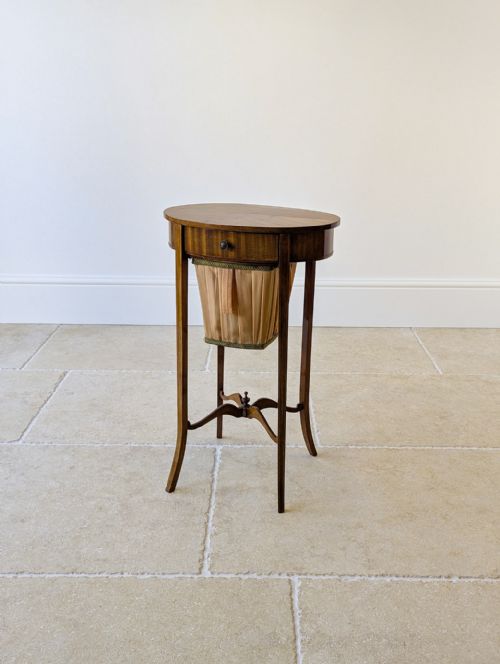
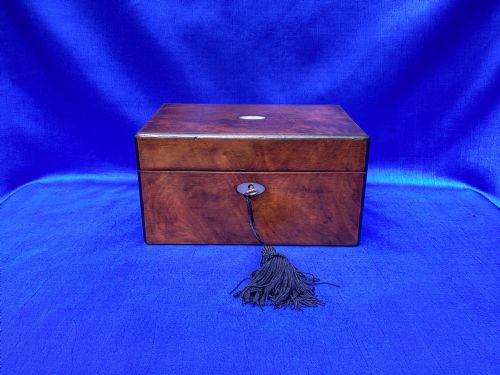


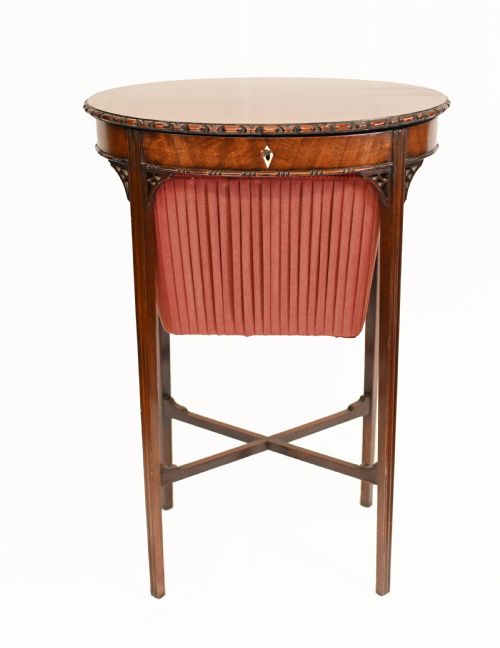
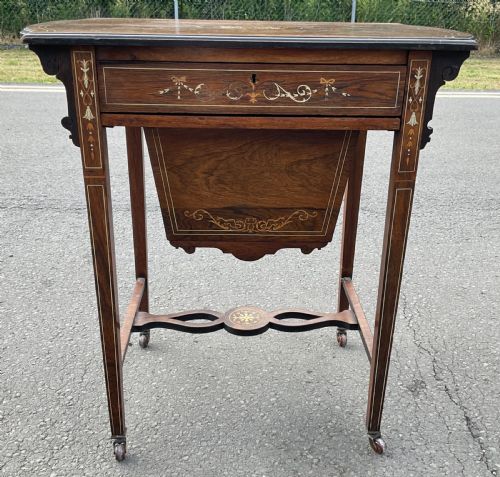

Edwardian Mahogany Needlework Box
These edwardian mahogany needlework box items are practical sewing companions and decorative occasional pieces that bring refined timber work to a sitting room.
Edwardian Mahogany Needlework Box
An edwardian mahogany needlework box encompasses various sewing tables, work tables, and fitted boxes designed for domestic textile crafts. The pieces encountered here span primarily from the Edwardian period into the Victorian and Regency eras, with forms ranging from octagonal lamp tables and ottomans to side tables and folding sewing tables.
Most examples date from the Edwardian period around nineteen hundred to nineteen ten, often featuring inlaid boxwood and satinwood details alongside fitted interiors. Buyers frequently find dual-purpose items such as games tables and work boxes combined into a single compact footprint.
Earlier nineteenth century iterations provide simpler architectural lines, while Sheraton Revival and William Fourth influences appear across the broader selection of mahogany needlework furniture.
Materials and construction
Makers utilised solid mahogany and mahogany veneers as the primary timber carcass, frequently incorporating contrasting boxwood and satinwood inlay or shell motifs to enrich the surfaces. Cross banding and flame mahogany grains are common decorative treatments on the lids and tabletops.
Internal fittings rely on intricate small-scale compartments, trays, and silk baskets designed to organise threads, needles, and fabric scraps. Structural additions such as brass hinges, locks, and handles complete the operational hardware of these sewing pieces.
Listings feature mahogany as the principal timber, supplemented by satinwood, boxwood inlay, and brass hardware.
Factors determining quality
Superior examples distinguish themselves through finer timber selection, such as distinct flame mahogany figuring and precise boxwood stringing, rather than plain surfaces. The complexity of the internal fitted compartments and the survival of original silk baskets or textile linings elevate a piece significantly.
Proportion and scale dictate the desirability of sewing furniture, with smaller, more delicate proportions commanding greater attention than heavier forms. Clean joinery, intact brass hardware, and the crisp execution of serpentine or octagonal shapes indicate superior cabinetmaking skill.
The Edwardian Mahogany Needlework Box Glossary
- Cross banding
- A strip of veneer running perpendicular to the grain of the main surface, often bordering the top of a sewing table.
- Boxwood inlay
- Light-coloured wood inserted into recesses of a darker timber background to create geometric lines or decorative motifs.
- Serpentine
- A furniture front or tabletop shaped with a central convex curve flanked by two concave curves.
- Work table
- A specialised domestic table containing drawers, compartments, or hanging bags for sewing and needlework implements.
- Sheraton Revival
- A late nineteenth and early twentieth century design style drawing on the lighter neoclassical forms of the eighteenth century.
Edwardian Mahogany Needlework Box: Frequently Asked Questions
What is an edwardian mahogany needlework box used for?
These pieces served as dedicated repositories for sewing threads, needles, and textile projects while functioning as decorative tables in sitting rooms.
Today, owners utilise the compartments for small personal storage or display them purely as occasional and lamp tables.
How do I distinguish an Edwardian table from a Victorian one?
Edwardian sewing tables generally exhibit lighter proportions, brighter mahogany tones, and delicate boxwood or shell inlay reflecting Sheraton Revival tastes.
Victorian counterparts tend to be heavier and darker in timber hue, often relying on simpler turned supports rather than inlaid decoration.
Do these tables still contain their original fittings?
Many surviving examples retain their compartmentalised wooden trays and interior lids designed to keep sewing tools organised.
Fabric elements like silk baskets are more prone to wear and replacement over time, though original textile components do survive on well-preserved pieces.
Can I use a sewing table as a regular side table?
The flat top surfaces and sturdy mahogany construction make these pieces entirely suitable for everyday placement beside a sofa or chair.
The enclosed storage beneath simply provides the added benefit of concealing clutter.