



Edwardian Mahogany Desk Mirror
These edwardian mahogany desk mirror pieces combine warm timber and bright plate, offering a practical touch of period elegance for any writing surface.
Edwardian Mahogany Desk Mirror
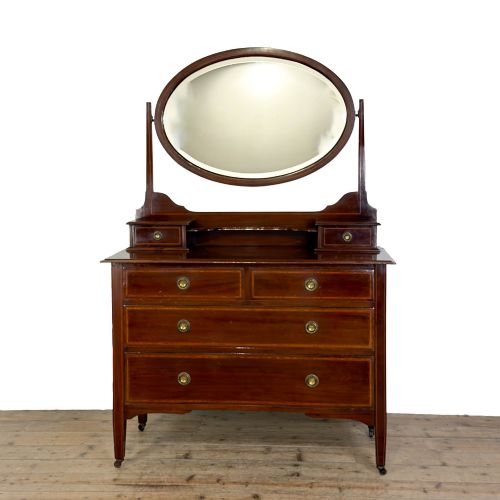
When you search for an edwardian mahogany desk mirror, you encounter pieces designed to sit upon writing surfaces, dressing chests, and tables. The selection ranges from dedicated small dressing mirrors to the pivoting plates mounted atop larger Edwardian and late Victorian dressing tables.
Most examples date from the Edwardian period and the late Victorian era, often reflecting Sheraton Revival or simpler vernacular tastes. They serve both a functional purpose for grooming or writing and a decorative role within a room scheme.
Materials and construction
Makers utilised solid mahogany and mahogany veneers, occasionally selecting satinwood for contrasting inlay work and decorative banding. Brass fittings, including pivoting screws and small support arms, secure the mirror frame to its upright supports.
The glass plate sits within a swing frame, supported by upright arms attached either to a box base fitted with small drawers or directly to the top of a larger dressing chest.
Several pieces double as secret writing spots where a stray hairpin or love letter easily hides behind a miniature drawer.
Distinctions in quality
Quality rests in the crispness of the inlay, the selection of figured mahogany timber, and the substantial weight of the brass hardware used to secure the mirror plate. Finer examples display meticulous joinery and balanced proportions rather than plain, utilitarian construction.
The condition and clarity of the mirror glass, alongside the integrity of the original polish, separate standard workshop output from pieces bearing the marks of established cabinet makers.
Maple & Co·Edwards & Roberts·Jas Shoolbred
The Edwardian Mahogany Desk Mirror Glossary
- Edwardian
- Dating roughly from the reign of Edward VII, marked by lighter furniture forms and revived eighteenth-century styles. This period produced many of the refined dressing pieces found on this page.
- Sheraton Revival
- A style popular around nineteen hundred that echoes the classical symmetry and delicate inlay associated with eighteenth-century designer Thomas Sheraton.
- Shield mirror
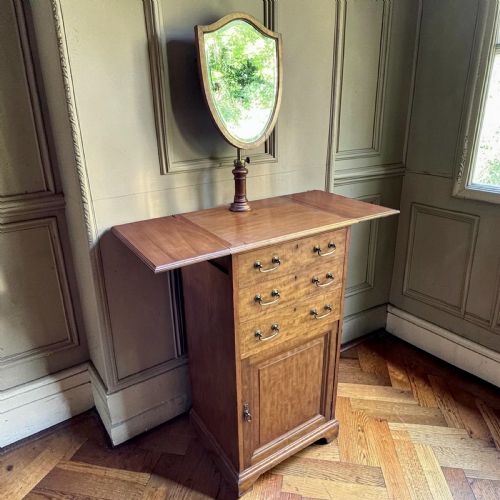
- A mirror plate cut into the outline of a heraldic shield, frequently mounted on pivoting pins within a dressing chest superstructure.
- Satinwood inlay
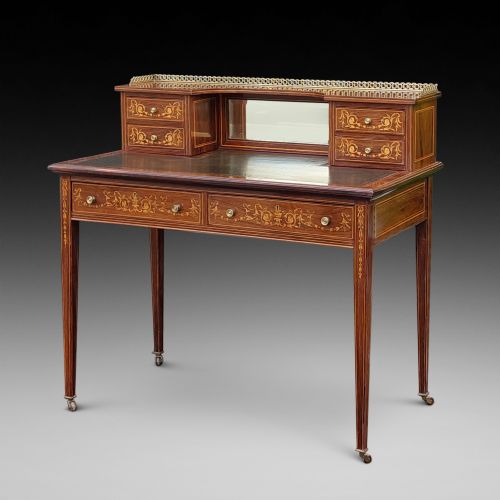
- Contrasting pale timber inserted into the darker mahogany surface to create geometric lines, bellflowers, or urn motifs.
- Bonheur du jour
- A light ladies writing desk featuring a small set of drawers and compartments above the main writing surface.
Edwardian Mahogany Desk Mirror: Frequently Asked Questions
How do I date an edwardian mahogany desk mirror?
Examine the timber species, the style of any inlay work, and the construction methods used on the drawers or base. Edwardian pieces typically display lighter proportions and refined satinwood details compared to earlier Victorian examples.
Hardware such as brass screws and hinge fittings also offer clues to the period of manufacture, though replacements can occur over time.
Are these mirrors fixed or adjustable?
Most examples feature a swing frame mounted on two vertical posts with adjustable brass thumbscrews. This allows the user to tilt the glass plate to the desired angle.
Some designs sit within a small box base containing miniature drawers, while others form part of a larger dressing table superstructure.
What is Sheraton Revival style?
Sheraton Revival refers to late nineteenth and early twentieth-century furniture that copies the lighter, neoclassical designs of the seventeen nineties. It relies on mahogany veneers, satinwood banding, and tapered supports.
Pieces in this style often present a refined, elegant appearance well suited to polite drawing rooms and bedrooms.
How should I care for the mahogany timber?
Keep the wood away from direct heat sources and strong sunlight to prevent the mahogany polish from fading or drying out. Dust regularly with a soft, dry cloth and avoid silicone-based sprays.
Periodic application of a traditional beeswax feed helps maintain the natural lustre of the polished surface.