
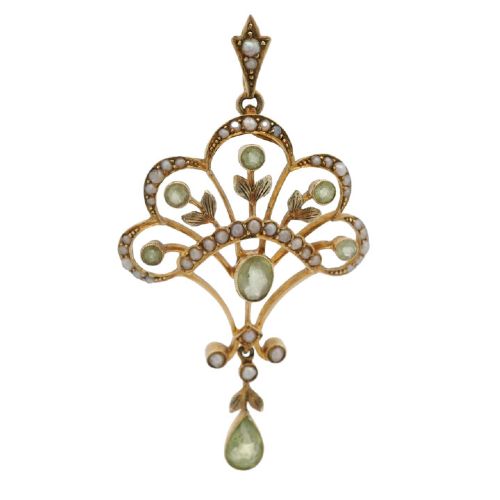


Edwardian Green Drop Necklace
An edwardian green drop necklace brings together vibrant peridot stones and delicate pearl work in pieces defined by the graceful lines of the early twentieth century.
Edwardian Green Drop Necklace
When you search for an edwardian green drop necklace, you encounter pendant designs that span the Edwardian era, the late Victorian period, and the early twentieth century. The prevailing form on this page is the drop pendant or lavalier, suspended from a delicate chain, where a central green stone hangs as the primary focal point.
Peridot is the most frequent green stone seen in these listings, often paired with seed pearls and set in fifteen-carat yellow gold, nine-carat gold, or silver. Alongside peridots, pieces feature emeralds, aquamarines, chrysoprase, and green paste stones, reflecting the diverse material choices of makers working around nineteen hundred.
The aesthetic of an edwardian green drop necklace draws heavily from Art Nouveau and Arts and Crafts design movements. These stylistic influences manifest in flowing natural motifs, silver wirework, and enamel elements that frame the central green drops with considerable artistry.
How they were made
Goldsmiths and silversmiths constructed these pendants using fifteen-carat yellow gold, nine-carat gold, sterling silver, and platinum. Metalwork techniques combined delicate wire framing with cast elements, often incorporating openwork settings to let light pass through the transparent green stones.
Seed pearls were meticulously drilled and wired or glued onto gold and silver frames, accentuating the central drops. Enamelling techniques, including plique-à-jour, appeared alongside hand-cut peridots, garnets, and paste stones to add rich colour and texture to the pendant bodies.
Some Edwardian green drop necklaces secretly double as brooches, letting a wearer pin the pendant to a lapel when the chain grows tired.
What varies in quality
Quality in these pieces rests upon the choice of materials and the finesse of the metalwork. Pendants featuring solid fifteen-carat gold or platinum alongside well-matched peridots and natural pearls sit at the higher end of the range, showing superior weight and structural integrity.
The reputation of the workshop also defines the upper tiers, with pieces bearing the marks of known makers exhibiting finer chasing, cleaner enamel work, and more thoughtful stone selection. Simpler nine-carat gold or silver iterations with paste stones or cultured pearls represent more accessible examples of the period style.
Murrle Bennett·Liberty and Co·Arthur and Georgie Gaskin·Charles Horner·Theodor Fahrner
The Edwardian Green Drop Necklace Glossary
- Lavalier
- A pendant featuring a drop suspended below the main body, popular during the Edwardian and Art Nouveau periods. This design often incorporates swinging stone elements that catch the light with movement.
- Peridot
- A yellowish-green gemstone favoured by jewellers of the early twentieth century. It serves as the primary green stone in the majority of Edwardian pendant designs.
- Seed Pearl
- A very small, naturally occurring pearl used extensively as an accent material in cluster settings and border work. These tiny pearls add a soft luminescent contrast to bright peridots and gold.
- Plique-à-jour
- An enamelling technique where enamel is applied in cells without a backing, resembling miniature stained glass. This method allows light to shine directly through the translucent coloured glass.
Edwardian Green Drop Necklace: Frequently Asked Questions
How do I date an edwardian green drop necklace?
Dating relies on hallmarks, metal purity standards, and stylistic markers such as fluid Art Nouveau curves or geometric Edwardian symmetry. Examining the clasp type and the cut of the stones also helps narrow down the decade of production.
Makers' marks stamped onto the reverse of the metal provide the most reliable evidence for dating a specific piece. Comparing construction methods against known examples from the same period confirms the timeline.
What is the difference between peridot and emerald?
Peridot possesses a distinct yellowish-green hue and was widely used in affordable and mid-tier Edwardian jewellery. Emerald exhibits a deeper, more bluish-green tone and generally appears in higher-value pieces alongside diamonds.
Both stones occupy the green drop pendants on this page, but they create entirely different visual impacts. Peridots offer a sunny warmth, whereas emeralds present a cool, intense saturation.
How should I care for seed pearl jewellery?
Seed pearls are organic gems that are sensitive to acids, cosmetics, and moisture. Clean them gently with a soft, dry cloth after wearing and avoid submerging the pendant in liquid cleaning solutions.
Store the necklace flat in a dedicated box to prevent the fine silk or wire stringing from stretching. Keeping pearls away from perfumes and hairspray preserves their natural lustre over time.
Can I wear an edwardian necklace every day?
While these pieces were built with considerable craftsmanship, their age requires mindful wear. Delicate seed pearls and fine gold chains benefit from careful handling rather than rugged daily use.
Reserving the necklace for special occasions protects the antique settings and fragile stone arrangements. Regular checks by a jeweller ensure the prongs holding the green drops remain secure.