



Edwardian Chippendale Chest
An edwardian chippendale chest brings together eighteenth-century revival proportion and solid timber construction for practical bedroom storage.
Edwardian Chippendale Chest
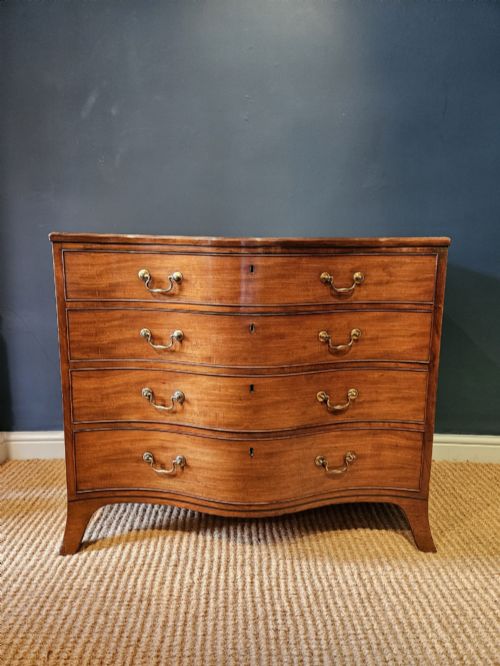
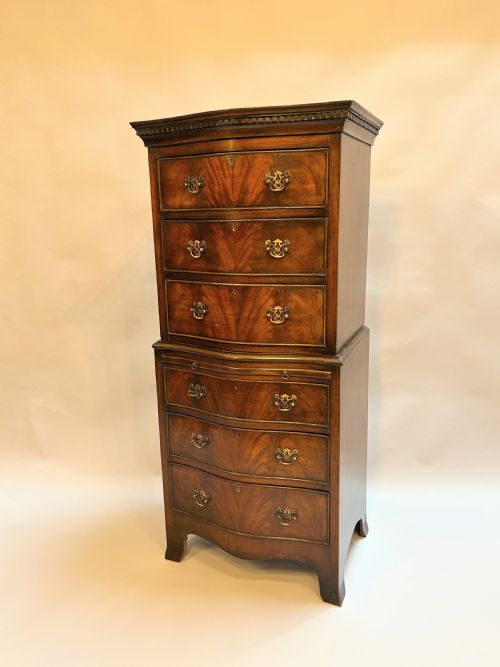
The edwardian chippendale chest category encompasses both authentic eighteenth-century George III pieces and their later Edwardian and revival reproductions. Buyers encounter serpentine fronts, tallboys, bow fronts, and dwarf chests on stands across these periods.
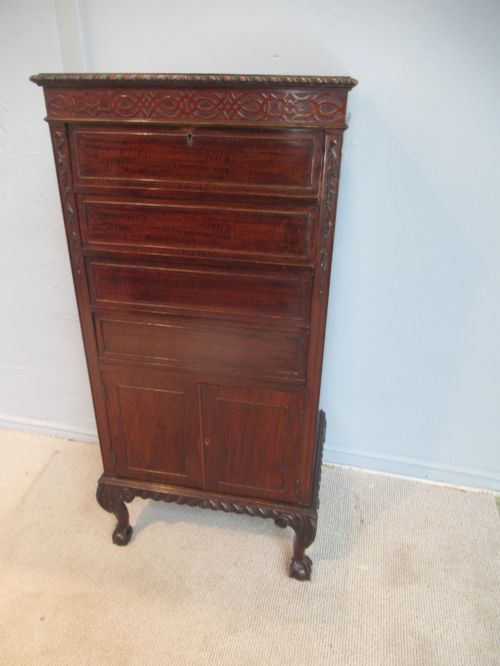
Mahogany predominates as the primary timber, occasionally complemented by brass hardware and oak secondary woods. Pieces range from simple chests of drawers to specialised forms like music cabinets, cellarettes, and dressing chests.
Materials and Construction
Cabinetmakers utilised solid mahogany and mahogany veneers over secondary timbers such as oak, building carcases designed to withstand decades of daily use. Drawer construction relies on traditional dovetail joints, reflecting standard workshop practices of the period.
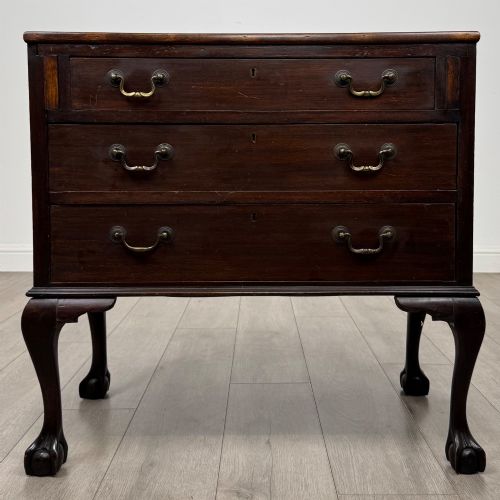
Brass handles, escutcheons, and ball and claw feet provide both structural accent and decorative detail. Surfaces finished with traditional polishing methods highlight the grain and rich colour of the mahogany.
Listings feature mahogany as the predominant material alongside oak, brass, and glass across Georgian and Edwardian periods.
Distinguishing Quality
Superior examples distinguish themselves through crisp carving on details such as ball and claw feet and serpentine drawer fronts. The crispness of the drawer dovetails and the choice of well-figured mahogany timber elevate the standing of a piece within the range.
Proportion and balance define the better pieces, whether dealing with a tallboy, a bachelor's chest with a sliding shelf, or a dwarf chest on a stand. Lesser pieces exhibit simpler secondary woods and less articulate execution of revival styles.
Waring and Gillows
The Edwardian Chippendale Chest Glossary
- Serpentine front
- A front configuration curving outward in the centre and inward at the sides, demanding high skill from the cabinetmaker.
- Tallboy
- A tall chest of drawers, often constructed in two sections with a smaller chest stacked upon a larger base.
- Brushing slide
- A pull-out shelf integrated above the top drawer, traditionally utilised for folding clothes or writing.
- Cellarette
- A fitted cabinet designed for holding bottles, appearing in mahogany across several periods.
- Dovetail
- An interlocking corner joint formed by wedge-shaped fingers, ensuring durable drawer construction.
Edwardian Chippendale Chest: Frequently Asked Questions
How do I use a brushing slide?
The brushing slide pulls out from just beneath the top surface or drawer, serving as a temporary shelf. It was traditionally used for folding garments or placing items while dressing.
In modern rooms, it functions well as a compact writing ledge or display space when extra surface area is needed.
What is a tallboy?
A tallboy is a vertical chest of drawers, frequently built as two distinct sections stacked together. This form maximises storage capacity while occupying a smaller floor footprint.
They appear in both eighteenth-century workshops and later revival periods, often utilising figured mahogany.
How do I identify Edwardian revival pieces?
Edwardian revival pieces replicate earlier George III and Chippendale styles, utilising mahogany and brass hardware. They combine historical design motifs with turn-of-the-century manufacturing techniques.
Examining the secondary timbers and interior construction helps distinguish these early twentieth-century interpretations from eighteenth-century originals.