
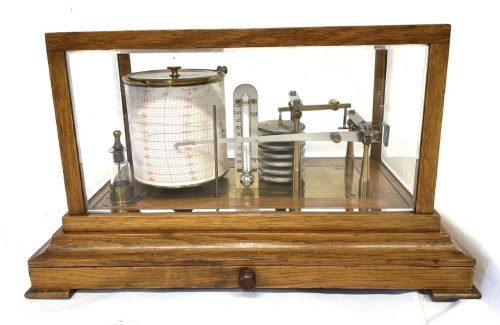
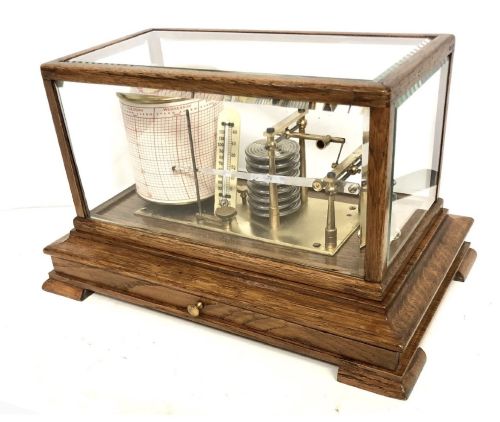


Edwardian Barograph Chart Drawer
An edwardian barograph chart drawer is a sophisticated meteorological instrument housed in a timber case, prized by collectors for recording atmospheric pressure alongside a neat storage compartment.
Edwardian Barograph Chart Drawer
An edwardian barograph chart drawer combines a recording barometer mechanism with a dedicated base compartment designed to hold spare paper charts and ink bottles. The examples appearing on this page span the Victorian, Edwardian, and early twentieth-century periods, capturing a time when domestic weather recording was both a science and a household pursuit.
Makers and retailers represented across these pieces range from specialised scientific instrument makers to prominent London department stores. While the mechanical movements measure atmospheric pressure continuously, the inclusion of the chart drawer provides a practical and self-contained archive for daily meteorological records.
Materials and construction methods
Cabinetmakers constructed the protective housings primarily from solid and veneered oak or mahogany, frequently utilising figured grains to display a rich surface finish. Bevelled glass panels were set into the wooden frames to enclose the delicate mechanical assembly while offering an unobstructed view from multiple angles.
The internal recording mechanisms rely on brass linkages and steel springs connected to evacuated metal aneroid chambers that respond to changes in air pressure. Paper charts printed for recording purposes were held on rotating drums driven by clockwork movements, while auxiliary instruments like thermometers were mounted using cast metal frames.
A tiny spare ink bottle tucked inside the chart drawer remains the ultimate survival from a century of weather watching.
Distinctions in quality and finish
Quality in these instruments is largely determined by the refinement of the cabinetwork and the reputation of the maker inscribed upon the bedplate or dial. Finely executed mahogany and oak cases with tight joinery and well-fitted chart drawers sit at a higher level than simpler utilitarian housings.
The precision and finish of the internal brass components and clockwork movements further differentiate the standard of production. Instruments retailed by established scientific houses or prominent stores often display superior engraving and more robust mechanical assemblies.
SHORT & MASON, LONDON·CASELLA LONDON·HARRODS OF LONDON·Negretti & Zambra
The Edwardian Barograph Chart Drawer Glossary
- Barograph
- A self-recording barometer that plots atmospheric pressure over time onto a paper chart. It uses stacked metal diaphragms connected to a recording arm.
- Aneroid
- Operating without liquid. This describes barometers and barographs that measure pressure using expanding and contracting metal chambers.
- Bevelled glass
- Glass panes with polished, angled edges fitted into the cabinet frame. This technique adds depth and a refined finish to the viewing windows.
- Bedplate
- The flat metal plate that supports the recording mechanism and drum. It often carries the signature or retailer name of the instrument.
Edwardian Barograph Chart Drawer: Frequently Asked Questions
What is an edwardian barograph chart drawer?
An edwardian barograph chart drawer is a mechanical weather-recording device housed in a wooden cabinet with a built-in storage compartment for paper records. These instruments measure air pressure continuously and ink the data onto rotating charts.
The inclusion of the drawer provides a neat base to keep spare charts and accessories close to the instrument. Such pieces reflect the domestic scientific interests of the early twentieth century.
How do these barographs work?
The mechanism relies on aneroid chambers that expand and contract with shifts in atmospheric pressure. These movements transfer through brass levers to an inked arm that traces a line onto the rotating drum.
A clockwork mechanism inside the drum turns the paper cylinder once a week or once a day. The user simply changes the paper chart at regular intervals to maintain a continuous weather record.
What materials are the cases made from?
The exterior housings are built primarily from oak or mahogany, chosen for their durability and attractive grain patterns. Many examples feature multiple glass panels held in wooden frames to protect the delicate interior.
Inside the case, the mechanical parts combine polished brass, steel springs, and paper charts. Some models also incorporate mounted brass thermometers finished with silvered scales.
How do I date these instruments?
Dating relies on stylistic details of the wooden case, maker signatures, and mechanical variations. Edwardian and Victorian pieces often show specific cabinet proportions and characteristic brass hardware.
Engraved signatures on the bedplate or retailer marks on the paper drums help narrow the period of manufacture. Surviving labels and retailer names provide further historical context.
How do I care for a barograph?
Place the instrument in a stable environment away from direct sunlight, extreme temperature changes, and excessive moisture. The wooden case benefits from occasional light dusting and periodic polishing to preserve the finish.
Avoid disturbing the delicate brass linkages and glass panels unnecessarily. If the clockwork movement requires servicing, consult a professional clockmaker familiar with scientific instruments.