





Edwardian Barley Twist Armchair
An edwardian barley twist armchair brings character and turned woodwork into a room, offering sturdy seating built with traditional craft.
Edwardian Barley Twist Armchair
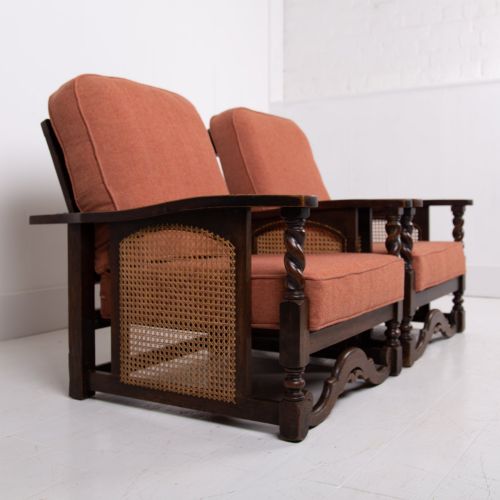
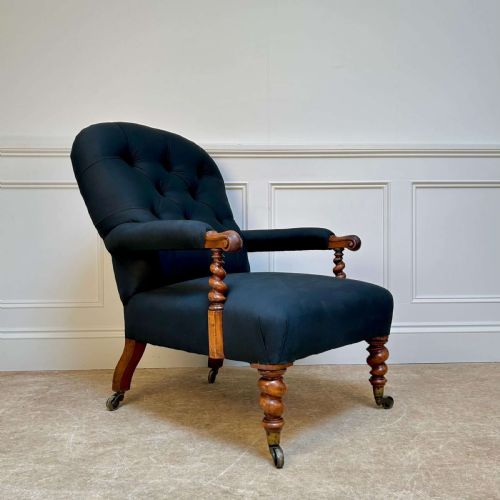
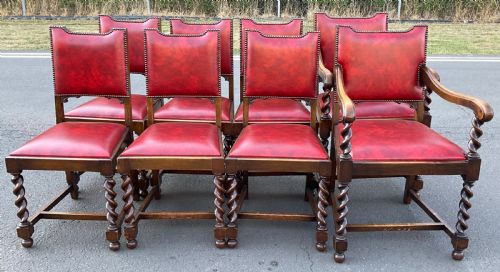
Most examples found here employ oak or walnut for their structural frames, often paired with cane, upholstery, leather, or fabric seats. Buyers encounter single chairs alongside pairs and larger sets, showing various forms of open framing, reclining mechanisms, and upholstered cushions.
How they were made
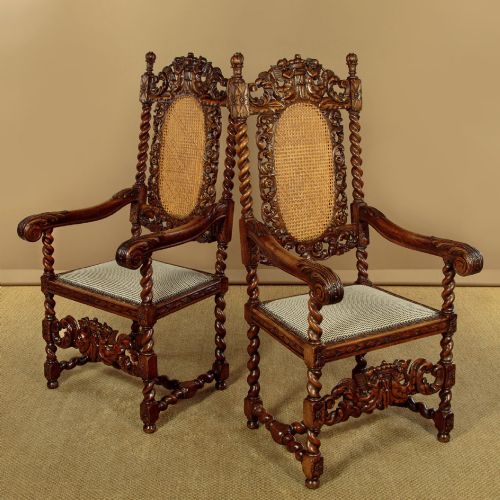
Joiners and cabinet makers shaped these frames using solid hardwoods such as oak, walnut, beech, and mahogany, applying lathe-turning techniques to produce the characteristic spiral or twist components. Structural stability relied on traditional mortise and tenon joinery combined with carved detailing on arms and stretchers.
Seating areas incorporate woven cane panels, known as bergere, or sprung upholstery covered in fabrics including velvet, leather, tapestry fabric, and modern replacement cushions. Brass fittings appear on reclining mechanisms and campaign elements, securing moving parts and folding frames.
Edwardian Barley Twist Armchair Retail Price Guide 2026
Typical asking prices for edwardian barley twist armchair among the pieces listed under this phrase on Sellingantiques today, from the lower quarter to the upper quarter. They describe what is for sale here now, not the wider market.
Listings feature armchairs, lounge chairs, and carver armchairs constructed from oak, walnut, beech, and mahogany, with cane and upholstery.
What varies in quality
The distinction between standard production and finer examples rests on the crispness of the turned barley twist carving and the quality of the timber selection. Heavier gauge oak and figured walnut frames demonstrate superior material choice compared to simpler utility builds.
The standard of upholstery work, the integrity of woven cane panels, and the preservation of original polish or patination determine the overall refinement of each piece. Retaining matching pairs or sets rather than single chairs also alters the character of the seating.
Hindley And Sons
The Edwardian Barley Twist Armchair Glossary
- Barley twist
- A spiral turning technique resembling a twisted rope, applied to furniture legs, uprights, and stretchers.
- Bergere
- A traditional French-style armchair featuring woven cane panels on the back and sometimes the sides.
- Carver armchair
- An armchair designed with arms, often wider than standard dining chairs and historically placed at the head of a table.
- Jacobean Revival
- A nineteenth and twentieth-century design style copying the heavy, carved oak furniture forms of the seventeenth century.
- Tub chair
- An armchair featuring a rounded, enclosed backrest that curves around to form the armrests.
Edwardian Barley Twist Armchair: Frequently Asked Questions
Are these chairs comfortable for daily use?
Many examples feature upholstered seats, padded cushions, or supportive cane backs designed for relaxation in living spaces or libraries.
Comfort levels vary depending on the depth of the seat and whether the piece is a dining chair, a lounge chair, or a reclining armchair.
How do I date an edwardian barley twist armchair?
Dating relies on stylistic clues, construction methods, and materials, with pieces spanning the Victorian period through the nineteen-thirties.
Revival styles often blend seventeenth-century turning techniques with the joinery practices of the early twentieth century.
What woods were used for these chairs?
Makers predominantly worked with oak and walnut for the structural frames, occasionally utilising beech, mahogany, and brass hardware.
Surface finishes include polished hardwood, exposed grain, and carved elements reflecting Jacobean and Renaissance revival influences.
Can I find matching pairs?
The selection frequently includes pairs of armchairs, library chairs, and carver armchairs alongside individual seating options.
Sets of dining chairs also appear, offering coordinated turned woodwork for larger rooms.