



Ecclesiastical Throne Armchair
An ecclesiastical throne armchair is a commanding seat rooted in church architecture, offering an imposing silhouette and historical presence that anchors a serious room.
Ecclesiastical Throne Armchair
An ecclesiastical throne armchair represents a distinct lineage of heavy seating designed for church, chapel or domestic hall use in a serious architectural taste. When you search for ecclesiastical throne armchair, you encounter robust seats shaped by nineteenth-century revivals of medieval design.
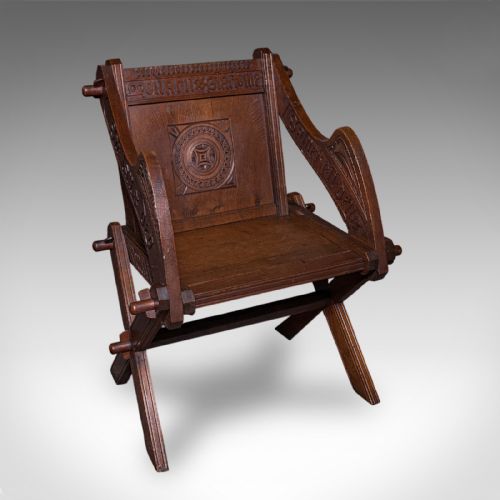
The pieces listed on this page span the Victorian and Edwardian periods, stretching from the late nineteenth century into the nineteen-twenties. They take the form of substantial armchairs, elbow seats and Glastonbury chairs carved from domestic timbers.
Origins vary across England, Scotland and Wales, with regional workshops producing both imposing chapel thrones and domestic carver chairs. Oak dominates the selection, accompanied by pitch pine and painted wood variants.
How they were made
Construction relies heavily on solid oak and pitch pine, selected for structural strength and a solemn appearance suitable for ecclesiastical use. Workshops utilised traditional joinery methods to build heavy frames capable of supporting elaborate Gothic carving and inscriptions.
Surfaces are often left as bare timber to show the grain, though some examples feature painted wood finishes or brass details. Upholstered elements incorporate fabric or leather inserts to provide function within the rigid wooden armature.
Ecclesiastical Throne Armchair Retail Price Guide 2026
Typical asking prices for ecclesiastical throne armchair among the pieces listed under this phrase on Sellingantiques today, from the lower quarter to the upper quarter. They describe what is for sale here now, not the wider market.
One listed Glastonbury chair comes complete with an antique inscription, proving that some nineteenth-century furniture makers loved a good backstory.
What varies in quality
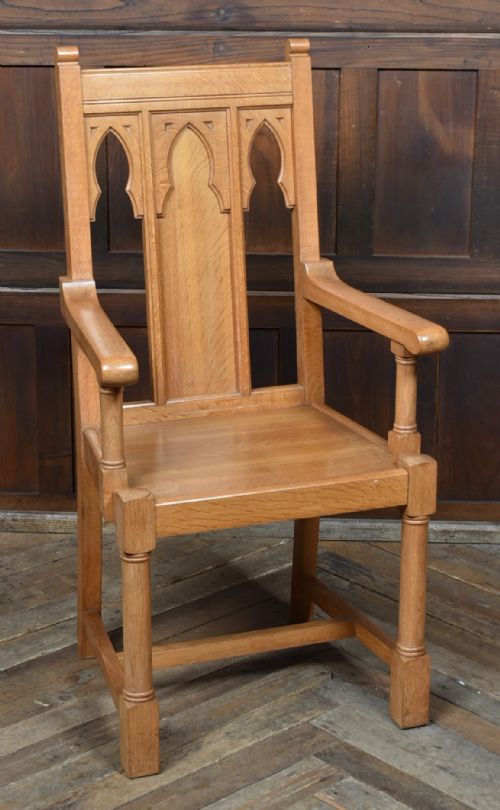
Quality rests upon the depth and crispness of the Gothic carving across the crest rail and panelled back. Pieces displaying hand-carved tracery and regional provenance command attention above plain vernacular examples.
The choice of timber and the integrity of the frame dictate durability. Dense English, Welsh or Scottish oak provides a superior foundation compared to lighter pine constructions, while surviving original inscriptions add significant character.
The Ecclesiastical Throne Armchair Glossary
- Gothic Revival
- A nineteenth-century architectural and decorative movement that emulates medieval forms, pointed arches and heavy ecclesiastical ornament. This aesthetic defines the primary style seen across the current selection.
- Glastonbury chair
- A specific nineteenth-century chair type based on an ancient relic, featuring an X-framed base and sloping arms. Several examples in oak appear within the current listings.
- Pitch pine
- A resinous North American softwood utilised in heavy Victorian furniture construction. It provides a durable alternative to oak with a distinct grain pattern.
- Carver armchair
- A traditional term for a sturdy wooden armchair, often placed at the head of a table or used as a hall seat. These pieces frequently incorporate ecclesiastical or Gothic revival motifs.
Ecclesiastical Throne Armchair: Frequently Asked Questions
How were these chairs used?
These chairs were primarily utilised by clergy or dignitaries during church services, meetings or academic ceremonies. In domestic settings, they functioned as hall chairs or formal carvers rather than everyday lounge seating.
Their upright backs and rigid wooden arms encouraged an authoritative posture. They were placed in prominent positions within a room to project status and tradition.
How do I live with an ecclesiastical armchair?
Living with these pieces involves acknowledging their considerable physical presence and weight. They function best as standalone focal points against plain walls or within large, high-ceilinged rooms.
Because of their sturdy timber frames and occasional fabric or leather upholstery, they require simple dusting and stable indoor humidity. Avoid placing them in direct sunlight to protect the aged wood finish.
How do I tell the periods apart?
Victorian examples often display heavy Gothic Revival ornament, deep oak carving and sometimes commemorative inscriptions. They tend to be exceptionally dense and dark in tone.
Later pieces extending into the Edwardian era and nineteen-twenty frequently show lighter painted wood finishes or simpler construction. Examining the timber type and style of the Gothic tracery helps clarify the date.