







Ecclesiastical Altar Sticks
These ecclesiastical altar sticks are substantial metal and wood lights from the nineteenth century that bring historic sacred presence into a room.
Ecclesiastical Altar Sticks
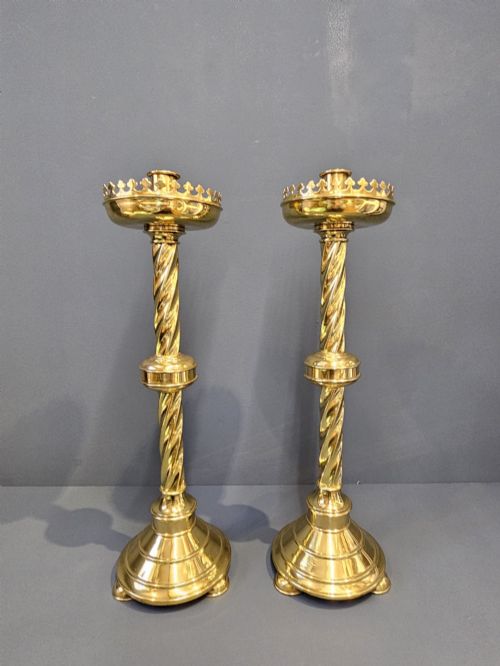
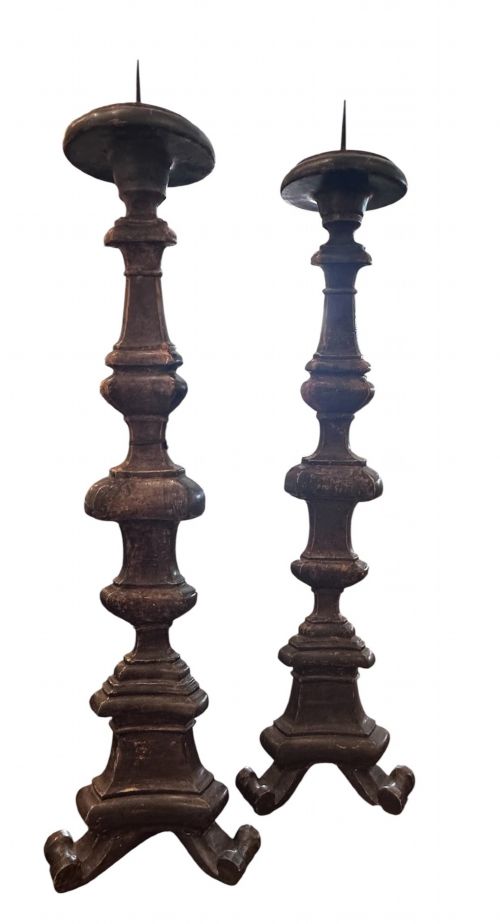
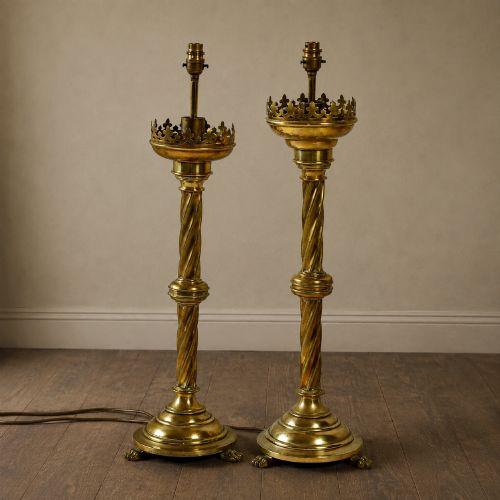
When you search for ecclesiastical altar sticks, you are looking at substantial devotional lighting from the nineteenth century that served in churches and chapels. These items take the form of tall candlesticks, pricket sticks with spikes for large candles, and occasional table lamps converted from older bases.
The versions you are most likely to meet on this page originate from Victorian Britain and continental Europe, spanning the nineteenth century from eighteen hundred onwards. They appear most frequently as matched pairs, fashioned for use on church altars before finding their way into domestic interiors.
Materials and construction
These pieces are built from cast brass, heavy iron, and carved wood, reflecting the robust requirements of ecclesiastical settings. Brass examples often utilise heavy casting techniques to support tall shafts and wide drip pans without tipping.
Wooden items rely on hand carving finished with gesso and silver leaf or gilt surfaces. Some variants incorporate fabric elements such as silk fringe, whilst others are adapted later into electrical table lamps.
Ecclesiastical Altar Sticks Retail Price Guide 2026
Typical asking prices for ecclesiastical altar sticks among the pieces listed under this phrase on Sellingantiques today, from the lower quarter to the upper quarter. They describe what is for sale here now, not the wider market.
Listings here feature nineteenth-century items in brass, carved wood, and iron, spanning styles from Gothic Revival to Italian Neoclassical.
Judging quality and character
The distinction between ordinary items and finer examples rests on the depth of the casting, the crispness of the Gothic Revival ornamentation, and the preservation of original gilding or silver leaf. Heavy brass work with intricate architectural moulding denotes superior workshop production.
Proportion and scale also separate standard pieces from monumental altar sticks. Taller pairs with substantial bases and unaltered pricket tops command greater presence and demonstrate more ambitious nineteenth-century design.
T Thomason And Co
The Ecclesiastical Altar Sticks Glossary
- Pricket stick
- A candlestick featuring a sharp metal spike at the top rather than a socket, designed to impale the base of a large wax candle. This form is traditional for church altars.
- Gothic Revival
- An architectural and decorative style prevalent during the nineteenth century that revived medieval pointed arches, trefoils, and ecclesiastical motifs. It dominates many brass and iron church candlesticks.
- Gesso
- A plaster-like mixture applied to carved wooden surfaces to provide a smooth base for gilding or silver leaf. It allows intricate relief details to be built up before finishing.
- Silver Leaf
- Extremely thin sheets of beaten silver applied to wooden cores to simulate solid silver objects. It develops a gentle tarnished patina over time.
Ecclesiastical Altar Sticks: Frequently Asked Questions
How were altar sticks used?
Altar sticks were placed upon church altars to hold large candles during services and ceremonies. Their height ensured the light illuminated the sanctuary.
Today, buyers use them as decorative floor or table pieces, sometimes converted into lamps while retaining their historic form.
How do I live with altar sticks?
Living with these pieces involves placing them on side tables, sideboards, or mantels where their height creates a strong vertical focal point. Paired examples work well framing a mirror or fireplace.
Keep them away from direct heat sources to protect historic wood finishes, gesso, and metal patinas.
How do I identify nineteenth-century styles?
Nineteenth-century altar sticks often display Gothic Revival details such as pointed arches, quatrefoils, and heavy brass mouldings. Italian and French pieces may lean towards Neoclassical or chateau styles with carved wooden leaves.
Examine the weight of the metal and the nature of any surface gilding or silver leaf to understand the period.