



Ebonised Wooden Framed Mirror
An ebonised wooden framed mirror brings dark contrast and architectural weight to a room, drawing the eye instantly.
Ebonised Wooden Framed Mirror
An ebonised wooden framed mirror combines deep, dark timber finishes with reflective glass, appearing primarily in wall and overmantel formats. These pieces emerge across nineteenth century, Victorian, and early twentieth century periods, reflecting diverse aesthetic movements.
Makers ranged from Arts and Crafts workshops like the Rowley Gallery to anonymous makers producing robust functional mirrors. Buyers frequently encounter nineteenth century English designs alongside continental European interpretations.
Materials and construction methods
Makers typically utilised timber substrates such as walnut, birchwood, or general carved wood, treating the surface to simulate costly ebony. This dark finish often pairs with gold leaf accents or painted details to accentuate mouldings and carved motifs.
Mirror glass sits within sturdy wooden frameworks, sometimes constructed in multiple sections or reinforced for large overmantel proportions. Traditional joinery secures the heavy frames, accommodating the substantial weight of period glass.
Ebonised Wooden Framed Mirror Retail Price Guide 2026
Typical asking prices for ebonised wooden framed mirror among the pieces listed under this phrase on Sellingantiques today, from the lower quarter to the upper quarter. They describe what is for sale here now, not the wider market.
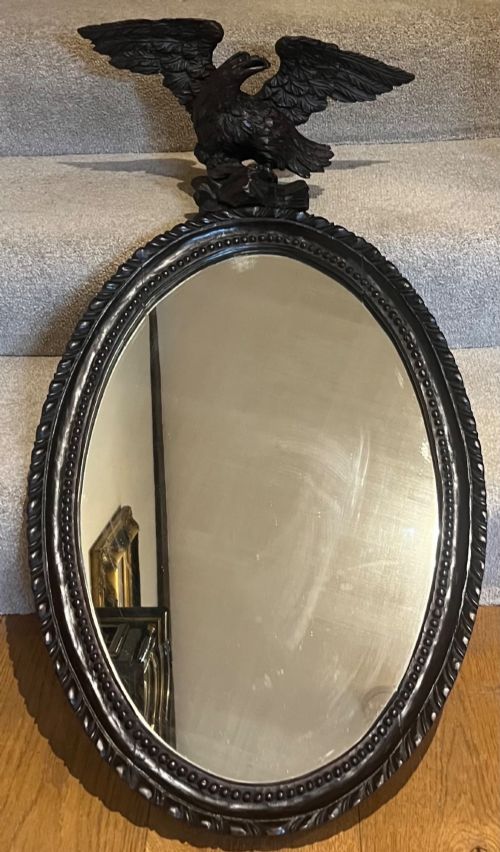
One particularly dramatic nineteenth century piece incorporates an antique carved eagle atop the frame, watching over every reflection below.
Distinctions in quality and execution
Quality reveals itself in the depth of the ebonised finish and the crispness of any carved wood details or gilt highlights. Superior examples maintain intact original surfaces where the dark stain complements the underlying timber grain rather than masking it entirely.
Structural integrity differentiates standard utilitarian pieces from fine decorative works, particularly in large overmantel formats that require robust internal framing. The clarity and beveling of the mirror glass further indicate the original tier of production.
Rowley Gallery
The Ebonised Wooden Framed Mirror Glossary
- Ebonised
- Wood stained or painted to resemble ebony. This dark finish became popular in European furniture and mirror production during the nineteenth century.
- Overmantel mirror
- A large mirror designed to hang specifically above a fireplace mantelpiece. These pieces often feature wide proportions to reflect the width of the hearth.
- Biedermeier
- A Central European style dating from the nineteenth century characterised by utilitarian comfort and clean lines. Mirrors from this tradition favour simple geometric forms over excessive ornamentation.
- Gilt
- A thin application of gold leaf or gold paint applied to surfaces. It frequently appears alongside ebonised wood to highlight carved details and mouldings.
Ebonised Wooden Framed Mirror: Frequently Asked Questions
Where should I hang a large overmantel mirror?
Large overmantel mirrors traditionally hang directly above a fireplace mantelpiece to reflect light and expand the visual space of a room. Their considerable weight requires secure wall anchoring into structural studs.
Alternatively, positioning them on a principal wall in a hallway or dining room creates a strong focal point.
How do I identify a nineteenth century mirror?
Nineteenth century mirrors often display specific construction traits, such as hand-beveled glass, older backing boards, and traditional joinery methods. The presence of period styles like Victorian or Biedermeier offers further chronological context.
Examining the ebonising technique and framing materials helps distinguish genuine nineteenth century examples from later reproductions.
What styles are common in these mirrors?
Common styles include Victorian, Arts and Crafts, Biedermeier, and Regency Revival designs. Each movement brings distinct aesthetic choices, from ornate gilt embellishments to restrained geometric framing.
Makers adapted these styles to suit domestic interiors ranging from grand Victorian drawing rooms to simpler Edwardian spaces.