
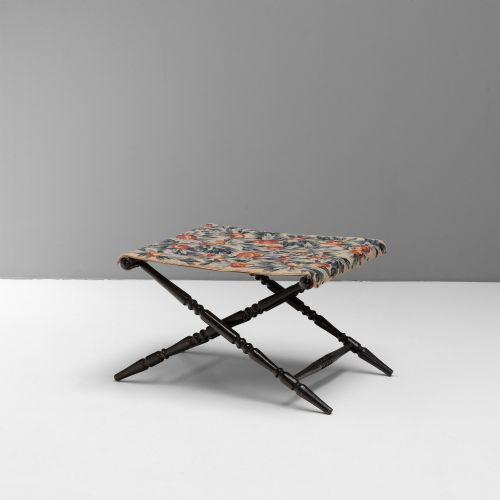
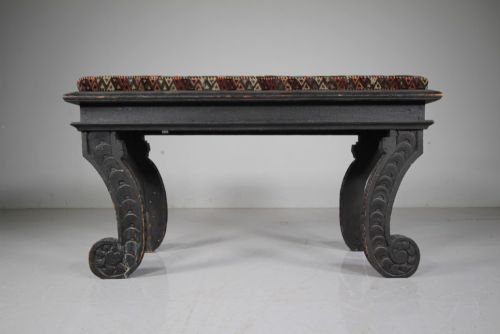
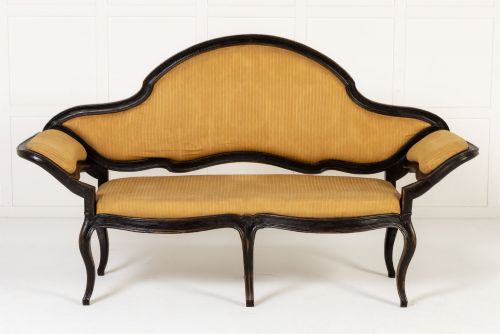


Ebonised Wooden Bench
An ebonised wooden bench brings deep, dark elegance to a room, offering both striking visual contrast and practical seating.
Ebonised Wooden Bench
An ebonised wooden bench unites dark, painted or stained wood surfaces with varied forms ranging from Victorian stools to eighteenth century Italian sofas. Buyers seeking an ebonised wooden bench encounter pieces spanning multiple eras, including the nineteenth century, Regency period, and Edwardian aesthetic movement.
The objects catalogued under this heading include window seats, hall benches, settling sofas, and folding luggage stands. Pieces frequently incorporate secondary elements such as fabric, textile, brass, tapestry, pine, and painted details alongside the dark wood structure.
Origin styles vary widely across the selection, taking in French chateau, rustic farmhouse, Chinese export, and Italian rococo influences. The nineteenth century examples often reflect the characteristic aesthetic movement taste for ebonised finishes paired with gilt or textile highlights.
Materials and construction methods
Wood serves as the primary structural material, frequently finished with a dark ebonisation process to emulate costly ebony. Pine and other timbers form the base frameworks, sometimes enhanced with paint or gilt highlights.
Upholstered elements incorporate fabric, tapestry, and textiles, secured to support comfortable seating on window seats and settees. Brass fittings and hardware appear on adjustable components and folding luggage stands, adding functional metallic contrast to the dark timber.
Listings feature periods spanning the eighteenth century, Regency era, nineteenth century, and nineteen-thirties.
Judging quality and character
The refinement of the ebonised finish and the crispness of any carved or gilt detailing define the visual standard of a piece. Finer examples display meticulous surface treatment that retains a deep lustre without appearing heavy or uniform.
Structural integrity rests on the joinery of the timber frame and the preservation of original upholstery materials where applicable. Pieces bearing distinct stylistic markers from the aesthetic movement or Regency era generally exhibit greater design ambition.
The Ebonised Wooden Bench Glossary
- Ebonised
- Wood treated with stain, paint, or chemical processes to achieve the dense, dark appearance of ebony. This finish gained immense popularity during the nineteenth century, particularly within the aesthetic movement.
- Aesthetic Movement
- A nineteenth century design current that emphasised art for art's sake, favouring clean lines, ebonised surfaces, and Japanese-inspired motifs. Pieces from this context often feature stylised floral or sun-flower decorations.
- Settle
- A wooden bench with high backrest, solid arms, and frequently a storage compartment beneath the seat. Historically utilised in drafty hallways and parlours to block cold air.
- Window Seat
- An upholstered or cushioned bench designed specifically to fit the recess of a window. These forms often date from the Georgian, Regency, and Victorian periods.
- Luggage Stand
- A folding wooden rack used in bedrooms and salons for holding trunks and travel bags. These compact stands frequently employ ebonised frames and webbing straps.
Ebonised Wooden Bench: Frequently Asked Questions
What is an ebonised finish?
An ebonised finish is a dark treatment applied to timber to mimic expensive ebony wood.
Craftsmen achieved this effect using stains, paints, or chemical darkening agents on woods like pine.
How were these benches used?
These benches served functional and decorative roles in nineteenth century and earlier interiors.
Window seats provided relaxation spots by rooms with natural light, while hall benches welcomed guests in entranceways.
How do I date an ebonised bench?
Dating relies on observing structural forms, decorative motifs, and secondary materials.
Victorian and aesthetic movement pieces display distinct stylistic flourishes, whereas earlier items show simpler regional construction.
What materials accompany the wood?
Many benches incorporate upholstered elements such as fabric, tapestry, and textiles.
Brass fittings and painted details also appear across various styles from French chateau to rustic farmhouse.