
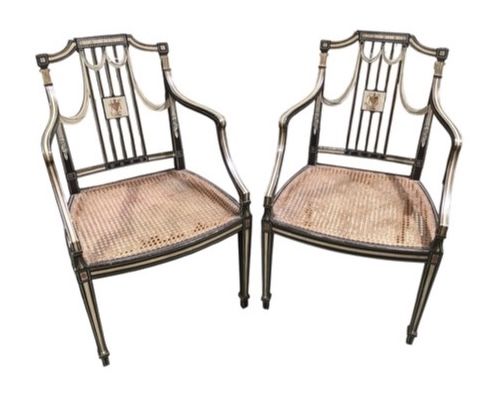


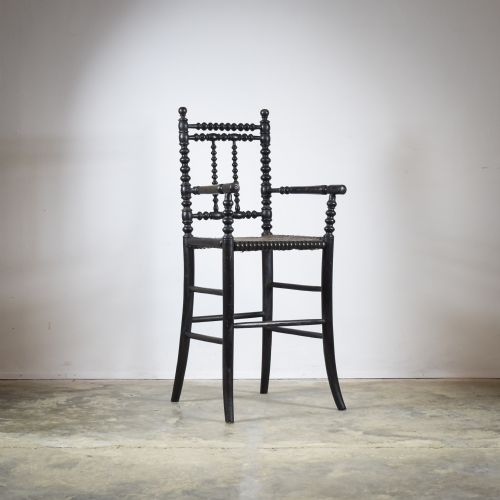
Ebonised Cane Armchair
An ebonised cane armchair offers dark, striking woodwork paired with woven seating that brings Regency and nineteenth-century character directly into a room.
Ebonised Cane Armchair
An ebonised cane armchair combines dark-finished or ebony timber with woven cane seating panels, appearing across nineteenth-century and Regency styles as well as Anglo-Indian Colonial variations. Buyers hunting for an ebonised cane armchair encounter dining chairs, library armchairs, rocking chairs, and occasional seating shaped by distinct historic periods.
The pieces seen on this page span the nineteenth century, Regency era, and early twentieth century, including Regency Revival and specific forms like bergères and corner chairs. Most examples lean towards Regency aesthetics, featuring painted finishes, faux bamboo details, and bobbin turnings alongside traditional library designs.
Materials and construction methods
Makers utilised timber such as beech, solid ebony, and other woods treated with black paint or ebonising processes to simulate expensive exotic hardwoods. This dark framework was then combined with natural woven cane for seats and backs, occasionally enhanced with brass mounts, gold leaf detailing, and leather elements.
Construction techniques range from precise Regency cabinetmaking, seen in library armchairs and bergères, to steam-bent wood methods found in later rocking chairs. Artisans also employed bobbin turning and faux bamboo shaping to build rigid, decorative frames that support the tension of woven cane panels.
Listings feature pieces spanning the nineteenth century, Regency era, and early twentieth century, constructed from cane, ebonised wood, brass, paint, ebony, gold leaf, beech, and leather.
Judging quality and execution
Quality in these armchairs rests upon the crispness of the ebonised finish, the tightness and regularity of the cane weaving, and the structural integrity of the timber frame. Superior examples demonstrate refined proportions and meticulous hand-turned details, such as bobbin turnings or faux bamboo moulding, rather than plain industrial uniformity.
The distinction between standard nineteenth-century production and top-tier pieces lies in the choice of materials, such as solid ebony versus painted beech, and the presence of documented workshop attribution. Finer seating integrates decorative elements like brass inlay or gold leaf cleanly into the dark woodwork, maintaining balance across the arms, legs, and back.
Gillows·Thonet
The Ebonised Cane Armchair Glossary
- Ebonised
- Wood finished to resemble ebony through staining, painting, or chemical treatment. This technique became popular during the nineteenth century to achieve a sleek, dark surface.
- Cane
- Material woven from the outer bark of rattan palms to create supportive, resilient panels for seats and backs. It offers flexibility while maintaining structural strength.
- Bergère
- An enclosed upholstered armchair with exposed wooden framing, originating in France. In British furniture, the term often describes deep-seated cane library chairs.
- Regency
- A style period spanning the early nineteenth century defined by classical restraint and archaeological revival. Furniture from this era frequently incorporates painted surfaces and dark finishes.
- Bobbin turned
- Wood turned on a lathe to produce a series of rounded, spool-like spheres resembling bobbins. This decorative turning style appears frequently on nineteenth-century seating frames.
Ebonised Cane Armchair: Frequently Asked Questions
What is an ebonised cane armchair?
An ebonised cane armchair is a historical seat built from dark or black-finished timber featuring woven cane panels on the backrest or seat. These chairs draw heavily on Regency and nineteenth-century design traditions.
They combine the sleek appearance of dark wood with the lightweight, breathable quality of woven rattan. The category includes library bergères, dining chairs, and decorative corner seating.
How do I care for cane seating?
Cane seating requires moderate humidity to prevent the natural rattan fibres from becoming brittle and snapping under pressure. Keeping the material clean from dust preserves its flexibility over decades of use.
Avoid placing these chairs near direct heat sources or in overly dry rooms. Occasional light dampening of the underside can help maintain the moisture levels of older cane.
Are these chairs comfortable for daily use?
Woven cane provides a surprisingly springy and supportive surface that adapts slightly to the body. Many historic forms, such as library armchairs, were specifically designed for extended periods of reading or relaxation.
Adding a loose squab cushion can further increase comfort for everyday seating. The sturdy wooden frames ensure long-term stability during daily use.
How do I identify a Regency piece?
Regency chairs typically display classical proportions, clean architectural lines, and decorative motifs inspired by ancient Greece, Rome, or Egypt. Details such as sabre legs, brass accents, and painted finishes often signal this period.
Construction methods and timber choices also help confirm the era, with many pieces utilising beech finished to resemble more expensive exotic woods. Attributions to known workshops further authenticate the period origin.