
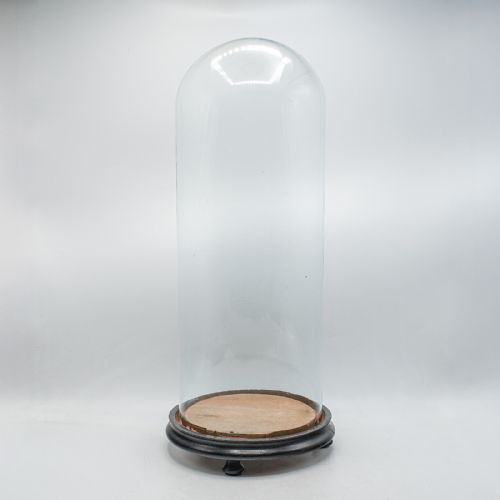


Ebonised Base Dome
An ebonised base dome holds fragile specimens and treasured objects beneath blown glass, bringing distinct Victorian character and dark timber contrast to an interior.
Ebonised Base Dome
The ebonised base dome brings together a clear glass cover and a dark, blackened wooden stand designed to showcase precious objects.
Most examples found here date from the Victorian and Edwardian periods, stretching from the middle of the nineteenth century into the early twentieth century.
These pieces served various domestic and scientific purposes, housing taxidermy birds, botanical specimens, skeleton clocks, and delicate ornaments.
Materials and construction
The glass covers are typically hand-blown, resulting in subtle bubbles and gentle irregularities in the transparency that reveal their nineteenth-century origin.
Bases are fashioned from wood, often treated with an ebonising finish to imitate ebony, and frequently lined with fabric such as velvet, felt, baize, or cloth.
Some configurations incorporate brass details or wooden mouldings to secure the glass securely to the plinth.
Birds of Paradise and stuffed kestrels gaze out from beneath these heavy glass covers, quietly defying the passage of time.
Factors influencing quality
The clarity and thickness of the blown glass define the upper tier of these pieces, alongside the symmetry of the dome shape.
Finer examples feature heavy, well-turned wooden bases with deep ebonising and intact interior linings like original velvet or baize.
Proportion matters greatly, with taller and wider models showing better balance between the glass height and the profile of the wooden plinth.
A Pollard·James Gardner
The Ebonised Base Dome Glossary
- Ebonised
- Wood treated with a dark finish to resemble genuine ebony wood. This dark staining technique creates a formal, uniform contrast against the clear glass above.
- Cloche
- A bell-shaped glass cover used to protect plants or delicate ornaments. The term is often used interchangeably with display dome.
- Taxidermy
- The art of preserving and mounting animal specimens for display. Many domes house birds or small animals arranged on naturalistic perches.
- Baize
- A coarse woolen material resembling felt, commonly used to line the interior base of a display dome. It provides a soft, protective cushion for delicate specimens.
- Specimen case
- A protective enclosure designed to house scientific, botanical, or natural history items. These cases kept dust away from fragile collections.
Ebonised Base Dome: Frequently Asked Questions
What fits inside an ebonised base dome?
These enclosures traditionally house taxidermy birds, pocket watch holders, skeleton clocks, and delicate botanical specimens.
They protect fragile items from dust while offering a clear view from every angle.
How do I date an antique dome?
Dating relies heavily on the thickness and optical properties of the hand-blown glass, along with the turning style of the wooden base.
Victorian examples often feature heavier glass with minor imperfections, whereas Edwardian versions tend toward lighter construction.
Can the glass be separated from the base?
Most domes lift straight off the wooden plinth, resting in a shallow turned groove designed to hold the rim securely.
Care is needed when lifting the heavy glass cover to clean or adjust the contents within.
How should I clean the glass?
Warm soapy water and a soft cloth suit the delicate nature of nineteenth-century blown glass best.
Harsh chemical cleaners should be avoided to protect the aged finish of the surrounding ebonised wood.