
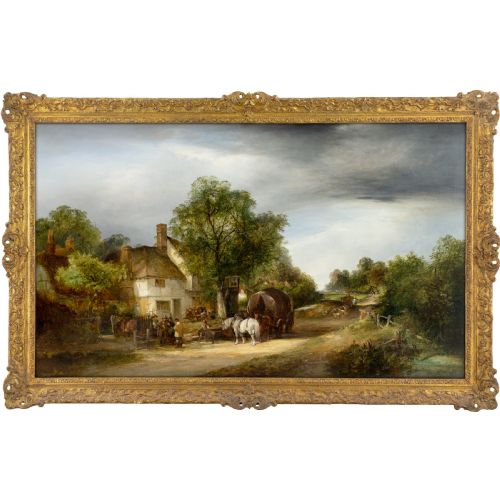
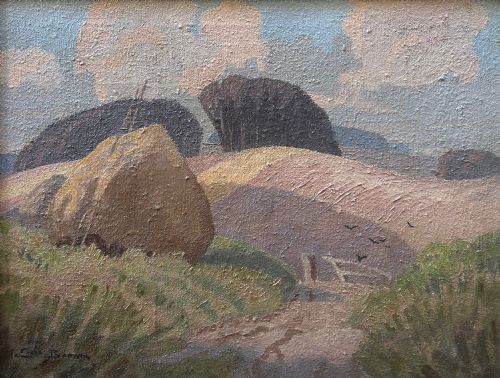
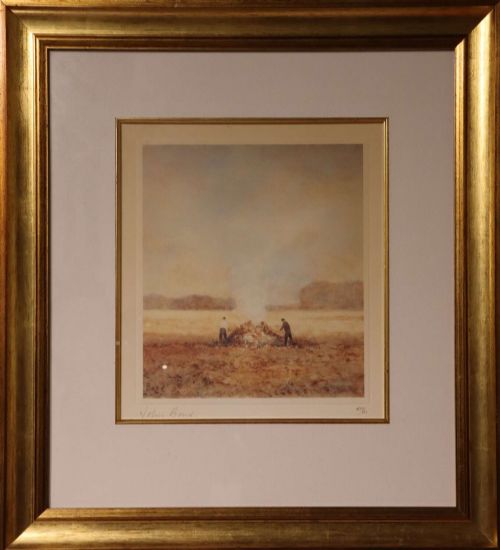


Earth Tone Rural Scene
An earth tone rural scene brings the quiet of farmsteads, rivers and harvest fields directly onto the wall through pastoral oils and watercolours.
Earth Tone Rural Scene
When you search for an earth tone rural scene, you are looking at pastoral views of farmsteads, haystacks, rivers and agricultural labour set across the nineteenth and twentieth centuries.
The versions you are most likely to meet on this page include oil paintings on canvas and watercolours on paper spanning periods from the Victorian era through the nineteen-twenties.
These works capture British and continental countryside subjects, ranging from quiet village lanes to figures working fields and waterways.
Canvas, paper and pigment
These pieces are built primarily with oil paint on canvas or watercolour applied to paper, framed beneath glass where the medium requires protection.
The physical support often includes wood for frames, while the foundational materials rely on traditional pigments to achieve muted natural palettes.
One recorded farmer loaded a horse and cart in nineteen-sixteen while a world war unfolded elsewhere.
Brushwork and atmosphere
Quality separates through the confidence of the brushwork and the artist's ability to render light and atmosphere within a restrained palette.
The strength of a composition rests on how effectively the maker translates mundane agricultural labour and pastoral landscapes into a coherent visual study.
John Bond·Ernest Higgins Rigg·Owen Bowen·William Greaves·William Manners·Henry Charles Fox·Thomas James Lloyd·Herbert Royle·Thomas Pyne·Frederick J Knowles·Edward Killingworth Johnson·Charles James Adams·John Percy Cooke·J V R Parsons·Charles Edward Wilson·Arthur Bateman·Sir Ernest Albert Waterlow·J E Hood·Fred Cecil Jones
The Earth Tone Rural Scene Glossary
- Watercolour
- A paint consisting of pigment suspended in a water-soluble binder, traditionally applied to paper to create luminous transparent washes.
- Oil paint
- A slow-drying paint made by mixing pigments with a drying oil such as linseed, allowing for rich blending and textured impasto.
- Pastoral
- A genre of art depicting rural life and landscapes in an idealized or peaceful manner, often focusing on shepherds, farmers and agricultural settings.
- Lithograph
- A printmaking technique where an image is drawn onto stone or metal with a greasy medium and inked for transfer.
- Impressionism
- A style of painting emphasising spontaneous brushstrokes and the shifting effects of light rather than precise detail.
Earth Tone Rural Scene: Frequently Asked Questions
What periods do these rural scenes date from?
The works span from the nineteenth century through the Victorian and Edwardian eras into the mid-twentieth century, including pieces dated across nineteen-ten and nineteen-twenty.
They reflect shifting pastoral styles from British Impressionism to traditional watercolour recording.
How should I hang a watercolour painting?
Watercolours require framing behind glass to protect the delicate paper surface and water-soluble pigments from moisture and atmospheric dust.
Keep them away from direct sunlight to prevent the subtle earth tones and washes from fading over time.
What subjects appear most often?
Common subjects include haystacks, harvest times, farmsteads, rivers, and figures working with horses and carts in rural valleys.
Scenes frequently capture quiet moments like cottage doorways, village lanes, and grazing cattle by streams.
Are these paintings original works?
The listings comprise original oil paintings on canvas and original watercolours on paper, alongside occasional signed limited edition prints.
Each piece reflects the individual hand of the artist recording specific British or continental landscapes.