
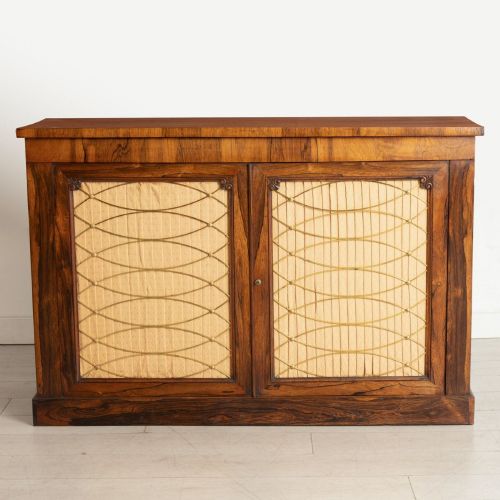
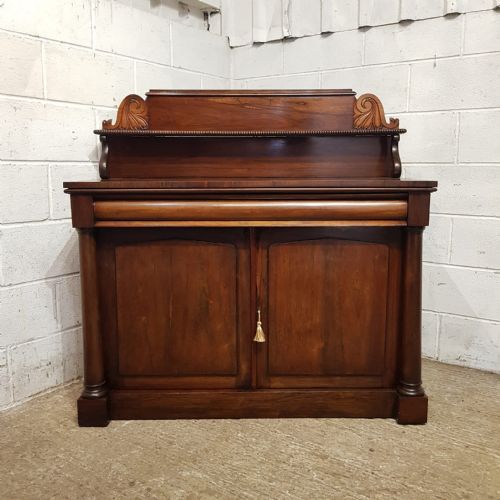


Early Victorian Buffet
An early victorian buffet is a sturdy tiered serving table designed for dining rooms, offering practical tiered surfaces and rich timber grain.
Early Victorian Buffet
The most common formats on this page are three-tier buffet stands and revolving dumb waiters made from mahogany, often featuring graduated shelves supported by turned columns or brass elements.
Related forms such as chiffoniers, sideboards, and dresser bases also appear under this heading, reflecting the overlapping terminology used for nineteenth-century dining room storage.
Materials and construction methods
Makers relied heavily on solid mahogany and mahogany veneer, sometimes turning to rosewood, walnut, pollard oak, or pine for specific commissions or country house pieces.
Construction techniques combined robust joinery with decorative turning, incorporating brass casters, glass components, and iron fixings to support the heavy tiered structures.
Listings span the nineteenth century, with mahogany and pine appearing alongside rosewood, walnut, and pollard oak across various sideboard and buffet formats.
Judging quality in early dining furniture
Quality rests upon the selection of timber figures, such as figured mahogany or burr walnut, and the crispness of turned supports and carved details.
Proportion and scale distinguish finer pieces, where smaller dimensions or adjustable tiers demonstrate careful design rather than utilitarian production.
The Early Victorian Buffet Glossary
- Buffet
- A tiered serving table or sideboard used in dining rooms for food and tableware. These pieces often feature two or three open shelves.
- Chiffonier
- A small sideboard cabinet, typically featuring enclosed cupboards below and sometimes a shelf above. They emerged as popular dining and drawing room storage in the nineteenth century.
- Dumb waiter
- A tiered serving stand or revolving table designed to hold dishes without servant attendance. They frequently stand on tripod bases with castors.
- Pollard oak
- Timber taken from trees pollarded to produce rich, knotted grain patterns. Cabinet makers used this decorative wood for striking drawer fronts and panels.
- Pedestal sideboard
- A large dining room sideboard featuring central storage flanked by pedestal cupboards or columns. These heavy pieces anchor grand nineteenth-century dining spaces.
Early Victorian Buffet: Frequently Asked Questions
What is an early victorian buffet used for?
These tiered stands served dining rooms as auxiliary surfaces for holding heavy dishes, silver, and glassware during large meals.
Today, they function well as serving tables, hallway display stands, or bookcase alternatives in domestic interiors.
What woods were used for these buffets?
Mahogany is the dominant timber seen across these pieces, ranging from plain boards to highly figured veneers.
Other examples utilise rosewood, walnut, pollard oak, or pine, sometimes paired with brass and iron hardware.
Are these pieces adjustable?
Certain tiered buffets and dumb waiters incorporate adjustable mechanisms allowing shelves to change height.
Fixed-tier models rely on permanent turned column supports secured between the platforms.