


Early 19th Century Press
An early 19th century press is a substantial storage piece built to house household textiles, and collectors choose them for their presence and timber.
Early 19th Century Press
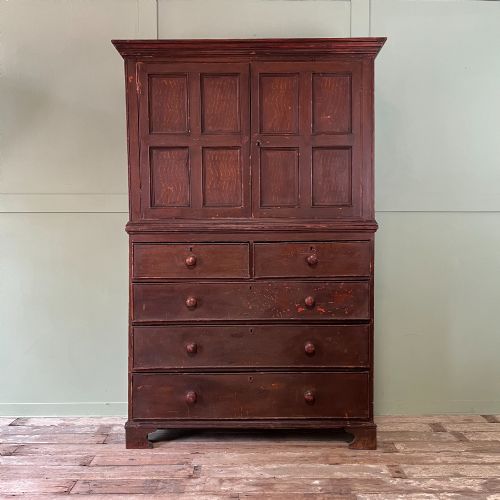
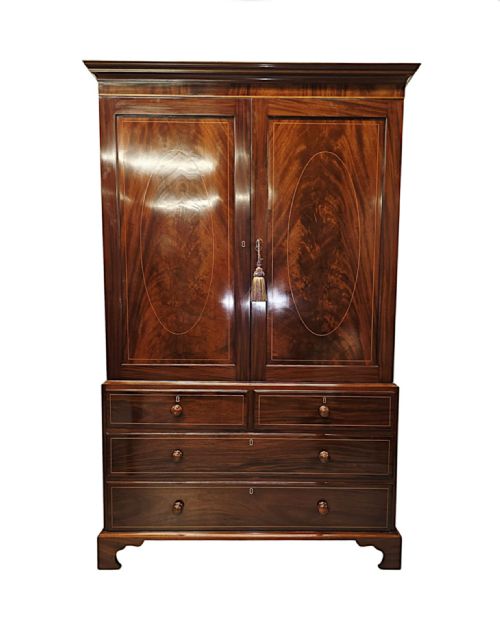
When you search for an early 19th century press, you encounter large-scale furniture designed primarily for domestic storage before fitted wardrobes became standard. These pieces typically combine a linen press or cupboard section with sliding trays or drawers, though related forms include bookcase cabinets and armoires.
The versions most frequently met on this page span Georgian, Regency, and early Victorian periods, appearing in regional variations such as Irish vernacular, Welsh oak, Scandinavian country, and German provincial styles. Alongside large mahogany and pine wardrobes, smaller dwarf cupboards and miniature cabinets surface regularly.
Beyond standard clothes storage, the broader category encompasses functional screw presses intended for books, cheese, and documents, constructed in oak, granite, and brass-mounted timber. These varied utility objects share the robust proportions and period joinery characteristic of the opening decades of the nineteenth century.
Materials and Construction
Makers of the period relied heavily on solid timber and rich veneers, constructing carcases primarily in mahogany, flame mahogany veneer, oak, and pine, alongside occasional regional uses of rosewood, yew-wood, and painted softwood. Timber selection dictated both the visual weight and the structural integrity of each press.
Hardware played a functional and decorative role, with brass handles, hinges, and mounts providing contrast against dark woods and painted surfaces. Surface treatments ranged from clear French polish and wax to hand-applied paint in Scandinavian and vernacular pieces.
Listings feature mahogany, pine, oak, rosewood, and painted finishes across Georgian, Regency, and Victorian periods.
Judging Quality and Execution
Quality in an early 19th century press rests upon the choice of timber and the precision of its application, particularly where figured flame mahogany veneers align across multiple doors and drawers. Finer examples display thoughtful grain matching and careful cabinetmaking rather than plain utility construction.
Proportion and interior completeness dictate distinction at the upper end of the range. Retained internal sliding trays, original brass fittings, and harmonious proportions between the upper cabinet and lower drawer base separate standard utilitarian storage from master workshop production.
Gillows of Lancaster and London·T. Wilson of Great Queen St London
The Early 19th Century Press Glossary
- Linen press
- A large storage cabinet featuring an upper section with sliding trays for folded textiles and a lower section with chest drawers. This form dominated bedrooms before hanging wardrobes became universal.
- Flame mahogany veneer
- A thinly sliced sheet of mahogany displaying a flickering, flamelike grain pattern applied to a secondary wood carcase. Cabinetmakers reserved this decorative wood for primary display surfaces.
- Press cupboard
- A regional vernacular term for a heavy storage unit combining enclosed shelving or hanging space with lower cupboards. Welsh and provincial examples often utilise native oak or painted pine.
- Dwarf cupboard
- A low-height storage cabinet scaling down the proportions of a standard press for smaller rooms. Regency and Victorian makers produced these compact pieces in mahogany and pine.
- Book press
- A mechanical screw device operated by a handle to flatten paper, bind books, or copy documents. These heavy timber and iron bench tools date alongside domestic furniture of the era.
Early 19th Century Press: Frequently Asked Questions
What is the difference between a linen press and a wardrobe?
A linen press traditionally houses internal sliding trays designed for flat-folding textiles, whereas a wardrobe provides vertical hanging space behind doors.
Many pieces from this era saw later interior conversion to accommodate modern clothing rails while retaining their original exterior cabinet doors.
How do I distinguish Georgian from Victorian presses?
Georgian and Regency pieces tend to exhibit restrained architectural lines, classical bracket feet, and balanced proportions in mahogany or inlaid veneers.
Victorian examples frequently introduce heavier mouldings, plinth bases, and darker polished surfaces, reflecting changing domestic tastes mid-century.
Can these large presses be dismantled for moving?
Most large linen presses of this period were constructed in modular sections to facilitate transport between rooms and houses. The upper cabinet typically lifts off the lower drawer base, and the side panels often separate from the backboards.
Where were regional press cupboards made?
Regional press cupboards emerged from workshops across Wales, Ireland, Scandinavia, and provincial Germany using locally available timbers like oak and pine.
These pieces often display distinct local joinery methods and painted finishes that set them apart from London workshop furniture.