


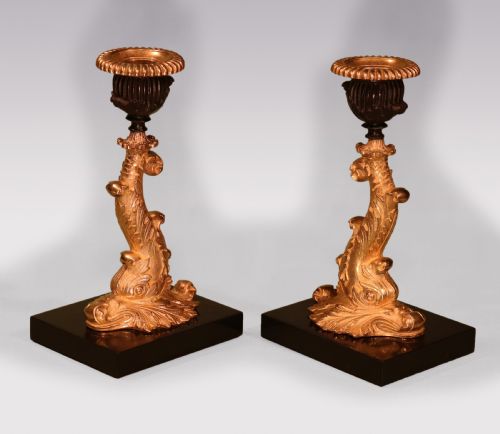


Early 19th Century Candle Holders
Early 19th century candle holders bring candlelight and rich Regency or French Empire design into a room.
Early 19th Century Candle Holders
When you search for early 19th century candle holders, you are looking at functional lighting from periods such as the Georgian, Regency, and French Empire. These pieces range from simple turned wooden spill holders and chamber candlesticks to grand ormolu and bronze candelabra with multiple lights.
Makers and workshops of the time produced these items to light domestic spaces before the advent of gas and electric lighting. Their survival in varied materials demonstrates the high standard of metalwork and turning common in the nineteenth century.
How they were made
Metal candle holders from this period rely heavily on casting in bronze, brass, and copper, followed by hand chasing and the application of ormolu or gilt-bronze finishes. Ormolu work involves mercury gilding onto bronze, which creates a deep, lasting lustre that distinguishes higher-end pieces.
Other examples utilise wood turning, seen in walnut and spiral carver designs, or ceramic production as found in Minton chambersticks. Silver plating methods such as Old Sheffield Plate combine a thin layer of silver fused to a copper base, visible in chamber sticks from the Georgian era.
Early 19th Century Candle Holders Retail Price Guide 2026
Typical asking prices for early 19th century candle holders among the pieces listed under this phrase on Sellingantiques today, from the lower quarter to the upper quarter. They describe what is for sale here now, not the wider market.
Listings feature materials such as ormolu, gilt bronze, silver plate, patinated bronze, mirror glass, copper, and turned walnut across the nineteenth century.
What varies in quality
The distinction between ordinary and exceptional early 19th century candle holders lies in the crispness of the cast detail and the depth of the gilding. Items bearing a signature, such as those by Rabiat, or featuring complex figural elements like dolphins and mirror glass, sit at the upper end of the range.
Simpler turned wooden pieces or utilitarian chamber sticks rely on the quality of their timber grain and the preservation of their original plating. Completeness also alters desirability, particularly for matched pairs or sets of four.
Rabiat
The Early 19th Century Candle Holders Glossary
- Ormolu
- Gilt-bronze finish applied to metal objects using a mercury amalgamation technique. This process yields a rich golden surface characteristic of French Empire and Regency pieces.
- Chamberstick
- A low candlestick fitted with a saucer base and a handle, designed for carrying around a house at night. These often include a small cone snuffer.
- Candelabra
- A branched lighting fixture holding multiple candles. Examples from this era frequently feature central shafts flanked by removable arms.
- Old Sheffield Plate
- An early form of plated metal produced by fusing a sheet of silver to a thicker copper ingot. This technique predates electroplating.
- Girandole
- A decorative wall sconce fitted with mirror glass to reflect and amplify candle flame. These often incorporate Chinoiserie or neoclassical motifs.
Early 19th Century Candle Holders: Frequently Asked Questions
What is a chamber candlestick?
A chamber candlestick is a low candle holder featuring a wide saucer base and a loop handle for carrying. They were used to light bedrooms and hallways before fixed household lighting.
Most include a socket for the candle and sometimes a small metal snuffer resting in the tray. Plated and ceramic versions from the nineteenth century are particularly collectable.
How do I identify French Empire style?
French Empire pieces display heavy classical influences from the Napoleonic era, using dark patinated bronze contrasted against bright ormolu. Motifs often include military trophies, sphinxes, swans, and acanthus leaves.
These designs look heavy, balanced, and formal, contrasting with the lighter aesthetic of earlier Georgian furnishings.
Can I use real candles in them?
You can use standard taper candles provided they fit securely into the nozzle without wobbling. Dripping wax should be removed carefully with warm water rather than scraping.
Older metal holders tolerate standard use well, though silver plated items require gentle cleaning to protect the thin metal surface.
What is Old Sheffield Plate?
Old Sheffield Plate is a fused metal composite made by heating a sheet of silver and a copper block together until they bonded. The combined metal was then rolled into sheets for manufacturing items like chamber sticks.
Examining the edges under magnification can sometimes reveal a thin strip of copper where the silver layer has worn away through use.