

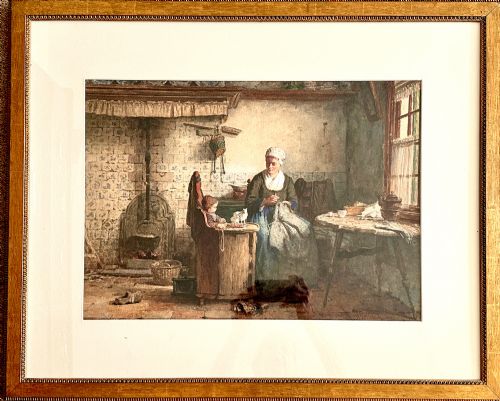


Dutch Watercolour Artwork
Dutch watercolour artwork brings luminous northern light and quiet coastal scenes directly into a room.
Dutch Watercolour Artwork
When you search for dutch watercolour artwork, you encounter original paintings and drawings on paper capturing landscapes, marine views, and rural scenes. The pieces on this page span the eighteenth, nineteenth, and early twentieth centuries, reflecting various iterations of realism and folk art.
You are most likely to meet nineteenth-century works framed in glass and wood, depicting Dutch rivers, coastal towns like Scheveningen, and traditional figures. These watercolours range from atmospheric British marine interpretations of the Netherlands to authentic Dutch realism and folk compositions.
How they were made
Artists applied watercolour pigments and ink onto paper surfaces, often building transparent washes to capture the characteristic grey skies and watery expanses of the Low Countries. Draughtsmen also utilised ink for preliminary sketching before laying down fluid colour.
Finished works were traditionally preserved behind glass and housed within wooden or gilt wood frames to protect the delicate paper from moisture and light damage.
Dutch Watercolour Artwork Retail Price Guide 2026
Typical asking prices for dutch watercolour artwork among the pieces listed under this phrase on Sellingantiques today, from the lower quarter to the upper quarter. They describe what is for sale here now, not the wider market.
What varies in quality
The distinction between standard works and finer examples lies in the confidence of the brushwork and the artist's handling of light and atmosphere. Superior pieces demonstrate subtle tonal gradations in the watercolour pigments rather than flat or overworked washes.
The preservation of the paper and the integrity of the original framing elements also influence the overall character of the piece. Works that retain their crisp ink lines and vibrant pigments without heavy fading stand out visually.
Hendrik Valkenberg·Thomas Bush Hardy·Jan van Couver·John D Walker·Fred Mayor·Madeline Hughes·Johan Noah Bemmel·David Adolph Constant Artz
The Dutch Watercolour Artwork Glossary
- Watercolour on paper
- A painting medium consisting of water-soluble pigments applied to a paper support. This is the defining technique for all the pieces listed under this search.
- Gilt wood frame
- A wooden protective border coated with a thin layer of gold leaf or metallic gilt paint. These frames are frequently found enclosing nineteenth-century watercolours.
- Dutch realism
- An artistic approach focused on the truthful, unidealised depiction of everyday life, landscapes, and rural scenes. It heavily influences the nineteenth-century works on view.
- Marine painting
- Artwork depicting ships, harbours, coastal views, and the open sea. Several pieces capture specific Dutch waterways such as the Maas.
Dutch Watercolour Artwork: Frequently Asked Questions
What is dutch watercolour artwork?
Dutch watercolour artwork comprises original paintings and drawings executed on paper, depicting the landscapes, coastlines, and daily life of the Netherlands. The selections here include nineteenth-century realism, marine views, and folk art.
These pieces capture historic scenes ranging from bustling river towns to quiet rural moments, preserved through water-soluble pigments and ink.
How should I display them?
Watercolours on paper require careful placement away from direct sunlight to prevent the pigments from fading over time. Hanging them behind protective glass within their original wooden frames preserves their physical condition.
Keep them in rooms with stable humidity levels to protect both the paper support and the surrounding wooden or gilt frames.
How do I identify periods?
Periods are identified through the handling of the medium, the style of the dress or architecture depicted, and the framing materials. Nineteenth-century works often exhibit the characteristic realism and muted palettes of the Victorian era.
Later pieces from the early nineteen-hundreds begin to show influences of impressionism and looser brush techniques while maintaining traditional Dutch subjects.
Were these works framed originally?
Many watercolours were framed shortly after completion to protect the vulnerable paper surface from dust and handling. Wood and gilt wood frames were standard choices for mounting finished paintings.
Retaining the period frame adds historical context to the artwork, though some pieces may have been reframed over the decades.