

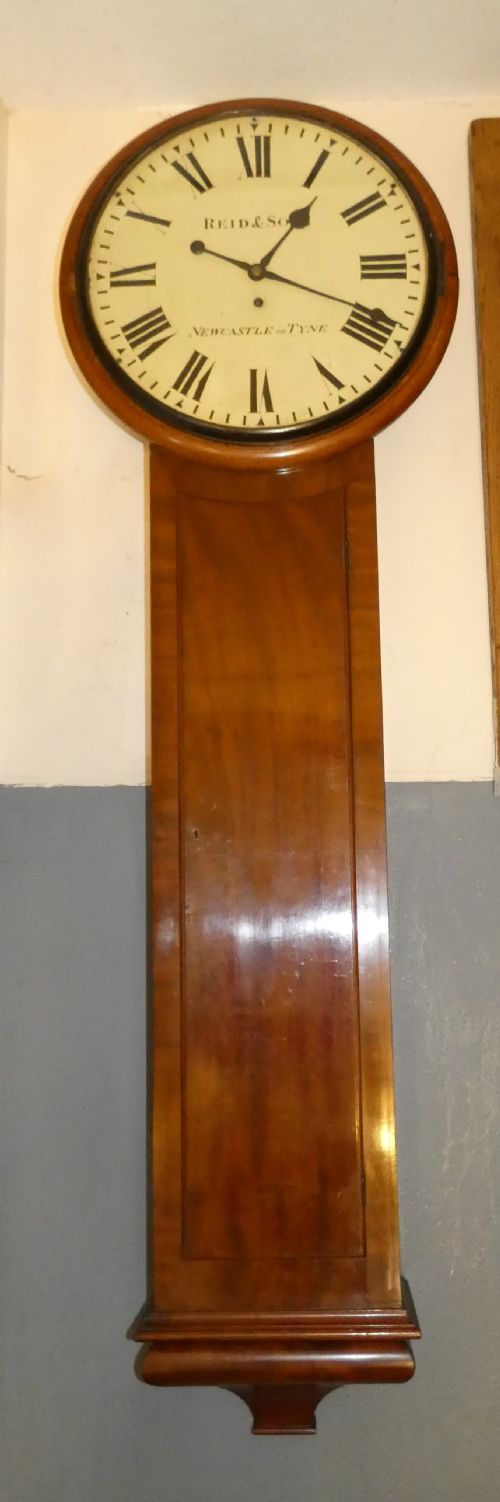


Drop Trunk Timepiece
A drop trunk timepiece is a dependable wall clock valued for its clear dial and compact hanging case.
Drop Trunk Timepiece
A drop trunk timepiece combines a circular dial with an extended lower wooden case, designed to hang securely upon a wall. These clocks appear across the nineteenth century, including the Victorian era, Regency period, and George V years.
The versions met most frequently on this page take the form of wall clocks and regulator wall clocks. They emerge in various timbers and styles, serving as practical timekeepers with distinct regional or maker identities.
How they were made
Cases utilise dense hardwoods such as mahogany, rosewood, and oak, occasionally incorporating brass details or mother of pearl inlay. Wood is shaped to form the rounded dial surround and the trunk below.
Internal mechanisms rely on fusee movements and eight day configurations, often paired with glass inspection doors and protective bezels. Iron and glass components complete the structural build of these wall mounted instruments.
Drop Trunk Timepiece Retail Price Guide 2026
Typical asking prices for drop trunk timepiece among the pieces listed under this phrase on Sellingantiques today, from the lower quarter to the upper quarter. They describe what is for sale here now, not the wider market.
What varies in quality
The caliber of a drop trunk timepiece rests upon the precision of its movement and the selection of cabinet timber. Finely figured mahogany or rosewood combined with a clean London fusee movement represents a superior standard of construction.
Simpler regional examples or plain oak cases present a more utilitarian character. The execution of the dial lettering and the crispness of the timber mouldings further distinguish the finer pieces.
John Walker·Haley and Milner·John Thwaites
The Drop Trunk Timepiece Glossary
- Drop dial
- A clock face mounted to an extended wooden case. This shape allowed room for a longer pendulum swing while keeping the footprint compact.
- Fusee
- A conical pulley connected to the mainspring by a chain or cord. It ensures even tension as the spring unwinds, improving timekeeping accuracy.
- Regulator
- A high precision clock designed to keep exact time. These often feature extended dials and sophisticated movements.
- Timepiece
- A clock that indicates the time without a striking mechanism. Simpler to maintain, it focuses entirely on the movement of the hands.
Drop Trunk Timepiece: Frequently Asked Questions
What is a drop trunk timepiece?
A drop trunk timepiece is a wall mounted clock featuring a circular dial above an extended wooden trunk. The design accommodates the pendulum while presenting a neat profile.
These clocks originated as practical timekeepers for public houses, offices, and domestic hallways throughout the nineteenth century.
How do fusee movements work?
A fusee movement uses a conical drum and a chain to regulate the power delivered from the mainspring. As the spring loses tension, the chain pulls on a wider part of the cone to maintain consistent force.
This clever mechanical arrangement ensures the clock maintains steady accuracy throughout its running cycle.
Where were these clocks used?
Drop trunk timepieces hung in railway stations, offices, taverns, and large homes where reliable timekeeping was essential. Their wall mounted design saved valuable floor space in busy environments.
Today, they suit hallways, kitchens, and studies where a classic timepiece provides both function and character.
How do I identify the period?
Period identification relies upon timber choice, dial construction, and stylistic clues within the case design. Mahogany and rosewood are typical of nineteenth century and Victorian examples.
Signatures on the dial or movement can also pinpoint the maker and approximate decade of production.