
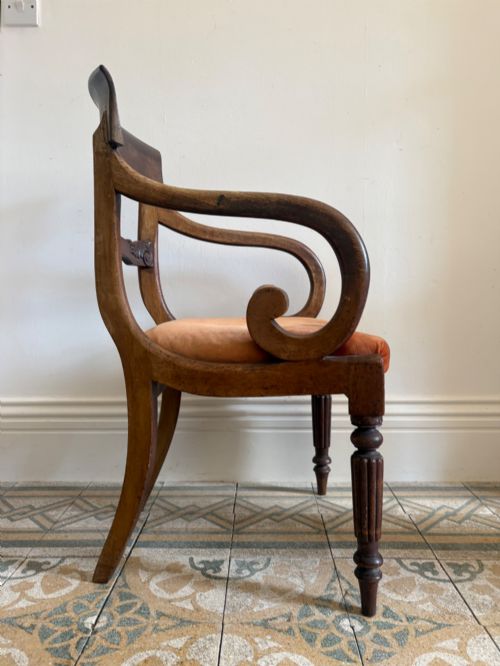
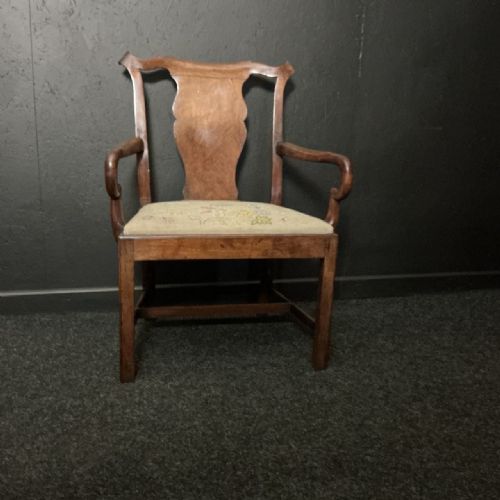


Drop in Seat Armchair
These drop in seat armchair examples bring together timber frames and removable upholstered pads for practical seating across several historic periods.
Drop in Seat Armchair
A drop in seat armchair is a seating form defined by its removable upholstered frame, which sits within a rebated wooden chassis. Buyers searching for a drop in seat armchair encounter various historic iterations originating from the Georgian, Regency, Edwardian, and later periods.
The timber framework typically manifests in mahogany, walnut, or oak, reflecting the prevailing tastes of the eighteenth and nineteenth centuries. Examples range from individual open armchairs and corner armchairs to larger dining chair sets.
Makers produced these chairs in styles such as Chippendale revival, Arts and Crafts, and distinct Georgian designs. The defining feature remains the drop in unit, which allows the textile or leather upholstery to be updated independently of the main timber structure.
How they were made
Cabinetmakers constructed the structural frames of these armchairs using traditional timbers such as mahogany, walnut, and oak, joined with pegged or mortise-and-tenon construction. The removable seat frames were fashioned to fit snugly into the wooden rails of the chair base.
Surface decoration and support details vary across the periods, incorporating carved slot backs, tapering supports, fluted legs, and structural stretchers. Upholstery methods secured textiles, leather, velvet, tapestry, or needlepoint directly over the dropped wooden slip seat.
Lost coins and pins occasionally turn up beneath old drop in seats during reupholstery, left behind by generations of past users.
What varies in quality
The standard of a drop in seat armchair rests upon the selection of timber and the crispness of any carved detailing on the arms, legs, and backsplats. Denser grain in the mahogany or walnut and precise joinery indicate superior construction.
Proportion and execution distinguish standard production from finer cabinetmaking. The fit of the drop in seat within its frame and the integrity of the underlying woodwork dictate the overall execution of the piece.
The Drop in Seat Armchair Glossary
- Drop in seat
- A removable upholstered wooden frame that fits into the rebate of a chair base. This design allowed easy reupholstering without altering the main frame.
- Carver armchair
- An armchair designed with open arms, frequently used at the head of a dining table or as a single fireside seat. These pieces match standard dining chair heights.
- Corner armchair
- A seating form featuring a continuous curved top rail supported by posts and a central seat set at a diagonal angle. They fit neatly into room corners.
- Slip seat
- An alternative term for the drop in seat frame. It slips out from the seat rails for maintenance.
- Stretchers
- Horizontal wooden rods connecting the legs of a chair to provide structural rigidity. They appear frequently on earlier and Arts and Crafts examples.
Drop in Seat Armchair: Frequently Asked Questions
What is a drop in seat armchair?
A drop in seat armchair is a wooden chair featuring a removable upholstered insert that rests inside the seat rails. This design facilitates reupholstery and cleaning.
Such pieces appear in various historic styles, from eighteenth-century walnut examples to Edwardian oak variations.
How do I remove the seat?
The upholstered insert lifts straight up out of the wooden frame once any securing turn-buttons or friction is overcome. The wooden slip frame sits loosely within the rebate.
Care is required to avoid damaging the surrounding timber edges when lifting the textile pad clear.
Are these chairs suitable for daily dining?
Many of these pieces function effectively around a dining table, particularly those originating from larger sets. Their arm heights and sturdy frames support extended sitting.
Single open armchairs and corner chairs serve well as occasional seating in living spaces or hallways.
How do I identify the period?
Dating relies on timber choice, structural joinery, and stylistic markers such as cabriole legs or fluted supports. Georgian and Regency pieces utilise dense mahogany and walnut, while Edwardian examples often display Arts and Crafts influences.
Comparing backsplat designs and arm shapes against established historical styles helps confirm the era of manufacture.