

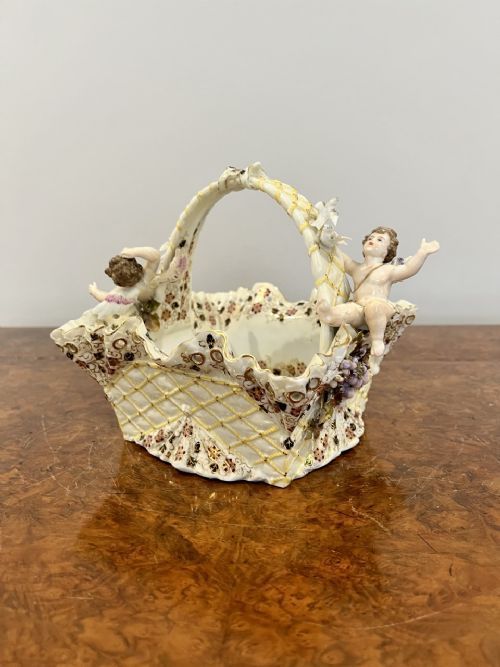


Dresden Floral Centrepiece
A dresden floral centrepiece brings intricate porcelain craftsmanship and hand-painted colour directly to the table.
Dresden Floral Centrepiece
When you search for a dresden floral centrepiece, you are looking at elaborate German ceramic tableware designed to command attention in the middle of a dining table or sideboard. These statement pieces emerge primarily from the Victorian and Edwardian eras, spanning the late nineteenth and early twentieth centuries. The listings show a strong presence of large figural bowls, baskets, and candelabra.
The objects serve as decorative centerpieces, comports, and fruit bowls rather than utilitarian vessels for everyday dining. They reflect the high Victorian and Edwardian taste for display and theatrical tablescapes. Collectors prize them for their sculptural ambition and detailed botanical modelling.
Materials and methods
Makers shaped these items from hard-paste porcelain, building complex forms by hand-modelling individual petals and figures before high-temperature firing. Artisans applied delicate floral encrustations, known as applied roses, petal by petal onto the ceramic body. They integrated enamel paint and gold leaf highlights to accentuate the sculptural details.
Gilding and painted enamel work required precise secondary firings to fuse the colours and metallic leaf to the glazed surface. Workshops employed moulds for the main structural bowls or baskets but relied on skilled hands for the intricate putti, cherubs, and floral arrangements. This combination of cast foundation and manual assembly defined the German porcelain industry of the era.
Dresden Floral Centrepiece Retail Price Guide 2026
Typical asking prices for dresden floral centrepiece among the pieces listed under this phrase on Sellingantiques today, from the lower quarter to the upper quarter. They describe what is for sale here now, not the wider market.
Many of these centrepieces feature miniature porcelain beetles and butterflies expertly hidden among the hundreds of fragile applied rose petals.
Distinctions in quality
The application of gilding and enamel paint also dictates the upper tier of the range, with hand-painted shading showing subtle depth rather than uniform blocks of colour. Structural complexity, such as multi-tiered candelabra arms or elaborate openwork baskets, demands greater technical control during the kiln firing.
C.G. Schierholz and Sohn·Sitzendorf Porcelain·Plaue Schierholz
The Dresden Floral Centrepiece Glossary
- Putti
- Plural of putto, representing plump, winged male infants or cherubs that frequently climb across the base or stem of a centrepiece. They appear frequently in Rococo Revival German porcelain.
- Comport
- A raised decorative dish or bowl used for serving fruit or sweets on a formal dining table. These elevated vessels dominate nineteenth-century tableware.
- Hard-paste porcelain
- A dense, durable ceramic composed of kaolin and petuntse fired at very high temperatures. It forms the robust white body of these German centrepieces.
- Gilding
- The application of gold leaf or powdered gold to the surface of the porcelain. It provides metallic highlights along the rims and scrolled feet.
- Rococo Revival
- A nineteenth-century design style emulating the theatrical curves, asymmetry, and C-scrolls of the eighteenth-century French movement. This style heavily influences the moulded frames of the listed pieces.
Dresden Floral Centrepiece: Frequently Asked Questions
What is a dresden floral centrepiece used for?
These pieces served as ornamental centrepieces for formal dining tables, often holding fruit or simply displaying sculptural botanical work. Wealthy households utilised them during dinners to impress guests with elaborate tablescapes.
Today, they function best as decorative focal points on sideboards, mantelpieces, or large dining tables where they remain protected from daily handling.
How do I identify the period of a centrepiece?
Examining the stylistic markers helps narrow down the date, with Victorian pieces often showing heavier Rococo Revival scrolling and Edwardian items leaning towards lighter botanical forms. Factory marks stamped or painted on the underside provide the most reliable guide to the exact decade of manufacture.
The listings on this page span the late nineteenth century up to approximately 1910, capturing the height of German porcelain production.
How should I clean my porcelain centrepiece?
Dust the intricate applied roses and delicate putti gently with a soft, dry brush to prevent the brittle petals from breaking. Avoid using harsh chemical cleaners or submerging painted and gilded surfaces in water.
Professional care is recommended if the piece requires deeper cleaning, given the fragile nature of the hand-modelled flowers.
Are these items made in Dresden?
While the trade term often encompasses various nineteenth-century German porcelain factories working in a similar decorative tradition, actual production spanned multiple towns including Plaue and Sitzendorf. Factories across the region adopted the elaborate floral encrustation and figural style associated with the Dresden aesthetic.
The listings reflect makers such as Schierholz and Sitzendorf operating across Germany during the Victorian and Edwardian periods.