



Double Pillar Dining Table
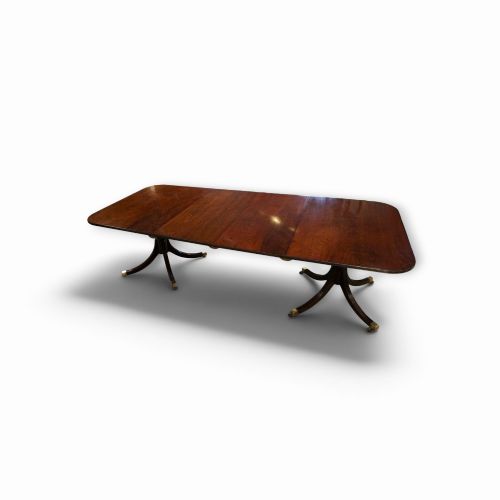
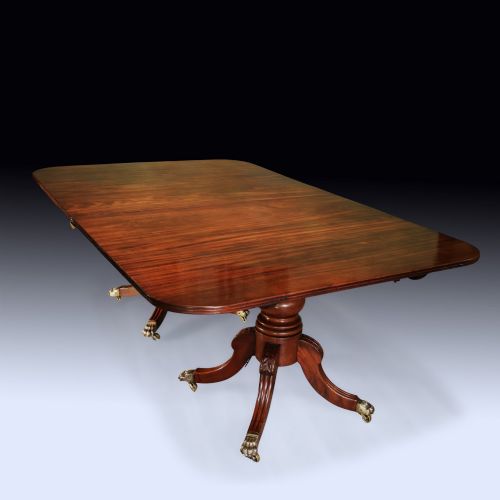
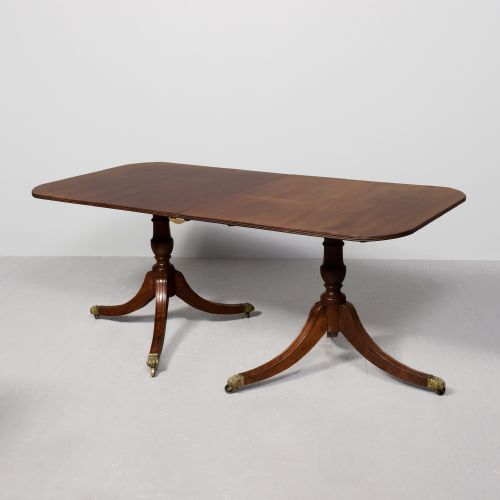
A double pillar dining table offers an adaptable surface for formal meals, resting upon two distinct pedestals rather than four corner legs.
Double Pillar Dining Table
When you search for a double pillar dining table, you find extendable dining furniture designed to seat several guests while allowing maximum legroom around the central pedestals. The examples available on this page span the Georgian, Regency, Edwardian, and 1930 periods, showing how cabinetmakers adapted the twin pedestal form across successive centuries. Most pieces on this page are constructed from mahogany, often featuring removable leaves to adjust the length of the tabletop.
The typical construction pairs two robust wooden columns with splayed legs, frequently terminating in brass castors for ease of movement. You will encounter genuine period items from the early nineteenth century alongside later revivals executed in the Georgian style. These tables suit dining rooms where hosting capacity needs to change periodically without sacrificing floor space.
Materials and construction methods
Makers relied primarily on mahogany, including figured varieties and Spanish mahogany, selected for both its rich grain and structural stability. Timber boards were joined to form top sections supported by turned or faceted central pillars that branch into sturdy tripod or tetrapod legs.
Metal components such as brass castors and connecting clips were integrated into the base to facilitate movement and secure the removable leaves in place during use.
These tables quietly witness generations of family arguments, spilled gravy, and hastily hidden homework before Sunday roast.
Markers of superior quality
Quality in a double pillar dining table reveals itself in the selection of timber figures and the precise turning of the central pedestals. Superior tables display cohesive grain matching across the main top and any additional leaves, indicating careful stock selection by the original maker.
The engineering of the pedestal joints and the stability of the splayed legs determine how well the table bears weight when fully extended. Finer examples retain original brass hardware and smooth mechanisms for inserting leaves.
The Double Pillar Dining Table Glossary
- Twin pillar
- A dining table construction utilising two separate vertical pedestals to support a single extended top. This configuration replaced traditional four-legged designs to improve seating comfort.
- Leaf
- A removable board inserted into the centre of the table to increase its overall length. Leaves allow the table to accommodate larger gatherings when necessary.
- Pedestal
- The central vertical column supporting the tabletop. It usually divides into three or four splayed legs near the floor.
- Castor
- A small wheel attached to the foot of a table leg. Brass castors allowed heavy mahogany tables to be repositioned easily within a dining room.
Double Pillar Dining Table: Frequently Asked Questions
How do I seat guests comfortably around a double pillar dining table?
The absence of corner legs allows chairs to slide freely around the perimeter of the table without interference. Guests sit between the two pedestals and alongside the extended ends.
When additional leaves are inserted, the spacing between the columns shifts, so positioning chairs evenly helps maintain balanced legroom for everyone.
Can I remove the leaves for everyday use?
Most tables feature removable leaves that detach easily to shorten the surface length for daily meals. This flexibility allows a large dining table to occupy less floor space when hosting fewer people.
Storing the loose leaves in a dry environment prevents warping and ensures they fit smoothly back between the pedestals when needed.
What is the difference between George III and Regency tables?
George III pieces often display classic proportions with straightforward mahogany pillars and subtle brass detailing. Regency examples frequently incorporate bolder architectural elements and more pronounced grain patterns.
Both styles utilise the dual pedestal format, though later revivals from the Edwardian period or the 1930s emulate these historic aesthetic traits.
How do I care for a mahogany dining surface?
Polishing the timber regularly maintains the sheen of the mahogany and nourishes the wood grain. Using protective mats during meals prevents heat marks and moisture damage to the finish.
Keeping the table away from direct heat sources and strong sunlight preserves the rich colour and prevents the wood from drying out.