


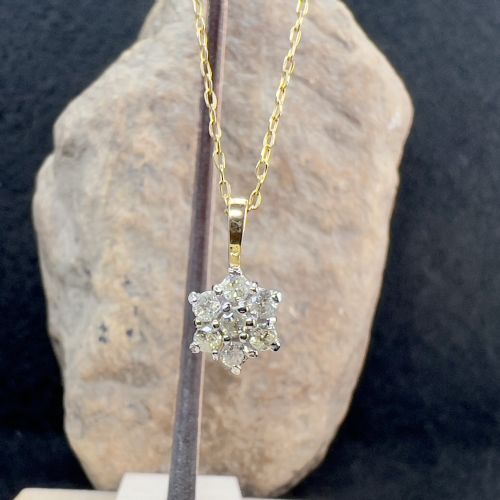


Diamond Flower Cluster Necklace
A diamond flower cluster necklace brings together brilliant stones and organic floral geometry, offering timeless charm for any collection.
Diamond Flower Cluster Necklace
A diamond flower cluster necklace presents central gemstone arrangements styled as blossoms, drawing on traditional and mid-century motifs. Buyers searching for a diamond flower cluster necklace encounter variations spanning the Victorian era through the 1950s and 1960s.
The selections on this page incorporate distinct configurations including starbursts, daisies, and larger multi-stone floral pendants. These pieces frequently combine diamond petals with centres of ruby, sapphire, peridot, opal, or cultured pearls.
Forms range from dedicated necklaces and convertible pendants to brooches adapted for suspension on modern chains. Victorian examples lean towards silver-topped gold settings, whilst mid-century pieces often utilise nine-carat yellow gold.
Materials and Construction
Maker construction relies heavily on combinations of gold and silver, with Victorian and nineteenth-century pieces frequently employing silver-topped gold to enhance the brilliance of old-cut and rose-cut diamonds. Later twentieth-century iterations turn predominantly to nine-carat and fifteen-carat gold foundations.
Gemstone arrangement is central to the technique, securing diamonds around coloured stones or pearls using traditional claw and collet settings. Enamel and high-carat rose and yellow gold further define the nuanced metallurgical methods seen across the Victorian items.
Victorian jewellers occasionally transformed insects and blooms into dual-purpose jewels, ensuring a diamond daisy could flutter on a lapel or rest against the collarbone.
Assessing Quality
Quality rests on the integrity of the stone setting and the crispness of the floral silhouette, distinguishing finely proportioned antique examples from standard production. The weight and consistency of the gold or silver work determine the structural substance of the mount.
The cut and clarity of the diamonds, alongside the matching of accompanying rubies, sapphires, or pearls, dictate visual impact. Intact enamel and secure conversion mechanisms between pendants and brooches also separate superior survivals.
The Diamond Flower Cluster Necklace Glossary
- Old-cut diamond
- A hand-faceted diamond shape typical of antique jewellery, featuring a smaller table and higher crown that produces a softer, candlelit sparkle. These stones are characteristic of Victorian and nineteenth-century pieces.
- Rose-cut diamond
- A vintage diamond cut featuring a domed, faceted top and a flat bottom, resembling an unopened rosebud. This style yields a translucent, understated shimmer common in older floral clusters.
- Cluster
- A jewellery arrangement where smaller stones are grouped tightly around a central focal gemstone. This configuration forms the structural basis of floral pendant designs.
- Convertible pendant
- An ornament engineered to function as both a pendant and a brooch. This versatility allowed Victorian wearers to pin the flower to garments or suspend it from a neck chain.
- Silver-topped gold
- A manufacturing technique where a thin layer of silver is soldered to a gold backing. This method placed a white metal against the diamond facets whilst maintaining the strength of gold underneath.
Diamond Flower Cluster Necklace: Frequently Asked Questions
How do I care for my necklace?
Antique gemstone jewellery requires gentle handling, avoiding harsh ultrasonic cleaners that might dislodge pearls or softer coloured stones like opals and peridots.
Store each piece separately in a lined box to prevent metal abrasion and protect delicate silver-topped gold settings.
Can I wear these every day?
Mid-century gold chains and robust cluster pendants withstand regular wear when handled with reasonable care during daily activities.
Victorian pieces with delicate silver work, enamel, or pearls benefit from more mindful, occasional wear to preserve their fragile historical components.
How are periods identified?
Dating relies on material combinations, such as silver-topped gold and rose-cut diamonds pointing to Victorian origins, alongside hallmark evidence for mid-century pieces.
Setting styles, from naturalistic Victorian flower motifs to structured mid-century daisy and starburst clusters, further clarify the timeline.