


Diamond Cluster Stud Earrings
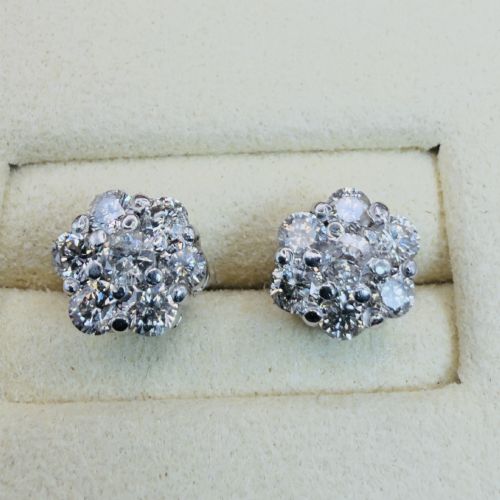
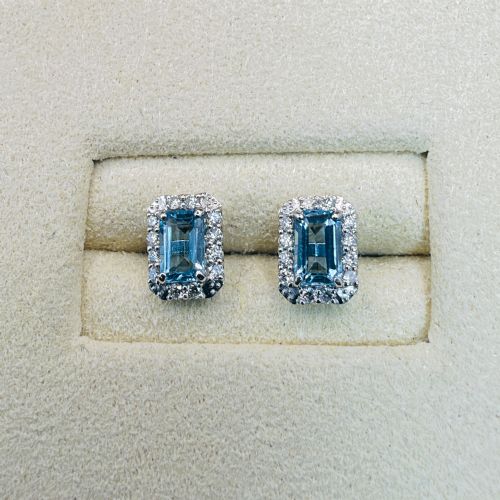
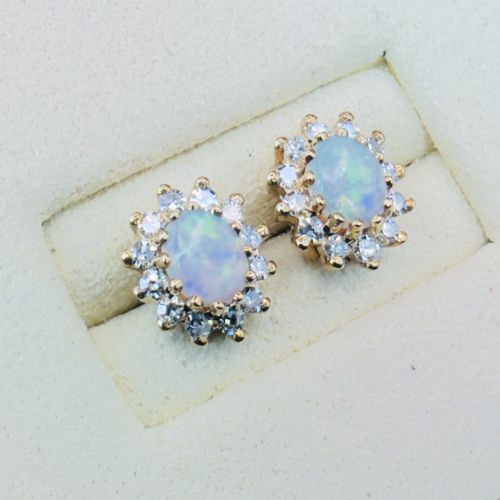
Diamond cluster stud earrings bring together central gemstones framed by smaller stones, offering a compact and brilliant form for the earlobe.
Diamond Cluster Stud Earrings
Diamond cluster stud earrings comprise a central stone surrounded by a ring of smaller gems, creating a concentrated focal point on the earlobe. The pieces on this page span Victorian, Edwardian, Art Deco, Retro, and Mid-Century periods, reflecting shifting tastes in geometric and floral arrangements over the decades.
The most common form on this page pairs a central diamond with a halo of smaller diamonds, or centres a coloured gemstone such as sapphire, emerald, aquamarine, or garnet within a diamond border. These configurations range from traditional daisy designs to linear and twirl arrangements.
Origins stretch from late nineteenth-century workshops through to mid-twentieth-century design movements. Buyers encounter secure screw backs, clip-ons, and traditional post fittings alongside drops and standard studs.
Variations in quality
Quality rests upon the proportion and matching of the stones within the cluster, alongside the precision of the underlying metalwork. Finer examples display stones selected specifically for uniform colour, clarity, and cut, ensuring the border complements rather than overpowers the centre.
The integrity of the mountings and the delicacy of the gallery work separate standard production from superior craftsmanship. Well-preserved pieces retain crisp angles in geometric Art Deco designs and secure, refined claw or bezel work on floral clusters.
Some mid-century daisy clusters double as clip-on earrings, allowing non-pierced collectors to wear substantial diamond configurations.
The Diamond Cluster Stud Earrings Glossary
- Cluster
- An arrangement where a central gemstone is encircled by a ring of smaller stones. This layout maximises surface sparkle and visual presence.
- Halo
- A specific form of cluster featuring a single central gem enclosed by a continuous border of smaller pavé- or claw-set diamonds.
- Old cut
- A term for diamond cuts executed before modern machine standards, typically featuring higher crowns and smaller tables that catch candlelight effectively.
- Cabochon
- A gemstone polished to a smooth, rounded convex surface rather than faceted. This cut is common for opals and certain sapphires seen in these designs.
- Screw back
- A threaded post fastening that secures the earring with a small nut turned down the shaft. This mechanism provides extra security for heavier cluster designs.
Diamond Cluster Stud Earrings: Frequently Asked Questions
How do I secure screw back earrings?
Screw back earrings use a threaded post paired with a matching backing nut that winds down the length of the pin. You gently twist the backing until it rests comfortably against the earlobe.
This mechanism offers added security compared to standard friction push backs. It prevents the earring from slipping off accidentally during wear.
How do I date antique cluster earrings?
Dating relies on examining the mounting style, metal types, and cutting techniques of the stones. Art Deco pieces often use platinum and geometric frameworks, whereas Victorian examples utilise yellow gold and rose cut diamonds.
Backings and fastening types also provide chronological clues. Screw backs and specific clasp styles align with mid-century manufacturing standards.
Are coloured gemstones common in clusters?
Coloured gemstones frequently occupy the central position in cluster earrings. Sapphires, emeralds, aquamarines, and garnets appear regularly framed by diamond borders.
These combinations reflect historical preferences for contrasting colours. The surrounding diamonds serve to highlight the depth and hue of the primary gem.