
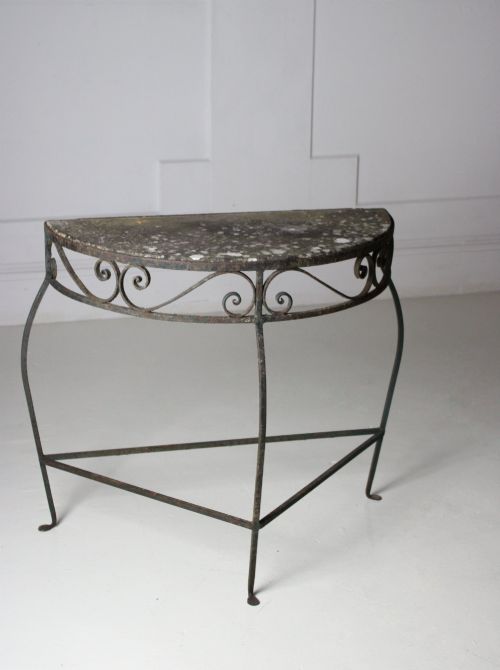
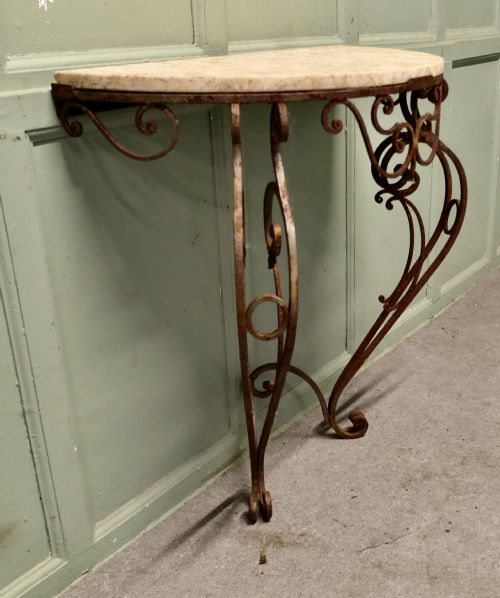
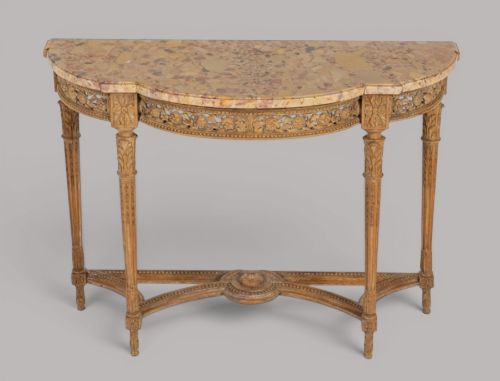
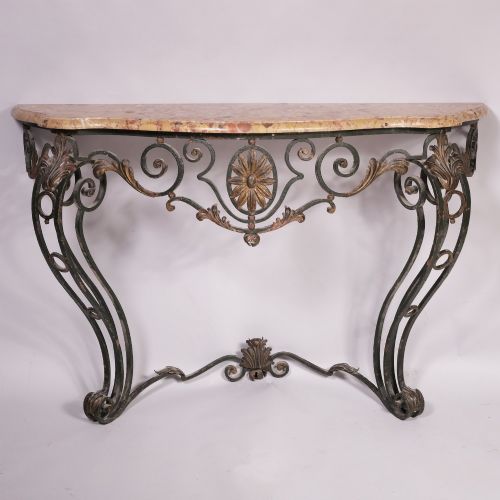
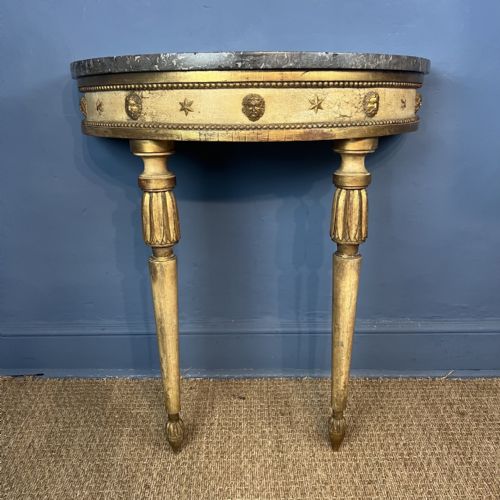


Demilune Marble Hall Table
These demilune marble hall table pieces combine semicircular timber or iron frames with stone tops to anchor an entranceway.
Demilune Marble Hall Table
A demilune marble hall table takes the form of a semicircular console designed to sit flat against an entrance wall. The pieces on this page span the eighteenth, nineteenth, and early twentieth centuries, encompassing Edwardian, Regency, and Victorian periods.
The dominant forms are console tables and washstands configured with flat stone surfaces. Styles range from French country and chateau to Neoclassical, Louis XVI, and Italian Neoclassical designs.
Origins include English, French, and Italian workshops, presenting both carved wood and metal frames. Buyers encounter painted wood, giltwood, and polished timber alongside wrought iron supports.
Factors of Quality
Quality rests in the harmony between the stone top and the supporting frame, whether giltwood, wrought iron, or polished mahogany. Heavier carving and refined surface treatments distinguish finer examples.
The integration of materials - such as parcel gilt accents on cream-painted wood or detailed ironwork - determines the visual weight of each console. Period authenticity in the joinery and the mounting of the marble surface define the standard of execution.
Periods represented span the 18th century, Regency, Victorian, Edwardian, and the early 20th century up to 1920.
The Demilune Marble Hall Table Glossary
- Demilune
- A half-moon shape used for console tables designed to stand flat against a wall. This profile saves floor space in narrow hallways.
- Console table
- A table supported by wall brackets or console legs rather than four independent vertical supports. They frequently feature decorative stone tops.
- Giltwood
- Timber coated with gold leaf or gold paint for decorative effect. It appears across French and Italian neoclassical pieces.
- Serpentine
- A curved line that is convex in the centre and concave at the sides. This contour softens the rectangular transition of furniture edges.
- Washstand
- A piece of furniture historically used for personal washing, often adapted with a marble top. These share similar proportions to narrow hall tables.
Demilune Marble Hall Table: Frequently Asked Questions
What is a demilune table?
A demilune table is a piece of furniture built with a semicircular top and a flat back designed to stand directly against a wall.
This half-moon shape allows the table to occupy minimal floor space while providing a functional surface in entrance halls.
How do I style a hall table?
Position the flat edge of the semicircular table flush against the entrance wall to create an organised focal point upon entry.
Keep the surface balanced by pairing the marble top with minimal decorative objects that do not obstruct the profile.
Are marble tops original?
Marble tops on period console tables are cut to match the specific half-moon contour of the underlying frame.
Examination of the fit and the seating of the stone against the timber or iron reveals how the elements were constructed together.
What periods are available?
The selections span the eighteenth century, the Regency and Victorian eras, up through Edwardian pieces and the early twentieth century.
Each period brings distinct stylistic influences, from Louis XVI Neoclassical to rustic French country designs.