


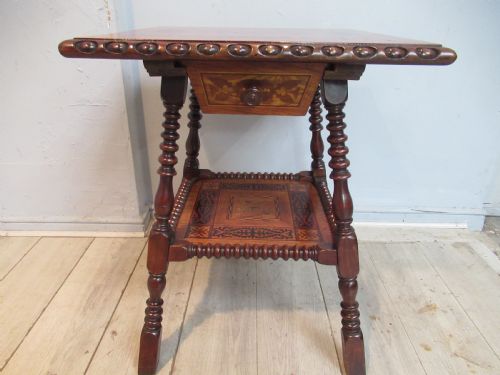


Decorative Tiered Table
A decorative tiered table brings multiple display surfaces and layered height to a room, offering both practical utility and elegant focal points.
Decorative Tiered Table
A decorative tiered table provides multiple stacked surfaces designed for display and occasional use within period interiors. Buyers searching for a decorative tiered table will encounter forms ranging from Victorian side tables and etageres to Edwardian plant stands.
The pieces on this page span the nineteenth century through the early twentieth century, incorporating styles such as Victorian, Sheraton Revival, William IV, and Arts and Crafts. These multi-level tables serve various functions, including plant stands, whatnots, and display consoles.
Originating from British and continental workshops, these tables utilise diverse forms like demi-lune consoles, tray tables, and freestanding etageres. Their tiered construction allows for the display of ornaments, books, and small plants across distinct levels.
Construction and materials
Cabinetmakers constructed these tiered tables using timbers such as mahogany, rosewood, walnut, satinwood, and ebonised wood. Marquetry inlay, hand carving, and brass mountings frequently embellish the frames and supports.
Selected pieces incorporate cane work, painted finishes, and porcelain elements to enhance their decorative appeal. Structural integrity relies on traditional joinery suited to supporting multiple upright tiers and shelves.
Listings feature pieces spanning the nineteenth century up to nineteen-twenty, utilising mahogany, rosewood, walnut, brass, and porcelain.
Assessing quality and craftsmanship
Quality in a decorative tiered table rests upon the selection of timber veneers, the precision of marquetry inlay, and the crispness of hand-carved details. Superior examples exhibit balanced proportions across their multiple tiers and robust internal framing.
Finishing touches such as brass mounts, porcelain inserts, and original surface patination distinguish finer workshop productions from simpler utilitarian items. The integration of secondary woods and the stability of upright supports further indicate the tier of craftsmanship.
Liberty and Co·Royal Worcester
The Decorative Tiered Table Glossary
- Etagere
- A piece of furniture with a set of open shelves or tiers for displaying small objects or ornaments. It often stands freestanding in a principal room.
- Whatnot
- A tiered cabinet or stand designed for holding various small articles and knick-knacks. The form became particularly popular during the Victorian period.
- Demi-lune
- A half-moon shape used for tables designed to stand flat against a wall. This profile saves floor space while providing a useful display surface.
- Marquetry
- Decorative patterns formed by the insertion of small pieces of wood, veneer, or shell into a wood foundation. It creates intricate pictorial or geometric designs.
- Satinwood
- A durable, lustrous yellowish timber native to India and Sri Lanka used extensively in fine cabinetmaking. It provides a bright, contrasting surface for inlay work.
Decorative Tiered Table: Frequently Asked Questions
What is a decorative tiered table used for?
These multi-level tables provide designated surfaces for displaying ornaments, ceramics, books, and small plants without occupying excessive floor space. Their stepped tiers allow collectors to arrange items at varying heights for visual impact.
Historically placed in parlours and drawing rooms, they functioned as versatile furniture pieces that adapted to changing interior displays.
How do I identify a Victorian etagere?
Victorian etageres typically feature three or more open shelves supported by turned or carved upright pillars. They frequently employ rich timbers such as rosewood, walnut, or mahogany.
Look for fine joinery details, decorative spindle galleries, and occasional brass mounts or marquetry panels characteristic of nineteenth-century production.
Where should I place a tiered table in my home?
A tiered table suits reception rooms, hallways, and corners where vertical display space is preferred over a large footprint. Their open construction prevents them from visually blocking light or making a small room feel crowded.
They work effectively as plant stands, bedside surfaces, or freestanding display units for collections of small antiques.
What woods were commonly used for these tables?
Cabinetmakers relied on hardwoods such as mahogany and walnut for their durability and rich grain patterns. Exotic timbers like rosewood and satinwood appeared on finer pieces for contrast and decorative inlay.
Ebonised finishes and painted surfaces also occur, reflecting specific nineteenth-century design trends influenced by French and classical styles.