
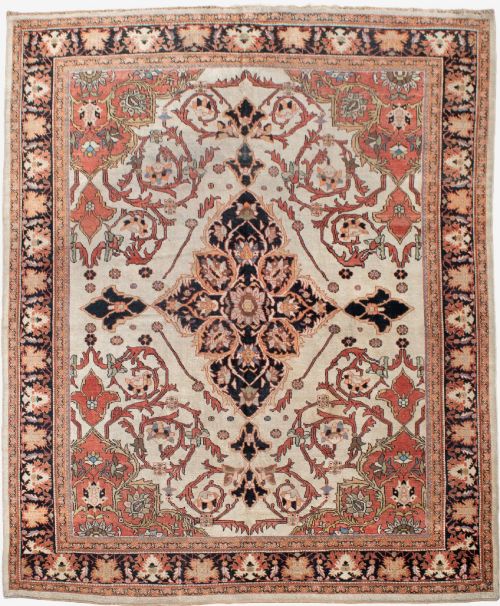


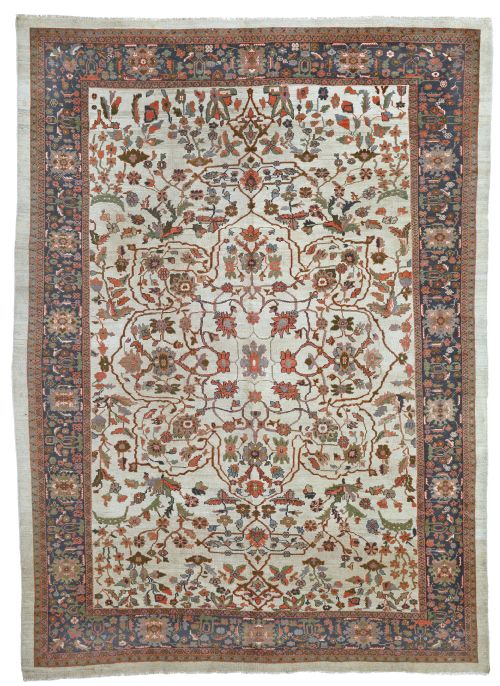

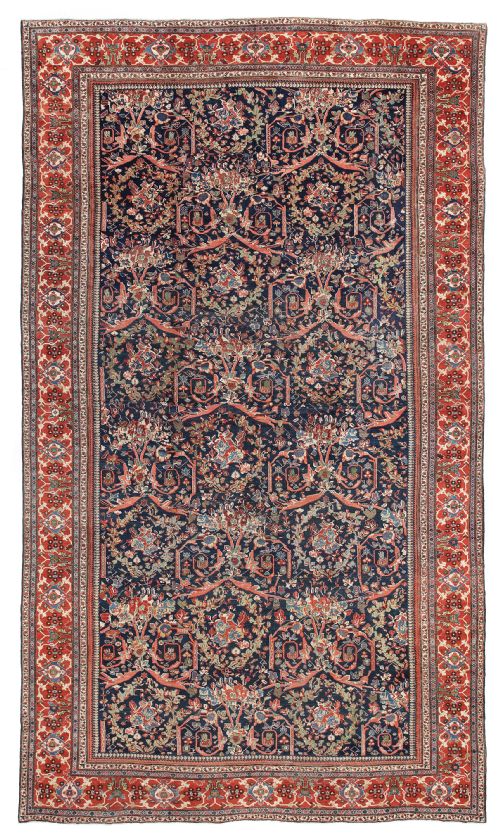
Decorative Sultanabad Carpet
These decorative sultanabad carpet examples bring layered Persian artistry into a room, offering large-scale floral patterns designed for formal interiors.
Decorative Sultanabad Carpet
When you search for a decorative sultanabad carpet, you encounter hand-knotted floor coverings originating from Persia during the late nineteenth and early twentieth centuries. These woven works bridge traditional regional motifs with Western interior tastes, often utilising expansive room sizes.
The versions most commonly met on this page date from eighteen eighty to nineteen ten, incorporating related regional classifications such as Mahal and Ziegler. Buyers find room-sized carpets alongside smaller area rugs, all displaying distinct room-scale floral compositions.
How they were made
Weavers constructed these carpets using wool pile knotted onto cotton foundations, creating durable surfaces designed for heavy domestic use. Natural dye traditions provided the palette for the intricate field designs.
The structural weave relies on hand-tied knots that afford flexibility and resilience across large formats. Loom techniques allowed workshops to produce both grand room-sized carpets and compact area rugs with equal structural integrity.
Some carpets travelled across continents before resting quietly beneath a dining table.
What varies in quality
Quality rests upon the execution of the drawing and the balance of the field composition against the border. Finer examples display precise control over curved floral lines and harmonious colour saturation.
The condition of the wool pile and the integrity of the cotton foundation dictate the longevity of the piece. Uneven wear across the surface alters the visual weight of the traditional patterns.
The Decorative Sultanabad Carpet Glossary
- Pile
- The upright yarn loops that form the soft surface of the carpet. This layer bears the direct friction of footsteps and defines the tactile experience.
- Foundation
- The underlying grid of warp and weft threads that supports the knots. Cotton provides the sturdy framework for these Persian weaves.
- Field
- The central background area of the carpet enclosed by the borders. This space typically houses the primary floral or medallion motifs.
- Warp
- The vertical foundation threads running parallel to the length of the loom. Knots are tied around these stationary elements during production.
- Weft
- The horizontal threads passed across the warp after rows of knots. This element secures the rows and adds structural stability to the carpet.
Decorative Sultanabad Carpet: Frequently Asked Questions
What is a decorative sultanabad carpet?
A decorative sultanabad carpet is a hand-knotted Persian floor covering produced around the turn of the twentieth century. These pieces feature large-scale floral designs tailored for spacious interiors.
They combine traditional regional weaving techniques with aesthetic demands from Western markets. Collectors value them for their expansive fields and harmonious palettes.
How do you date these carpets?
Dating relies on stylistic analysis, material examination, and structural comparisons with documented pieces from the late nineteenth and early twentieth centuries. Natural dye characteristics also offer clues to the production era.
Comparison with related Mahal and Ziegler weaving traditions helps narrow the period of origin. Workshops of this era maintained distinct structural traits that experts recognise.
Where were these carpets made?
These textiles originated in Persia, specifically within workshops associated with Sultanabad and surrounding districts. Production involved skilled artisans working on traditional vertical looms.
The regional trade connected local weavers with international merchants who exported the carpets globally. Sultanabad became a notable hub for commercial carpet production during this period.
How do you care for an antique carpet?
Care involves gentle vacuuming without rotating brush heads to protect the wool pile and cotton foundation. Professional cleaning ensures the natural dyes remain stable over time.
Placing the carpet out of direct sunlight prevents uneven fading of the colours. Using a proper underlay reduces friction between the floor and the antique weave.
What distinguishes Mahal from Sultanabad?
Mahal and Sultanabad carpets share regional origins in the same Persian district, though market designations often separate them by weave density and design scale. Both terms appear in historical and current classifications.
Distinctions often emerge through subtle variations in the floral drawing and knot count. Both types served similar domestic and export markets during the active production periods.