



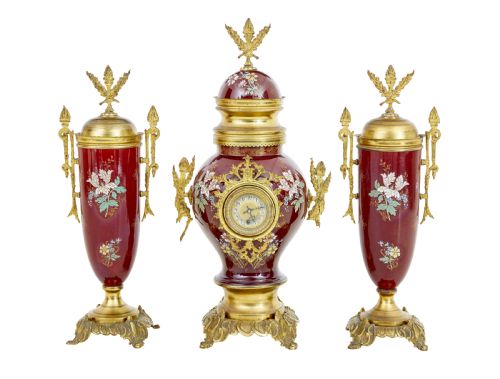
Decorative Painted Clock
A decorative painted clock brings colour and character to a room, drawing the eye with hand-painted ceramic panels, painted dials and ornate gilt metal cases.
Decorative Painted Clock
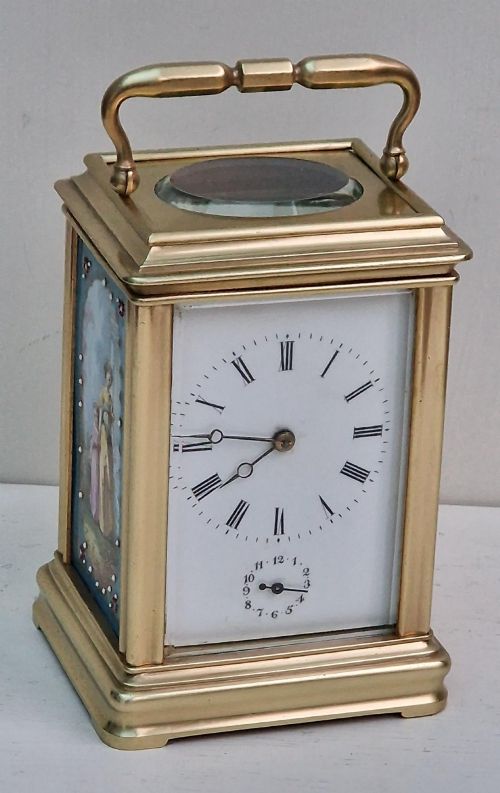
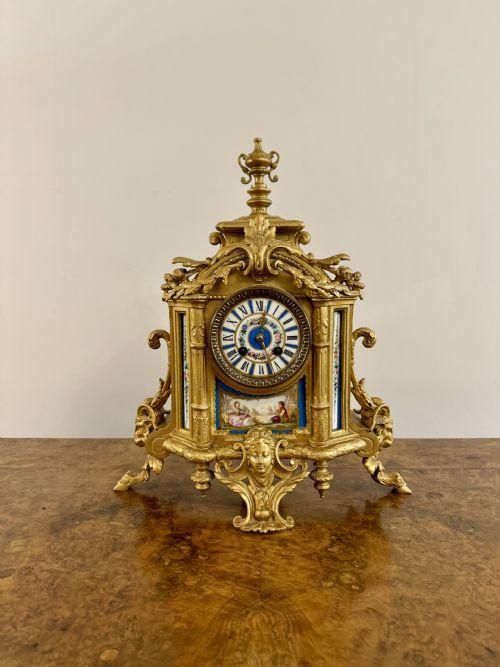
A decorative painted clock encompasses timepieces ranging from compact carriage clocks and mantel clocks to large garniture sets and longcase clocks. You will frequently encounter French mantel clocks framed in gilt metal alongside porcelain panel carriage clocks and porcelain garnitures.
The selection spans several periods, with Victorian pieces, late nineteenth century examples, and Georgian elements appearing alongside Edwardian and Art Deco designs. These objects serve both practical timekeeping and visual display, often accompanied by matching side pieces or brass and glass housings.
Materials and construction methods
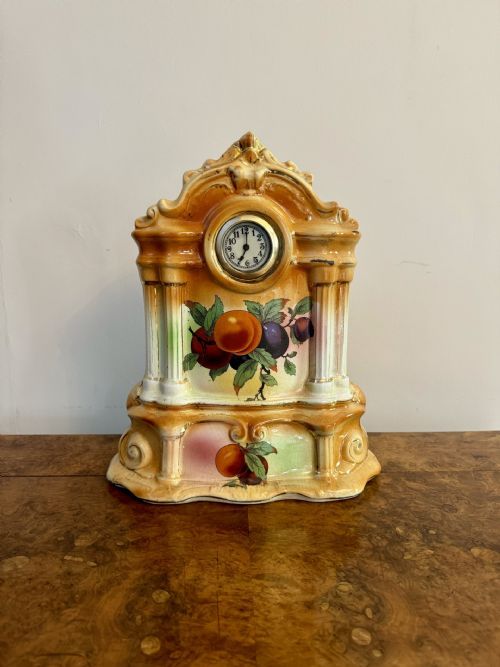
Cases combine wood, gilt metal, ormolu, and bronze, often enhanced by painted wooden surfaces or faux finishes like tortoiseshell and chinchilla. Porcelain panels and dials receive hand-painted decoration, frequently featuring figures, floral motifs, or intricate enamel work.
Movements rely on brass components, while glass protects delicate dials and repeater mechanisms. Secondary elements incorporate copper hands, plaster mounts, and gilt bronze framing to support complex French and Swiss movements.
Materials span porcelain, brass, gilt metal, toleware, and bronze, often paired with hand-painted dials and ceramic panels.
Distinctions in quality
Quality rests in the execution of the hand-painted details on dials and porcelain panels, where fine brushwork and rich enamel distinguish superior items from simpler production. The crispness of gilt metal castings and ormolu mounts further separates robust pieces from ordinary ones.
The presence of complete garniture sets and fully restored repeater mechanisms adds to the standing of an item. Superior examples also show careful integration of materials, such as balanced porcelain and bronze compositions.
PH Mourey·KPM Berlin·Sevres
The Decorative Painted Clock Glossary
- Garniture set
- A clock accompanied by matching decorative side pieces, such as vases or urns, designed to display together on a mantelpiece.
- Carriage clock
- A small, portable spring-driven timepiece fitted with a carrying handle, frequently enclosed in glass panels.
- Ormolu
- Gilt bronze ornamentation applied to furniture and clock cases, created by fixing a mercury-gold amalgam to a bronze base.
- Champlevé
- An enamelling technique where troughs are dug into a metal surface and filled with vitreous enamel before firing.
- Repeater
- A clock mechanism that chimes the hours and quarters on demand when a lever or pendant is pressed.
Decorative Painted Clock: Frequently Asked Questions
What is a clock garniture?
A clock garniture consists of a central timepiece flanked by two matching decorative objects, such as urns or vases, intended to be placed together on a mantel or sideboard.
These sets were popular in the nineteenth century, using coordinated materials like porcelain and gilt metal to create a unified display across a room.
How do carriage clocks work?
Carriage clocks use a spring-driven movement housed in a brass frame with glass panels, allowing the internal mechanics to be viewed from multiple angles.
Originally designed for travel, they include a folding handle on top and often feature lever escapements or repeater mechanisms for sounding the time.
Where should I place a porcelain mantel clock?
Porcelain mantel clocks suit stable flat surfaces away from direct heat sources and strong sunlight, which can affect painted dials and delicate gilt finishes.
Because many examples feature fragile ceramic panels or glass bezels, positioning them where they are secure from accidental knocks is essential.
How do I distinguish Victorian from Georgian clocks?
Victorian clocks often embrace revival styles like Rococo or feature ornate painted porcelain panels and gilt metal cases dating from the mid to late nineteenth century.
Georgian items from earlier decades tend to employ different structural elements, such as copper clock hands or longcase formats with distinct regional cabinetwork.