

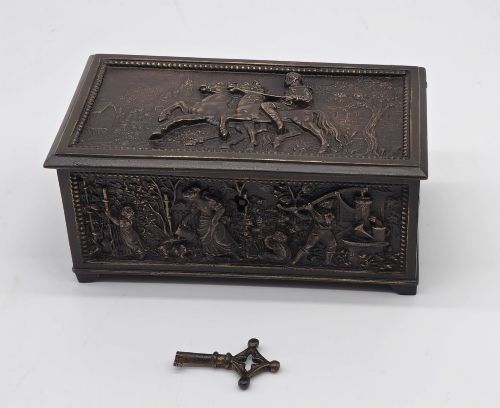


Decorative Metal Trinket Box
These decorative metal trinket box examples offer small-scale storage crafted across centuries in brass, bronze, enamel, and steel.
Decorative Metal Trinket Box
A decorative metal trinket box serves as a small receptacle for personal valuables, taking forms such as snuff boxes, patch boxes, jewellery caskets, and keepsake cases. These containers emerge from periods spanning the eighteenth century through to the Edwardian era, reflecting diverse global workshops from Britain, France, Germany, and Japan.
The most frequent examples on this page are nineteenth-century French and British pieces, alongside eighteenth-century enamel pocket boxes and later Arts and Crafts or Art Nouveau metalwork. Buyers encounter everything from simple brass repositories to elaborate bronze caskets decorated with rural scenes, mythological motifs, or enamel work.
Regional variations add distinct character to these containers, including Anglo-Indian woodwork styles, Dutch tobacco boxes, and Japanese Meiji cloisonne lidded pots or gourds. Each box fulfils a domestic function for holding dry goods, tobacco, personal diaries, or small ornaments while displaying metalworking skills of the past.
How they were made
The construction of these boxes relies on foundational base metals such as brass, bronze, copper, and steel, often enhanced with silver gilt or gilt metal finishes. Artisans shape these materials through casting, hammering, and riveting, visible in beaten steel caskets and chiselled brass caddy boxes.
Surface ornamentation defines the visual impact of these objects, utilising enamel techniques like cloisonne and champleve, alongside hand painting on tole ware. Makers also incorporate wood cores beneath metal plating or apply intricate repousse and rococo motifs directly onto the metallic surfaces.
Decorative Metal Trinket Box Retail Price Guide 2026
Typical asking prices for decorative metal trinket box among the pieces listed under this phrase on Sellingantiques today, from the lower quarter to the upper quarter. They describe what is for sale here now, not the wider market.
Geographic origins span British, French, German, Dutch, Indian, and Japanese workshops across multiple decades.
What varies in quality
Quality rests upon the crispness of the metalwork detail, such as the depth of chiseled motifs on brass or the precision of rural scenes cast in bronze. Superior examples display clean joints, secure hinges, and well-executed decorative techniques that remain sharp and intact.
The refinement of the surface decoration separates standard containers from finer works, particularly in the hand-painted execution of enamel plaques or the complex multi-coloured cells of cloisonne work. Material purity also plays a role, with solid silver gilt and heavy bronze outperforming plated base metals in durability and prestige.
S Theeman·Hunter and Palmer·Belinda Gentle
The Decorative Metal Trinket Box Glossary
- Cloisonne
- Enamelling technique where thin metal wires form raised partitions on a metal base, creating cells filled with coloured paste and fired. This method produces intricate geometric or floral patterns across the surface of caskets and bowls.
- Champleve
- Enamelling method where troughs or cavities are dug directly into the surface of a thick metal plate and filled with enamel before firing. It creates bold, coloured designs set flush with the surrounding metal.
- Tole ware
- Enamelled or lacquered sheet metal, typically tinplate, painted with decorative scenes or motifs. It was widely used for domestic tobacco boxes and household containers during the nineteenth century.
- Patch box
- Small container, often made of enamel and copper, originally designed to hold cosmetic beauty patches used in the eighteenth century. They frequently feature mirrors fitted inside the hinged lid.
- Snuff box
- Small pocket-sized container manufactured to hold ground tobacco for nasal ingestion. These items showcase high levels of decorative metalwork and enamel artistry from the eighteenth and nineteenth centuries.
Decorative Metal Trinket Box: Frequently Asked Questions
What did people keep in a decorative metal trinket box?
These boxes held high-value personal items, ranging from snuff and tobacco to personal diaries, patches, and fine jewellery.
Their compact sizes made them suitable for dressing tables, desks, or pocket transport.
How do I identify an eighteenth century enamel box?
Eighteenth century enamel boxes, such as those from South Staffordshire or Bilston, typically combine copper bases with hand-painted enamel lids depicting figures or landscapes.
They often feature hinged brass mounts and delicate interior mirror panels.
What is the difference between champleve and cloisonne?
Cloisonne uses soldered wire partitions to hold enamel paste on top of a metal body, creating raised outlines.
Champleve involves carving depressions directly into the solid metal surface to hold the coloured enamel.
Where were Japanese Meiji metal boxes made?
Japanese Meiji metal boxes and lidded pots were produced in Japan during the late nineteenth century, reflecting traditional artisan techniques combined with international export designs.
They frequently utilise detailed cloisonne enamel over copper or bronze bodies.