


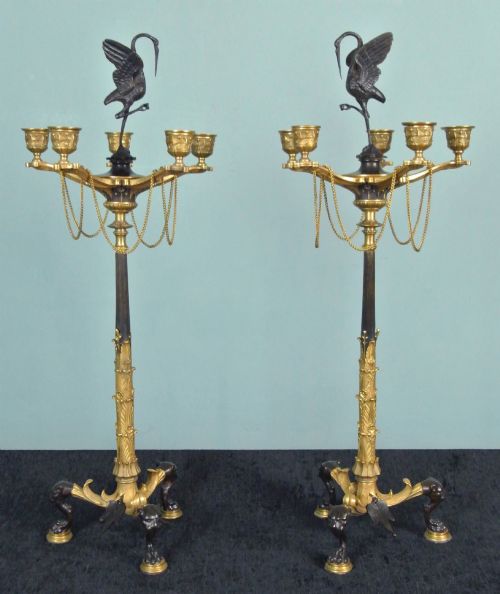



Decorative Bronze Candelabra
These decorative bronze candelabra bring weight and candlelight to a room, ranging from French Empire pairs to Regency designs.
Decorative Bronze Candelabra
A buyer seeking decorative bronze candelabra encounters multi-branch lighting stands designed for tables and mantelpieces. The selection on this page consists predominantly of nineteenth-century French and Regency pairs cast in bronze, ormolu, and gilt bronze.
Formally, these pieces range from classical figures holding branch arms to architectural arrangements incorporating marble bases and cloisonne enamel. Makers and foundries such as Barbedienne, Pierre Philippe Thomire, and Auguste Cain produced work that appears in these listings alongside unassigned nineteenth-century items.
Most examples survive as balanced pairs intended for symmetrical placement, frequently featuring three or four candle arms rising from a central stem. Alongside standard candelabra, related objects such as wall sconces, porcelain elephant figures, and converted table lamps occasionally appear in the inventory.
Materials and production methods
Surface decoration relies heavily on mercury gilding to produce rich ormolu highlights that contrast against dark patinated bronze bodies. Artisans frequently combined these metallic elements with white marble bases, porcelain bodies, and sections of cloisonne enamel to add colour and texture to the composition.
Decorative Bronze Candelabra Retail Price Guide 2026
Typical asking prices for decorative bronze candelabra among the pieces listed under this phrase on Sellingantiques today, from the lower quarter to the upper quarter. They describe what is for sale here now, not the wider market.
Nineteenth-century listings in this category frequently combine cast bronze with contrasting ormolu highlights and white marble bases.
Judgements of quality and execution
The distinction between standard commercial output and masterwork production lies in the crispness of the hand-chased surface details. Superior examples exhibit deep, clean definition in cast ornamentation, whereas lower grades show softened edges where finishing work was hurried or omitted.
Proportion and structural integrity dictate the visual success of a pair, with finer pieces maintaining perfect balance across multiple branching arms. The quality of the original gilding or patination, alongside the integration of secondary materials like marble and enamel, further separates standard nineteenth-century workshop pieces from documented foundry productions.
Barbedienne·Pierre Philippe Thomire·Auguste Cain·Liberty
The Decorative Bronze Candelabra Glossary
- Ormolu
- Gilded bronze produced by applying a mercury and gold amalgam to a bronze base and firing it in a kiln. This historic technique creates a durable, golden surface finish characteristic of fine nineteenth-century French metalwork.
- Patinated Bronze
- Bronze treated with chemicals or heat to produce a dark surface tone, providing visual contrast against bright ormolu mountings. This finish protects the underlying metal while defining the contours of figural and architectural castings.
- Candelabrum
- A branched lighting fixture designed to hold multiple candles simultaneously on a central stem. Pairs of these objects served as functional centrepieces on dining tables and mantle shelves throughout the nineteenth century.
- Cloisonne Enamel
- A decorative technique where enamel paste is applied within wire compartments soldered to a metal base. Pieces incorporating this method display vibrant coloured patterns integrated directly into the bronze framework.
- Chasing
- The manual process of refining a metal casting with small hammers and punches to sharpen details and textures. High-end nineteenth-century bronzes received extensive hand-chasing to achieve lifelike depth in hair, fabric, and foliate motifs.
Decorative Bronze Candelabra: Frequently Asked Questions
How do I clean decorative bronze candelabra?
Dust the surfaces gently using a soft, dry brush to prevent accumulation in recessed chasing. Avoid liquid polishes, as abrasive compounds can strip historical ormolu and patinated finishes.
For stubborn grime, consult a professional conservator rather than attempting chemical cleaning at home. Preserving the original nineteenth-century surface skin maintains both the appearance and the historical integrity of the metal.
Can these candelabra be used for candles?
Most surviving nineteenth-century examples retain their original socket configurations and accommodate standard taper candles safely. Ensure any dripping wax is removed immediately with warm water to protect the bronze and gilt surfaces.
If a pair has been converted to electricity as a table lamp, check the wiring specifications before operating. Reversion to traditional candle use is possible with certain fittings, provided the original drip pans remain intact.
What does a French Empire style indicate?
The French Empire style references the neoclassical design aesthetic popular during the early nineteenth century under Napoleon. Pieces from this movement feature strict symmetry, military motifs, and classical architectural references derived from ancient Rome.
Foundries working in this idiom emphasised heavy cast bronze forms with strong contrasts between burnished ormolu and dark patination. This aesthetic influenced subsequent nineteenth-century revivals including the Restauration and Charles X periods.
Are these pieces sold in pairs?
The majority of nineteenth-century lighting items in this inventory survive and are offered as matched pairs. Symmetrical placement on mantelpieces or sideboards formed an essential part of period interior decoration.
Single candelabra or individual wall sconces do occasionally appear alongside pairs. Each listing specifies whether an object is sold individually or as part of a matched set.