
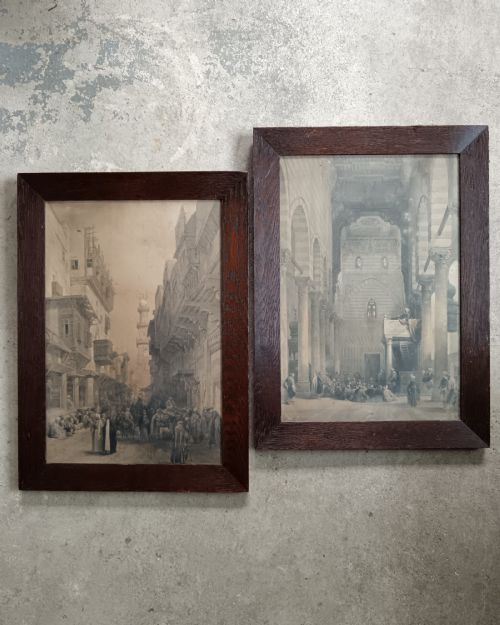




Dark Wooden Framed Prints
Dark wooden framed prints bring nineteenth-century lithographs, engravings and chromolithographs onto the wall inside heavy oak and carved surrounds.
Dark Wooden Framed Prints
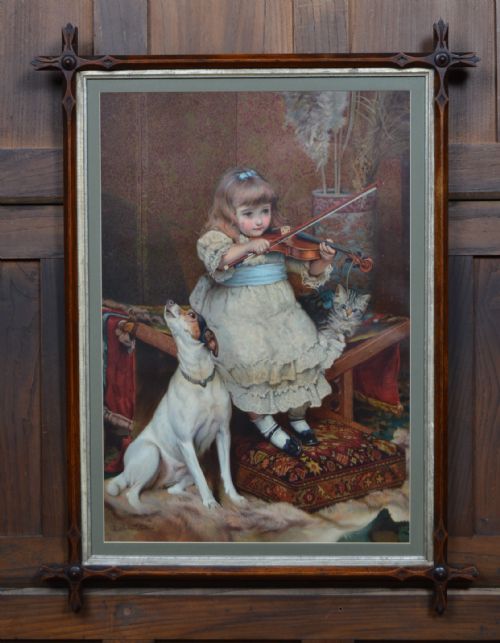
When you search for dark wooden framed prints, you encounter paper images set behind glass inside timber surrounds dating from the nineteenth and early twentieth centuries. These pieces encompass Victorian and Edwardian works, including pairs of Cairo lithographs, aquatints of the English coast, and large chromolithographs.
The selection on this page ranges from mid-nineteenth-century engravings and 1850 sets to Edwardian wall mirrors incorporating prints and 1920 coloured plates in carved frames. Subjects stretch from cartographic maps and American lithographs to sentimental scenes after known artists.
Most items combine traditional paper prints with original timber mouldings, though forms vary from serving trays with map inserts to wall-hung art and mirror combinations.
Materials and construction
Makers utilised wood, specifically oak and heavier carved timbers, to build deep frames that protect the paper artwork within. Glass covers the face of each print, shielding delicate ink and gold leaf details from atmospheric dust.
The imagery relies upon period printing techniques such as lithography, engraving, aquatint and chromolithography applied to paper. Original framing workshops supplied custom surrounds, occasionally retaining maker stamps or labels on the reverse.
One extraordinary Edwardian wall mirror multitasks by wearing prints on its face.
Assessing quality in dark wooden framed prints
Quality rests upon the crispness of the printing technique, whether an intricate engraving or a multi-layered chromolithograph, and the preservation of the paper beneath the glass. Finer examples display strong tonal depth in the ink without excessive fading or foxing.
The integrity and originality of the wooden frame elevate a piece, particularly when carvings remain sharp or when the frame matches the exact period of the print inside it. Associated makers' labels and original glass further distinguish superior works from later marriages of print and frame.
The Dark Wooden Framed Prints Glossary
- Chromolithograph
- A multicoloured print produced through a planographic lithographic process using multiple stones for different ink hues. This technique allowed vibrant reproductions of paintings during the Victorian era.
- Aquatint
- A variant of etching that uses powdered resin to create tonal areas resembling watercolours or washes. Printmakers utilised this method extensively for topographical views and coastal scenes.
- Engraving
- A printmaking method where an artist cuts lines directly into a metal plate with a burin. The resulting impressions on paper exhibit extreme fine-line precision.
- Lithograph
- A planographic print pulled from a flat stone or metal plate treated to repel and accept ink. Nineteenth-century publishers adopted this method for speed and fidelity to original artwork.
Dark Wooden Framed Prints: Frequently Asked Questions
What periods do these pieces span?
The inventory spans the nineteenth century through to the Edwardian period and the 1920s. Pieces frequently date from the 1850s and 1880s up to the early twentieth century.
Constructed across these decades, the frames and prints reflect prevailing tastes in domestic decoration, from Regency-influenced designs to folk art interpretations.
Are the frames original to the prints?
Many items retain their original period timber frames, such as those supplied by nineteenth-century framing firms or workshop houses. Original pairings are noted where recorded.
Other examples bring together older prints and period carved frames, or combine functional objects like serving trays and mirrors with printed elements.
What print methods appear in this group?
The selection includes lithographs, engravings, aquatints and chromolithographs on paper. Each method produces distinct visual textures, from fine linear hatching to rich chromatic layers.
Works after named artists and cartographers showcase the commercial and artistic range of print production across Victorian and Edwardian Britain and America.
How should I hang a heavy wooden frame?
Due to the substantial weight of dense oak and carved timber surrounds combined with glass, secure wall fixings into masonry or wall studs are essential. Check the hanging wire or brackets on the reverse before mounting.
Position pieces away from direct sunlight to protect the underlying paper and ink from fading over time.