


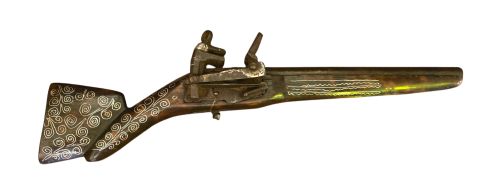


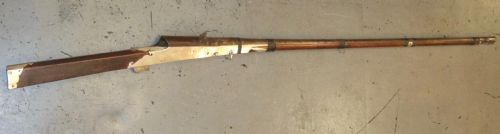
Dark Wood Long Gun
A dark wood long gun brings centuries of global military history into a room, spanning flintlocks and matchlocks.
Dark Wood Long Gun
A dark wood long gun encompasses antique firearms and wall pieces from the eighteenth and nineteenth centuries, taking the form of muskets, rifles, and jezails. These pieces originate from various regions including the Ottoman Empire, North India, and the Afghan frontier, alongside English and American examples.
The version most commonly encountered on this page is the traditional matchlock or flintlock musket, often featuring extensive decorative work along the stock. These historic arms reflect both defensive use and craftsmanship from periods such as the Georgian era and the late eighteenth century.
Militaria and wall art listings in this category demonstrate the practical and ornamental roles these firearms held across different cultures. Buyers encounter specimens with distinct regional mechanisms like snaphaunce and miquelet locks.
Construction and materials
Stocks are shaped from dense hardwoods such as walnut, providing a sturdy foundation for the heavy metal barrels and intricate firing mechanisms. Wood selection prioritised durability alongside suitability for detailed surface embellishment.
Makers integrated contrasting elements into the timber stocks, utilising bone, mother-of-pearl, brass, and silver inlay work. Metal components combine forged steel and iron for barrels and locks, complemented by brass bands and engraving.
Several pieces boast enough bone inlay to give a whole new meaning to skeleton staff.
Assessing quality and execution
The standard of a dark wood long gun rests upon the complexity and preservation of its decorative inlays and metalwork. Pieces featuring extensive bone work, engraved brass bands, and intact geometric or floral patterns stand apart from simpler utilitarian arms.
The integrity of the lock mechanism and the original condition of the hardwood stock dictate the overall grade of the firearm. Finer examples retain their complete mounting assemblies and original barrels without excessive modern restoration.
Sargant and Son
The Dark Wood Long Gun Glossary
- Toradar
- A traditional South Asian matchlock musket characterised by a straight stock and a slow-burning match mechanism. These firearms were widely used across India from the sixteenth century onwards.
- Jezail
- A type of long gun used in the Middle East and Central Asia, recognised for its distinctive curved stock and often ornate inlaid decoration. They were frequently utilised by tribal forces along the North-West Frontier.
- Snaphaunce
- An early type of flintlock mechanism using a steel and frizzen mounted separately from the pan cover. This system preceded the standard flintlock and offered improved reliability in the field.
- Miquelet
- A form of snaplock firearm mechanism originating in the Mediterranean region during the late sixteenth century. It uses an external mainspring and a combined steel and pan cover.
- Frizzen
- The vertical steel plate struck by the flint to create sparks in a flintlock firearm. Its grooved face directs sparks down into the priming pan.
Dark Wood Long Gun: Frequently Asked Questions
What is a jezail?
A jezail is a long gun originating from Afghanistan and neighbouring regions, known for its distinct curved stock. These firearms were designed for long-range shooting in mountainous terrain.
They frequently feature elaborate bone or metal inlay work along the wooden body, reflecting local decorative traditions of the nineteenth century.
How do matchlocks and flintlocks differ?
A matchlock uses a slow-burning match cord held in a serpentine lever to ignite the gunpowder priming powder when the trigger is pulled. This represents an earlier technological stage.
A flintlock relies on a piece of flint striking a steel frizzen to generate a spark, offering a faster and more reliable ignition method in varied weather conditions.
Are these antique guns functional?
These pieces are offered primarily as historic artefacts, antiques, and wall art rather than serviceable modern firearms. Many date from the eighteenth and nineteenth centuries and require specialist assessment before any attempt at firing.
Collectors value them for their mechanical ingenuity, historical associations, and traditional craftsmanship rather than practical use.
Where were these long guns made?
The pieces span multiple geographical regions, including the Ottoman Empire, North India, Afghanistan, England, and America. Each area developed distinct stylistic traits in its woodwork and lock mechanisms.
Indian specimens often display intricate bone inlay, while English arms from the Georgian period reflect standard military production of the Napoleonic era.